
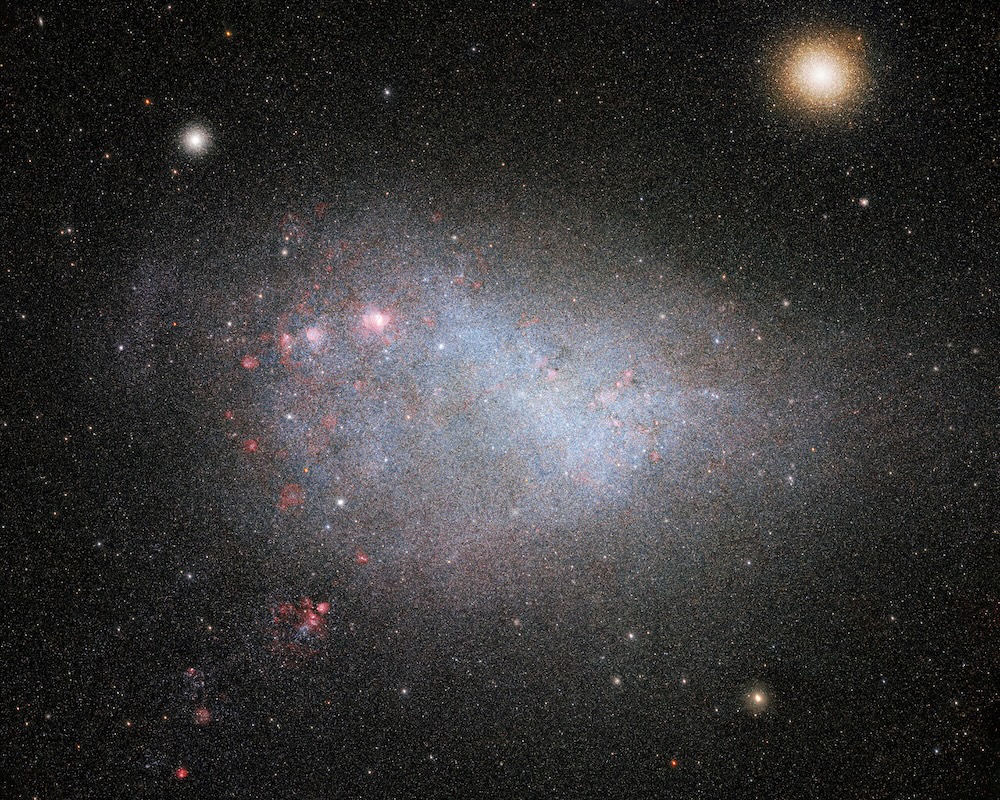
Researchers show that the highly disrupted state of the Small Magellanic Cloud can be attributed to a long history of interactions with its neighbor, the Large Magellanic Cloud.
A Disrupted Dwarf Galaxy?
The Small Magellanic Cloud (SMC) is one of the largest and nearest satellites of the Milky Way. At a distance of just 200,000 light-years, the SMC has long been used as an accessible analog for low-metallicity star-forming galaxies in the early universe.
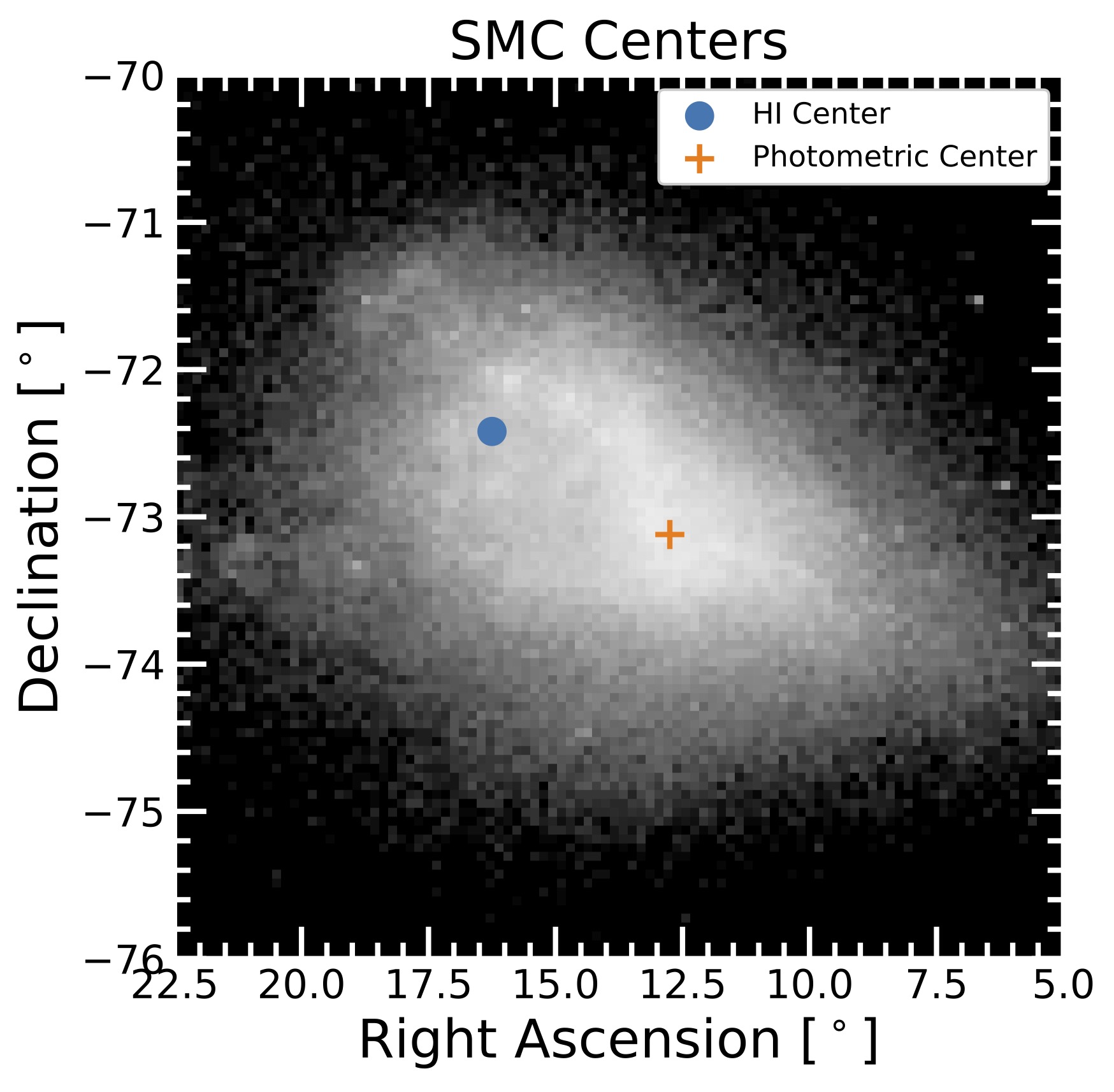
Locations of the SMC’s photometric center and hydrogen gas kinematic center. The two locations are separated by several thousand light-years. [Adapted from Rathore et al. 2026]
The source of this disequilibrium might be the Milky Way’s largest satellite, the Large Magellanic Cloud (LMC). As the SMC inches along its orbit around the Milky Way, it also engages in a gravitational dance with the LMC. These galaxies may be clumsy dance partners, with data suggesting a potential direct collision between the SMC and LMC within the past 200 million years.
Modeling the Magellanic Clouds
To understand how a potential collision between the Magellanic Clouds might have impacted the present-day properties of the SMC, Himansh Rathore (University of Arizona) and collaborators used hydrodynamical simulations to explore the interconnected histories of the SMC, the LMC, and the Milky Way.
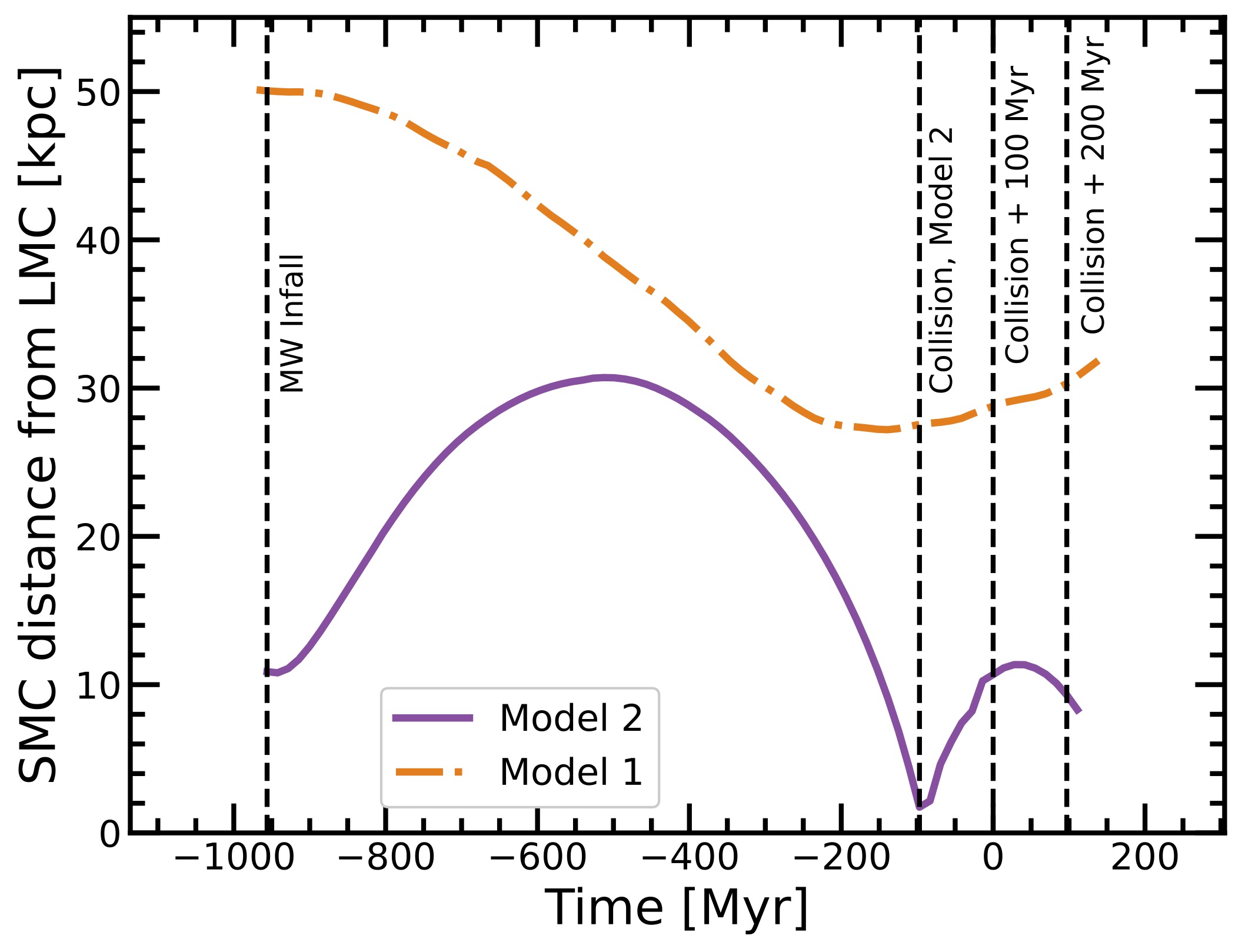
SMC–LMC separation over time in the control model (orange dot-dashed line) and the collision model (purple solid line). Click to enlarge. [Rathore et al. 2026]
Both of these model scenarios reproduced certain features of the SMC–LMC system, such as the bridge of gas that spans the distance between them. Only the collision scenario, though, can explain the apparent discrepancy between the SMC’s stars and gas.
An Impactful Collision
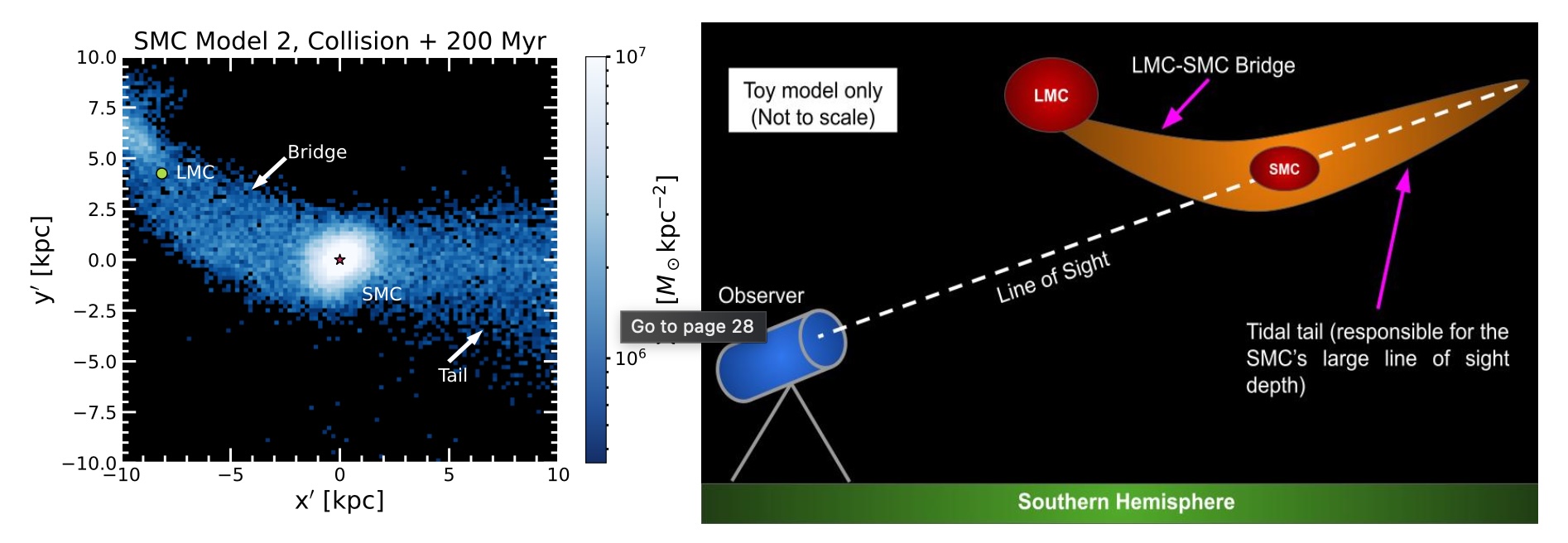
Left: Simulated stellar density 200 million years post-collision. Right: A schematic of our likely perspective on the post-collision SMC–LMC system. Click to enlarge. [Rathore et al. 2026]
In terms of the galaxy’s rotation, only the stars nearest the SMC’s center rotate, while the rest move radially outward, swayed by the tidal pull of the LMC. This radial motion is also present in the galaxy’s gas. While previous work has interpreted the observed velocity dispersion of the SMC’s gas as a sign of rotation, Rathore’s team showed that radial expansion, viewed from an inclined angle, can mimic a rotational signature.
The team also showed that the gas is far more disturbed than the stars, reflecting the pressure exerted by the LMC’s gas when the two galaxies collided. This type of interaction can transform an irregular dwarf galaxy into an ellipsoidal or spheroidal dwarf galaxy — a transition that Rathore’s team argues is underway for the SMC.
Ultimately, these simulations demonstrate that the SMC is a profoundly disrupted galaxy, likely still reeling from a recent collision with its larger neighbor. Viewing the SMC through this lens is critical to understanding its role as an analog to early universe galaxies.
Citation
“A Galactic Transformation — Understanding the SMC’s Structural and Kinematic Disequilibrium,” Himansh Rathore et al 2026 ApJ 1000 50. doi:10.3847/1538-4357/ae4507