
Editor’s Note: Astrobites is a graduate-student-run organization that digests astrophysical literature for undergraduate students. As part of the partnership between the AAS and astrobites, we occasionally repost astrobites content here at AAS Nova. We hope you enjoy this post from astrobites; the original can be viewed at astrobites.org.
Title: Soot Planets Instead of Water Worlds
Authors: Jie Li et al.
First Author’s Institution: University of Michigan
Status: Published in ApJL
They Might Be Planets with a Lot of Water…
Since the discovery of PSR B1257+12 c and d in 1992 and 51 Pegasi b in 1995, we have found evidence for thousands of planets in other star systems. One of the most striking things (aside from how common planets seem to be) is how many of them are so unlike anything we had imagined we would find. Our growing list of exoplanets includes a truly remarkable variety of types, from cold rocky planets smaller than Earth to scorching hot giants bigger than Jupiter.
However, one category of planets is particularly interesting: the sub-Neptunes. These planets, smaller than Neptune but larger than Earth, are characterized by their low densities, which suggests they could be dominated by water or volatile-rich atmospheres. What makes sub-Neptunes so intriguing is that we don’t have a clear counterpart for them in our own solar system. As such, we don’t really know a lot about them other than there seem to be a lot of them out there.
Although these planets are sometimes theorised to be rocky worlds with large hydrogen–helium envelopes, they have alternatively been considered as water worlds, i.e., worlds with giant planet-wide oceans thousands of kilometres deep. The thinking goes that since water ice appears to be abundant beyond the snow line, water worlds would be a natural consequence of planet formation. And if these planets exist, some might host a temperate liquid ocean with the conditions for life.
…or They May Just Be CHON(ky)
However, today’s article suggests that these supposed water worlds may not be as wet as we think they are. They may instead be rich in what are called refractory carbonaceous materials. This term describes solids rich in carbon, hydrogen, oxygen, and nitrogen, or CHON. It is a bit of a mouthful and is often just referred to as “soot,” but it is important to remember that it is different from the black stuff you would find in ye old chimney. Soot, in this case, is a major component of comets. We know that this type of material is present around planet formation, as protoplanetary dust contains not just silicates (rock) and water ice but also a significant amount of CHON, and comets are leftovers from this dust.
Soot is stable and remains in the solid state to much greater temperatures (∼500K) than water ice (∼160K), so the authors argue that there should be regions in the protoplanetary disk where planets accrete both rock and soot but little water. They define a “soot line” akin to the snow line and look at three archetypical planets that may form, shown in Figure 1.
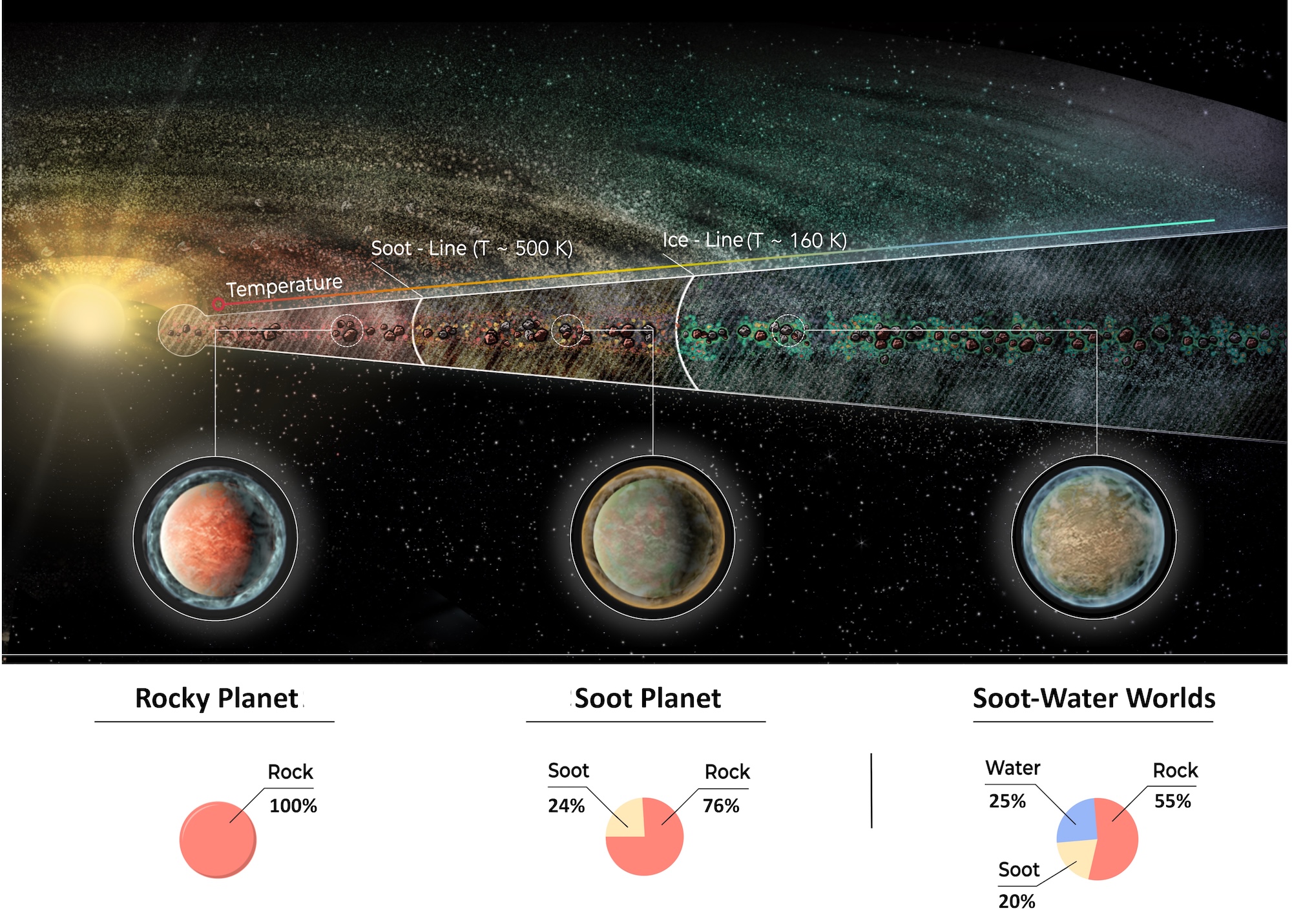
Figure 1: Illustration of a protoplanetary disk and three chemically distinct planet types that may form as the distance from the host star increases. Close in, the temperature in the disk is too high for volatiles to exist in the solid state, but farther out, the temperature drops to allow for water to freeze into ice beyond the water ice line, also known as the snow line. Between the two regions lies another where it’s cool enough for carbonaceous materials or “soot” to avoid destruction via thermally driven reactions. Depending on where planets form, they may contain a varying amount of astrophysical soot. [Li et al. 2026]
What Do the Models Say?
The authors got down to modelling planet compositions based on both observations of protoplanetary disks and the distribution of solid materials found in comets.
They considered two model planets. One is fully stratified, i.e., with a metallic core enclosed in a silicate mantle overlain by a hydrocarbon-rich layer and then a water-ice surface layer. The other, a single-layer mixed planet, is a hypothesised scenario where iron, silicate, soot, and water are fully mixed throughout the planet as a result of exotic chemistry from the high temperature inside the sub-Neptune planet. They expect any potential real planets to lie somewhere between the two extremes. The mass–radius relations for these models can be seen in Figure 2, where they are also compared to a number of known exoplanets, of which several fall within the models’ parameter spaces.
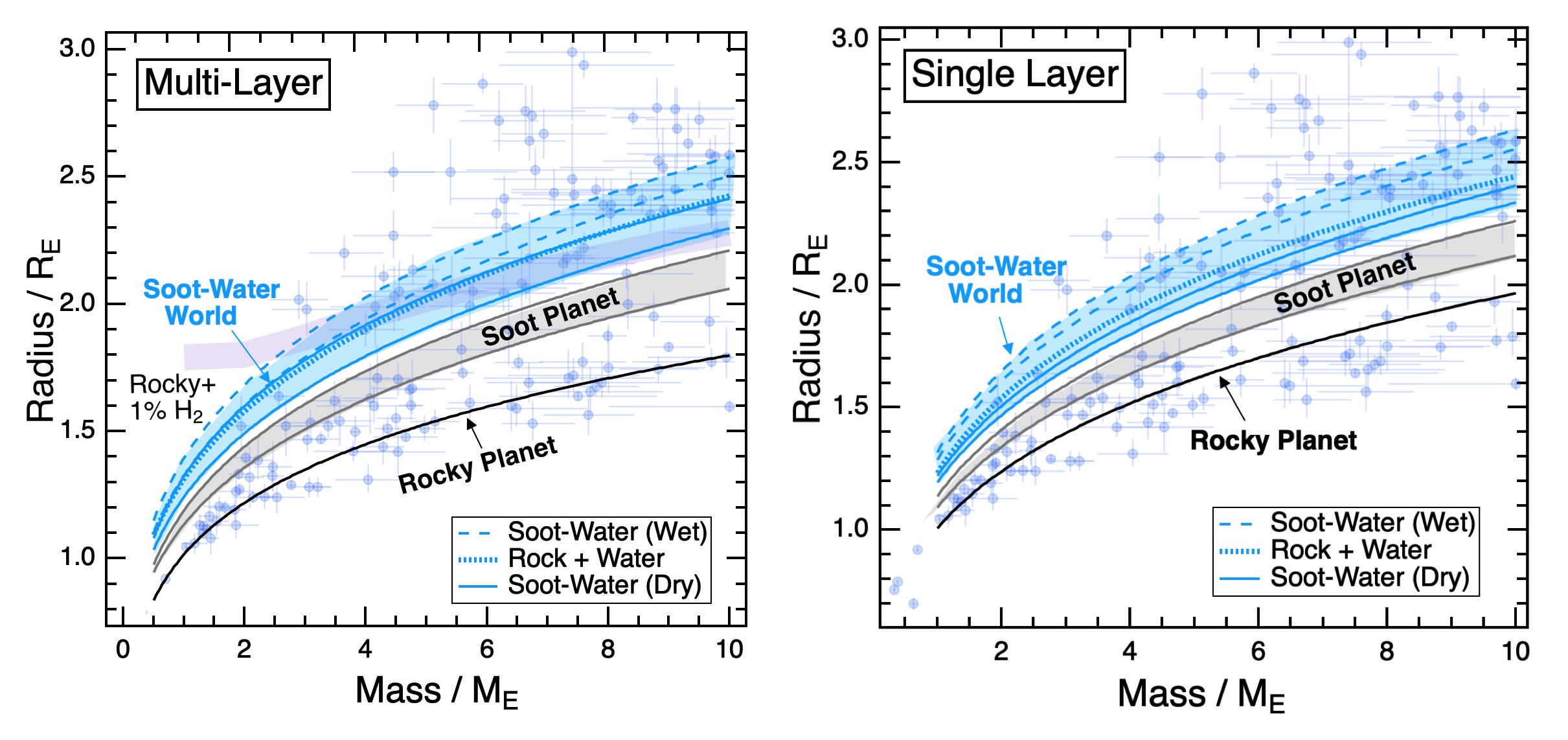
Figure 2: Mass–radius relations for model Earth-like rocky planets (black curves), soot planets (gray bands), and soot-water worlds (blue bands). On the left are multi-layer planets, while on the right are single-layer planets. Overlaid are a number of exoplanets along with their respective uncertainties. Also shown as dashed lines are models for Earth-like planets with 50% rock and 50% water. These fall squarely within the same region as soot-water worlds, making the two indistinguishable from each other. [Li et al. 2026
We Might Have a Telescope That Can Help
How might we break through this impasse? Well, because significant fractions of methane and other simple hydrocarbons are expected to be released from the interior, the soot-rich planets may feature methane-rich atmospheres. These may naturally lead to the formation of hydrocarbon hazes, akin to the tholins in Titan’s atmosphere.
Looking at the atmospheres of exoplanets is one of the main mission goals of JWST. Many of the spectra from sub-Neptunes have so far been featureless, which may indicate the presence of clouds or photochemical haze. The telescope also has the ability to detect carbon-bearing species in the atmospheres of other sub-Neptunes, like with the discovery of CO2 and CH4 in the atmospheres of K2-18b and TOI-270d. Although these planets currently orbit interior to the soot lines of their respective stars, they may have originally formed farther out and later migrated inward during their evolution. Of particular interest is TOI-270d. Aside from also showing signs of water, it has a carbon-to-oxygen ratio that is moderately high for the planet, hinting that it could be a world with a considerable amount of soot.
The presence of soot may have significant implications when it comes to habitability. The planet’s core may be rich in diamond, which would impede the movement of volatiles in the mantle. This would make it challenging for the planet to generate a magnetic field and thus leaving any potential life vulnerable to cosmic radiation. However, they could also be abundant in methane and other volatile organic compounds, substances thought to be crucial for the development of prebiotic chemistry. Regardless, it is interesting that there might be something out there that is not so unlike something we know from our own solar system, a hazy supersized Titan. While the frigid moon is unlikely to show signs of life, a temperate soot-water world might be one place to look in the future.
Original astrobite edited by Sowkhya Shanbhog.
About the author, Kasper Zoellner:
I have a Master of Science in astronomy and I am currently working towards a PhD in physics and educational science. My greatest passion is the search for exoplanets and how stellar variability may influence the possibility of life. I am also interested in science outreach, education and discussing what sci-fi novel to read next!