
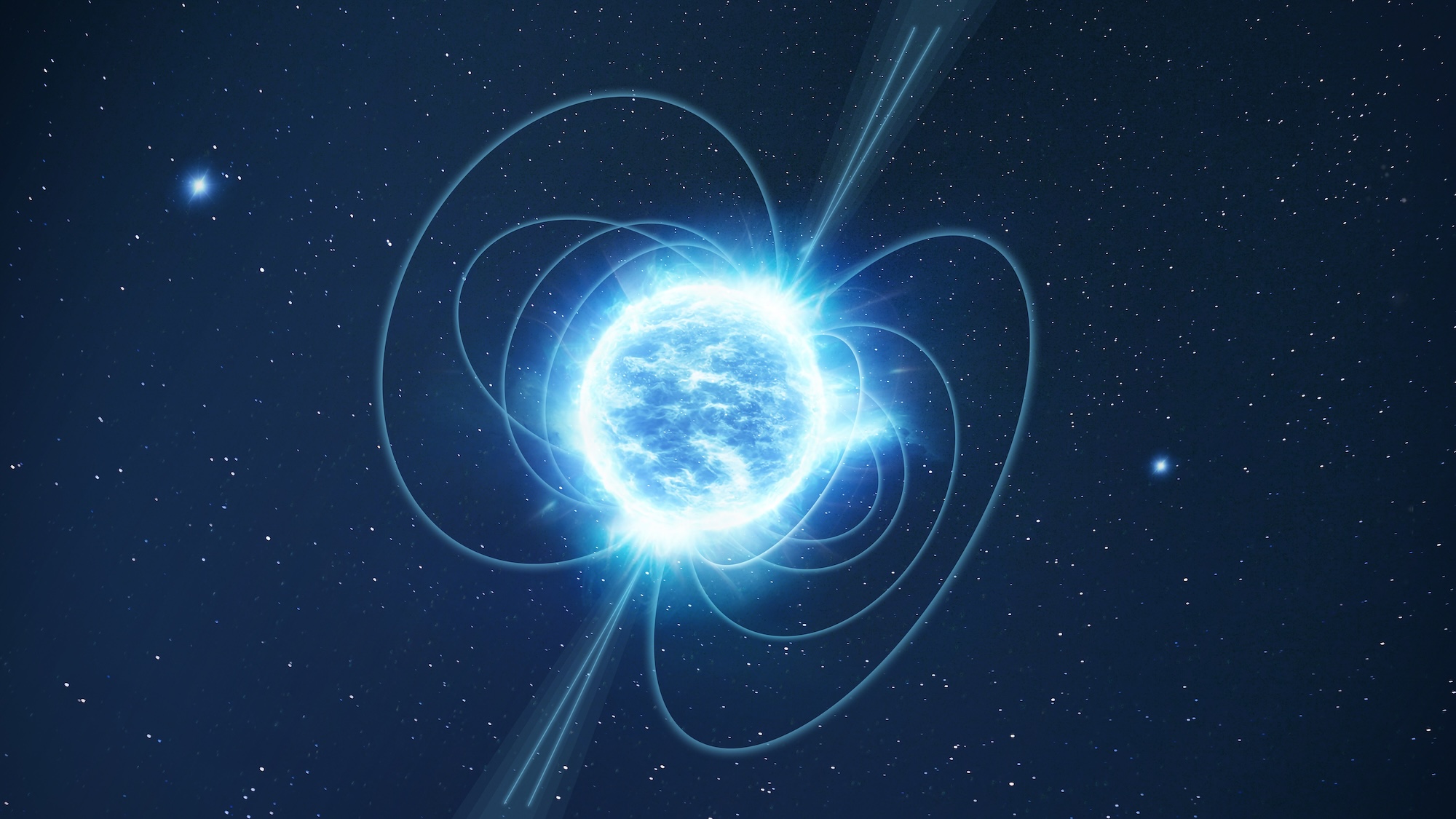
Researchers have recently discovered a number of ultra-long-period pulsars that are difficult to explain with typical pulsar models. A new article explains how these pulsars might arise from massive stars in close binary systems.
Strangely Slow Sources
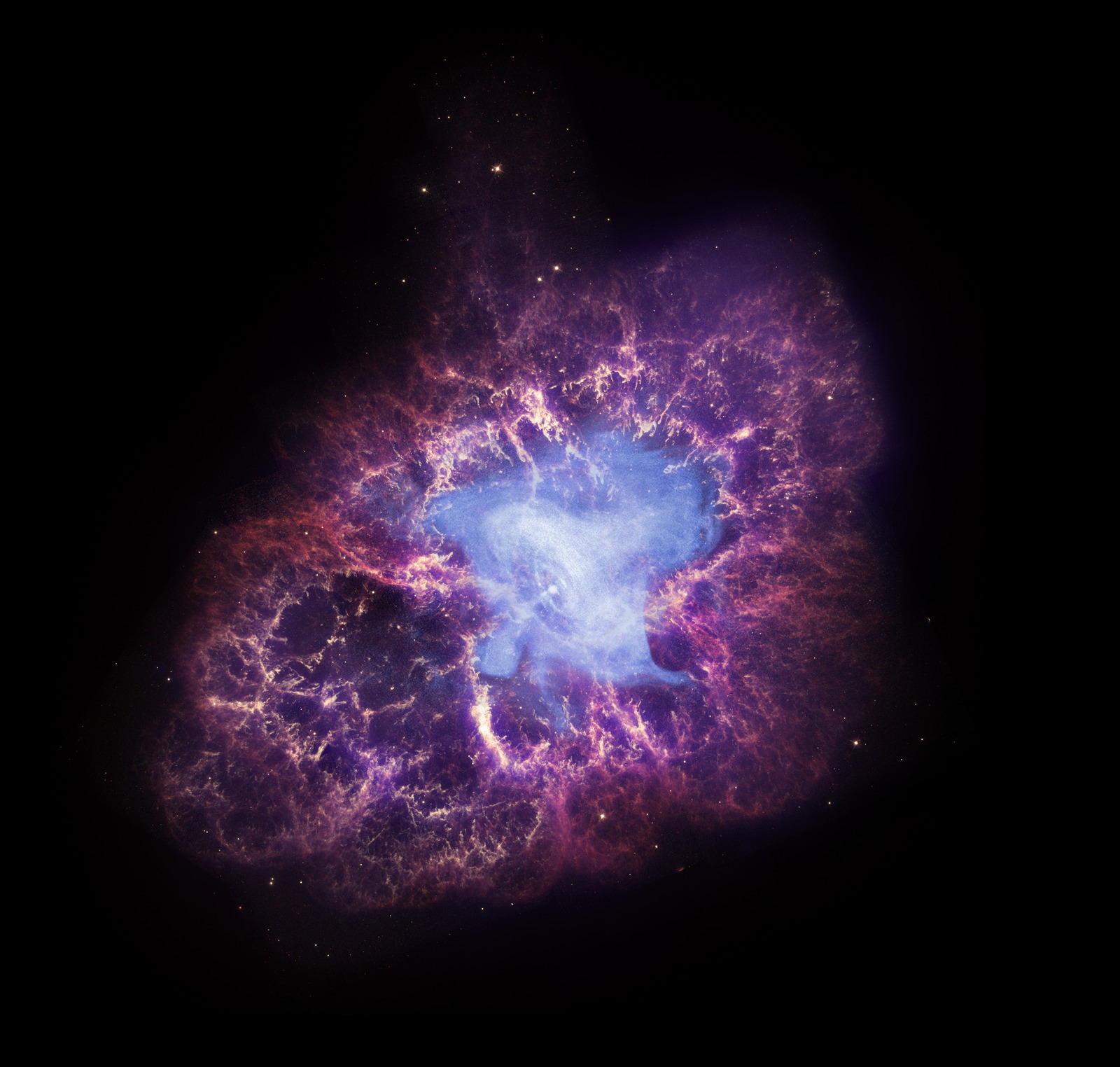
A multi-wavelength view of the Crab Nebula, the remnant of a supernova that birthed a neutron star. The neutron star powers a pulsar wind nebula, shown in blue. [X-Ray: NASA/CXC/J.Hester (ASU); Optical: NASA/ESA/J.Hester & A.Loll (ASU); Infrared: NASA/JPL-Caltech/R.Gehrz (Univ. Minn.)]
Until not too long ago, pulsars appeared to have periods no longer than 12 seconds. Above that “sluggish” rotation rate, researchers suggested, pulsars could no longer produce electron–positron pairs and channel them along polar magnetic field lines to generate their characteristic radio signals.
So it seemed, until unexpectedly slow pulsars began to crop up. The first trend-breaking pulsars had periods of a few dozen seconds, and objects with pulse periods of minutes or hours have now been found. What could these strange objects be?
Neutron Star Origin Story
In a recent article led by Savannah Cary (University of California, Berkeley), researchers proposed that these strange radio sources are pulsars, but pulsars that rotate slowly and have magnetically powered (rather than rotationally powered) radio emission.
The proposed origin story for these ultra-long-period pulsars begins with a binary system containing a massive star and a close stellar companion. As the massive star evolves, it transfers its outer layers to the companion and expires as a stripped-envelope supernova that births a rapidly spinning neutron star. As the supernova ejecta crashes into the companion star, the star heats up and expands to 5–100 times its original radius.
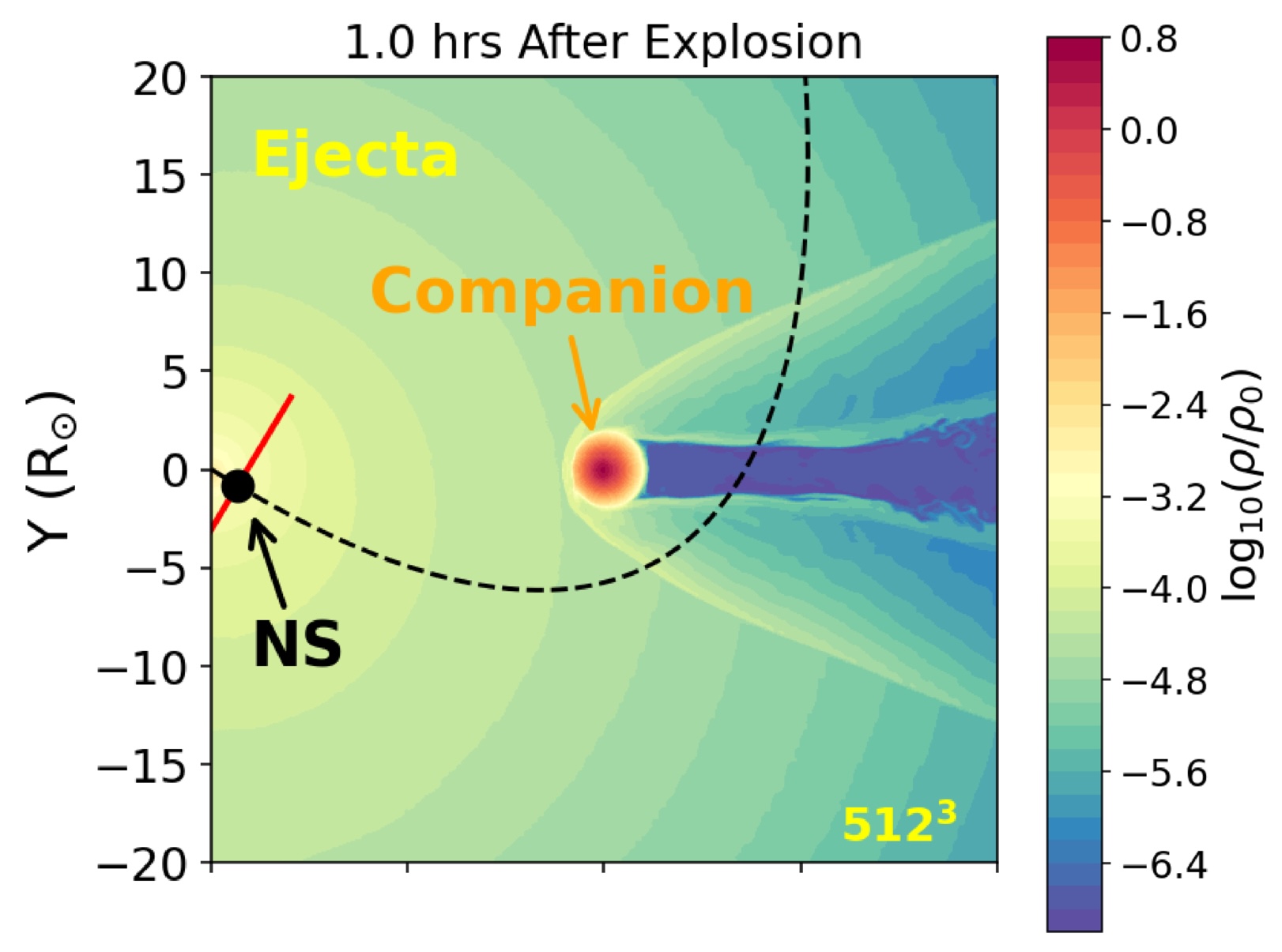
Simulation snapshot taken one hour after the supernova explosion. The black dashed line shows the path the neutron star (NS) will take through the companion star’s outer layers. Click to enlarge. [Adapted from Cary et al. 2026]
Slowing Down
Cary’s team explored the outcomes of this scenario with a trio of simulations: hydrodynamical models for the shock heating of the companion star, numerical models for the formation of the disk around the neutron star, and analytical models for the interaction between the disk and the neutron star.
For a binary system containing stars of 6.4 and 4.0 solar masses and a separation of 20 solar radii — values drawn from observations and simulations — the resulting unbound neutron star collects a disk in 8–10% of cases. The neutron star’s mass, radius, rotation rate, and magnetic field strength determine whether the neutron star and the disk will interact. If they don’t, the neutron star remains rotating rapidly like a typical pulsar. If they do, the neutron star’s rotation will slow to a relative crawl over about a million years. For modest magnetic fields between 1013 and 1014 Gauss, this means rotation periods in the realm of 102 seconds, whereas stronger magnetic fields, above 1015 Gauss, yield periods of roughly a day.
This work suggests that close binary systems could be the source of ultra-long-period pulsars, of which Cary’s team estimates there may be 10–1,000 in the Milky Way. Future work will explore this possibility further, examining broader swaths of parameter space to learn more about how this scenario could contribute to the population of ultra-long-period pulsars in our galaxy.
Citation
“Accretion from a Shock-Inflated Companion: Spinning Down Neutron Stars to Hour-Long Periods,” Savannah Cary et al 2026 ApJ 996 141. doi:10.3847/1538-4357/ae1d43