
Editor’s Note: This week we’re at the 247th AAS meeting in Phoenix, AZ. Along with a team of authors from Astrobites, we will be writing updates on selected events at the meeting and posting each day. Follow along here or at astrobites.com for daily summaries, or follow @astrobites.bsky.social on Bluesky for more coverage. The usual posting schedule for AAS Nova will resume on 12 January.
Table of Contents:
- 2025 Annie Jump Cannon Award Lecture: Gravitational Waves from the Stellar Graveyard, Maya Fishbach (University of Toronto)
- Press Conference: High Redshifts and High Energies
- Bruno Rossi Prize Plenary: The Dawn of Low-Frequency Gravitational Wave Astronomy, Maura McLaughlin (West Virginia University) & Xavier Siemens (University of Wisconsin, Milwaukee), on behalf of the NANOGrav Collaboration
- Press Conference: Active Galactic Nuclei Across the Universe
- From CubeSats to Flagships: Innovation Through Exoplanet Exploration, Evgenya Shkolnik (Arizona State University)
- Lancelot M. Berkeley – New York Community Trust Prize Lecture: Measuring Cosmic Sound with DESI, Daniel Eisenstein (Harvard University), on behalf of the DESI collaboration
2025 Annie Jump Cannon Award Lecture: Gravitational Waves from the Stellar Graveyard, Maya Fishbach (University of Toronto) (by Bill Smith)
Maya Fishbach delivered her Annie Jump Cannon Award plenary on what we have learned about binary black holes from the LIGO, Virgo, and KAGRA (LVK) detectors. She began by explaining that gravitational waves are tiny ripples in spacetime created when massive, compact objects orbit and merge. LVK detects these ripples with laser interferometers that measure minute changes in the length of kilometer-scale arms. After several observing runs and hundreds of detections, the field has evolved from studying just individual events to analyzing the full population of binary black hole mergers.
To understand this population, we first ask how these black holes form astrophysically. Fishbach outlined multiple formation channels. The most well known channel is stellar binary evolution: two massive stars in a binary orbit live and die together, eventually becoming binary black holes that later merge. Another channel is dynamical formation in dense star clusters, where black holes can pair up and merge simply because the environment is crowded. Crucially, key properties of a merger are encoded in the gravitational waveform, especially the masses and spins of the black holes, and these can offer clues about which channel produced a given event.
Fishbach then described how population models fit these properties across many events. For example, the mass distribution, as a first-order approximation, can be approximated by a power law. LVK models incorporate measurement uncertainties and selection effects, recognizing that the detectors are more sensitive to some signals than others. They also include more complex models than simple power laws. A central component of this story is the pair-instability mass gap, a theoretically predicted mass range in which normal stellar evolution should not produce black holes. Early LVK population studies found black holes in this gap, prompting new ideas about how black holes could exist there. The leading explanation is hierarchical mergers: two black holes merge to form a heavier remnant, which later merges with a third black hole. LVK researchers refer to first-generation black holes as 1g, second-generation as 2g, and label events accordingly, for example a “1g+1g merger” or “1g+2g merger.”
She highlighted several recent results from population studies. Work by Claire Shi Ye shows a small subpopulation where both merging black holes lie in the mass gap. Hui Tong’s analysis focuses on the distribution of the lighter mass (also called the secondary mass) in the pair. Events with primary masses in the gap tend to have higher spins, a pattern consistent with hierarchical formation scenarios.
She concluded with additional evidence of generational mixing in the population, including work suggesting a population of 2g+1g mergers at lower masses, and newer analyses that are increasingly confident in separating the mass distributions of first- and second-generation black holes. Research by Amanda Farah and Aditya Vijaykumar indicates that 2g+1g mergers are more common at higher redshifts.
Fishbach concluded by thanking her LVK collaborators, the University of Toronto/CITA, and the Compact Objects and Other Loosely Related Stuff (COOLS) group.
You can read Astrobites’s interview with Maya Fishbach here.
Press Conference: High Redshifts and High Energies (Briefing video) (by Drew Lapeer)
An Unlensed Barred Spiral Before Cosmic Noon
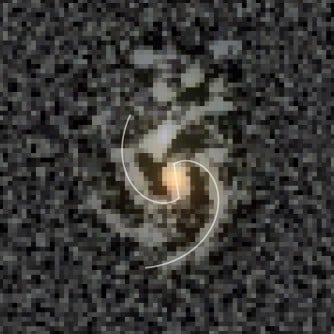
The barred spiral galaxy COSMOS-74706, seen as it was just 2 billion years after the Big Bang. [Daniel Ivanov]
At this morning’s press conference, Daniel Ivanov (University of Pittsburgh) presented results on a barred spiral galaxy in the early universe. At a redshift of z = 3.1591, or just 2 billion years after the Big Bang, this is the most distant barred spiral galaxy ever detected without gravitational lensing. Ivanov and collaborators confirmed the presence of the bar feature using three independent analysis methods. They hope to get further observation time with JWST to further understand the distant galaxy, placing it in a cosmological context to better understand galaxy evolution. | Pitt Press Release | UMass Press Release
A Precessing Radio Jet Drives Super-Heated Gas Outflows from a Disk Galaxy
Thursday morning, Vivian U (Caltech/IPAC) presented new multi-wavelength results studying the active supermassive black hole (SMBH) in nearby galaxy VV340a. Active SMBHs rapidly accrete gas from their surroundings, and they can drastically influence their host galaxy by injecting some of that gas into the surrounding environment.
JWST observations revealed an extended jet of heated gas emerging from the galaxy’s central region. While such features are common in galaxies with active SMBHs, VV340a’s jet is unique due to its size and orientation. The jet is significantly longer than other examples, stretching at least 20 light-years outward from the galaxy’s center (typically, jets are ~10x smaller). In addition, the jet isn’t perpendicular to the galaxy disk, suggesting that the jet is shifting its orientation over time.
Archival data from the Very Large Array (VLA) radio telescope revealed a colder, older, more extended component of the jet, providing a “fossil record” to study the system. From the data, Vivian U and collaborators estimated the speed at which the jet is moving, finding a precession period of ~820,000 years. Using data from Keck, they also estimated the rate at which the jet is depleting the galaxy’s gas reservoir. The deduced mass outflow rate of 19 solar masses per year suggests that the galaxy is using up its reservoir quickly, unless an additional inflow of gas is present to sustain the loss. Several scenarios could produce this wobbly jet — such as two SMBHs in the center of VV340a or an instability in the disk of material surrounding the SMBH. More data is needed to fully confirm the nature of the system. While this is a benchmark case for synergetic observations of active SMBHs, more data is needed to fully understand the system. | Keck Press Release | NRAO Press Release
A Close Quasar Pair in a Massive Galaxy Merger at z = 5.7
Quasars, some of the most luminous objects in the universe, are powered by rapidly accreting supermassive black holes (SMBHs). When two galaxies merge, dormant SMBHs in one, or both, of the galaxies can be triggered, with the latter being exceptionally rare. Such systems are called “quasar pairs.” In Thursday’s press conference, Minghao Yue (University of Arizona) presented new results showcasing a new close quasar pair in two merging galaxies at a redshift of z = 5.7.
The two sources, named J2037-4537, were initially found in 2021 and marked as the first double quasar candidate at z > 5. Dedicated follow up observations from the ALMA radio telescope confirmed that the pair were indeed two individual, physically close galaxies with quasars in their center. Such a system at z > 5 places important constraints on galaxy evolution models, with the search for similar systems still ongoing. Yue and collaborators are hoping to obtain follow up observations with JWST to further understand the groundbreaking system.
An Ultra-Luminous Fast Transient Powered by Rapid Accretion of a Star onto a Black Hole
In 2018, a new enigmatic transient event was detected. These so-called Luminous Fast Blue Optical Transient events are as bright as, or brighter than, supernova explosions, but they disappear much faster. Initial work proposed many models to explain observations of these events, such as stars being destroyed by massive black holes. Since 2018, several other events have been detected, but follow-up observations always occurred too late to constrain the physical origin of the emission.
Daniel Perley (Liverpool John Moores University) announced Thursday that a new event had been detected, named AT2024wpp. The event was originally detected in data from the Zwicky Transient Facility, with follow up observations from Keck. AT2024wpp is one of the most luminous cosmic explosions ever detected, with a peak brightness of 100 billion times that of our Sun. Follow-up observations failed to reveal an expected abundance of spectral lines, challenging theories on the origin of these events. Follow up data from the VLA and ALMA revealed an extremely powerful shock wave passing through a zone of dense gas, moving ~20% the speed of light. To explain this event, Perley and collaborators posited that it was produced by a massive star being eaten by a black hole companion. Future observations obtaining spectra of similar events before they dim can further constrain the nature of these mysterious events. | Summary | LJMU Press Release | NRAO Press Release
Bruno Rossi Prize Plenary: The Dawn of Low-Frequency Gravitational Wave Astronomy, Maura McLaughlin (West Virginia University) & Xavier Siemens (University of Wisconsin, Milwaukee), on behalf of the NANOGrav Collaboration (by Neev Shah)
Maura McLaughlin delivered the Bruno Rossi Prize Plenary Lecture on behalf of the NANOGrav Collaboration. She mentions that Xavier Siemens, who was also going to be there to deliver the plenary, but could not make it due to travel difficulties. Her lecture is on how we use giant radio telescopes across the world to look at extremely precise pulsar clocks to search for gravitational waves. NANOGrav was started in 2007 and is now a NSF Physics Frontier Center with more than 200 members. It is also part of the International Pulsar Timing Array, which consists of a worldwide collaboration of different teams with a common goal, searching for nanohertz gravitational waves.
She starts by talking about how electromagnetic observations over decades have shown us that galaxies grow and evolve through mergers. Most galaxies contain a central supermassive black hole (SMBH). When two galaxies merge, their respective central SMBHs can come close to each other and form a SMBH binary (SMBHB). However, she mentions that we don’t understand the behaviour of SMBHB at close separations very well, commonly referred to as the “final parsec problem.” We also cannot easily study SMBHB through electromagnetic observations, which is where gravitational waves enter the picture.
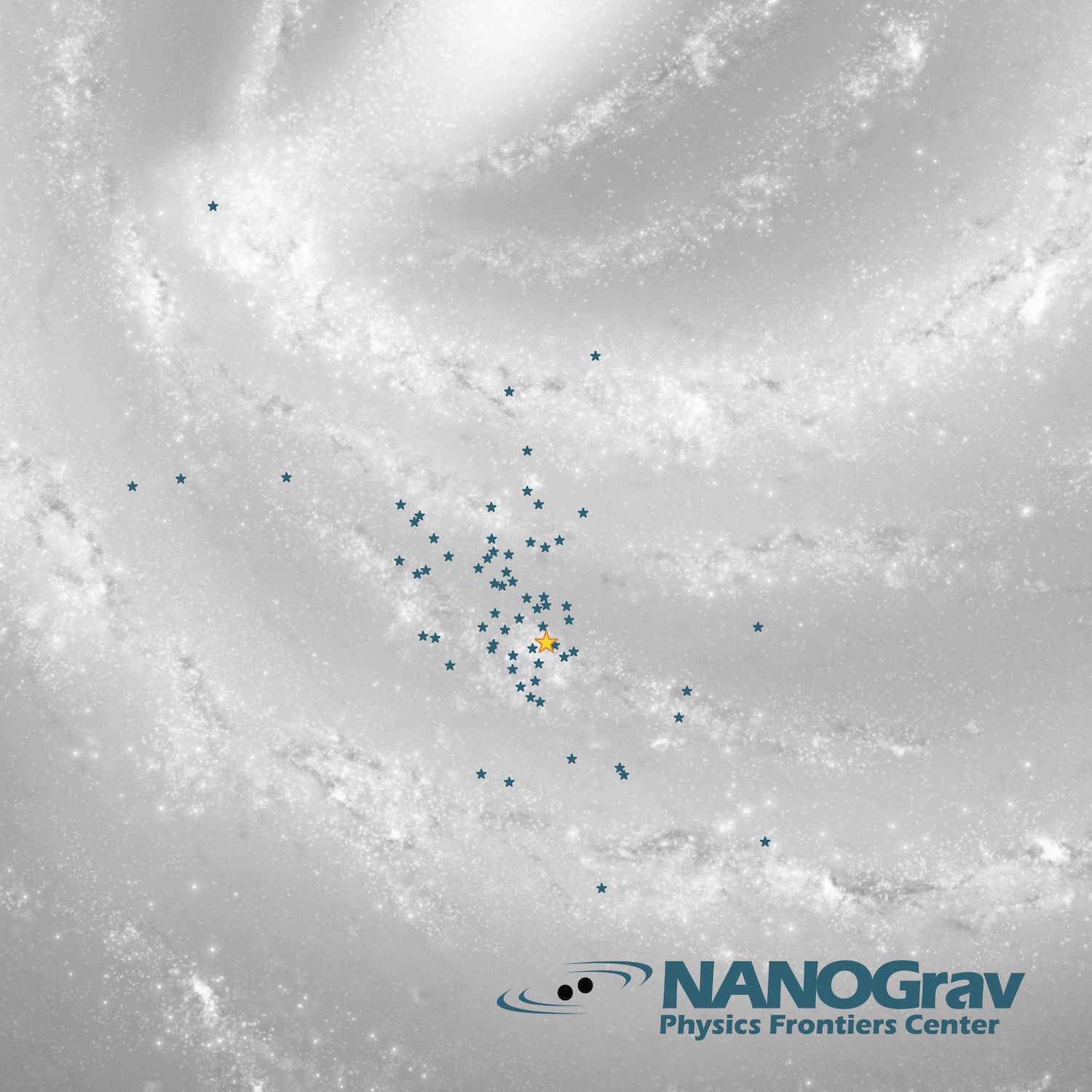
Locations of pulsars (blue stars) in the NANOGrav pulsar timing array relative to the location of the Sun (yellow star). Some pulsar locations are approximate. Click to enlarge. [Ross Jennings / NANOGrav; CC BY 4.0]
Speaking about the dataset, she highlights that NANOGrav observed 68 millisecond pulsars with various radio telescopes such as GBT, Arecibo (rip!), VLA and CHIME. She mentions that a key step in studying pulsars is fitting the arrival times of their pulses with a timing model, which takes into account all the effects that can cause changes in their arrival times. The next step is to search for gravitational waves by cross-correlating the residuals in the timing data of all the pulsars, where the residuals are what is left in the data after subtracting out the timing model. As the stochastic background has a red noise, they search for such a spectrum in their timing residuals as well.
However, she cautions that there could be many other sources of noise, as pulsars are not perfect rotators; there are pulse jitters and various other effects that need to be carefully accounted for. However, all these noise sources have different signatures, and the gravitational wave background has a unique noise signature that can be teased out in the data.
After decades of accumulating data, in June 2023, NANOGrav, along with various other pulsar timing array collaborations across the world announced the discovery of the stochastic gravitational wave background. She emphasizes that finding the background is just the initial step. But more importantly, what do we learn from it? They find that the slope of the spectrum is consistent with what is expected of SMBHBs, but the signal is also in agreement with many other exotic scenarios. They also perform searches for gravitational waves from individual SMBHBs, and although they do not find any evidence for a signal, they are able to place constraints that will significantly improve in the future.
Speaking about the future, she highlights that NANOGrav is currently working on their 20-year-long dataset. She also shows a preliminary Hellings–Downs curve, which is now much more tightly constrained than in the original discovery paper. The worldwide collaboration of various pulsar timing arrays, called the IPTA, is working on their third data release, which will be the most sensitive dataset in the world for searchers for nanohertz gravitational waves. She also mentions that with improved radio instrumentation and new telescopes such as the Deep Synoptic Array, they will be able to detect and study many more pulsars. With an amazing sensitivity, they expect that many tens of SMBHBs could be detected, and there could also be synergy with electromagnetically identified sources for targeted searches, embarking on a new era in multimessenger astronomy.
You can also read Astrobites’s interviews with Maura McLaughlin and Xavier Siemens.
Press Conference: Active Galactic Nuclei Across the Universe (Briefing video) (by Lexi Gault)
Hidden Hearts: The Central Galactic Structures That Grow Black Holes
Sky surveys have revolutionized our understanding of galaxy-wide morphologies — observations of galaxies across the sky reveal various structures and shapes that can clue us in to what may be happening inside these galaxies. Michael Koss (Eureka Scientific, Inc.) presented the importance of high-resolution imaging of nearby galaxies. Sometimes missed in shallower surveys, higher resolution observations from the Hubble Space Telescope and Keck often reveal detailed internal structures like nuclear dust lanes, spiral arms, and clumpy structures. These features, Koss pointed out, could provide fuel for active supermassive black holes within these galaxies. With planned missions like Euclid and Roman, these telescopes will be able to see through obscured galaxy light and reveal things like mergers and detailed structures that provide better insights into the internal structures and mechanisms of galaxies. Given the volumes of these surveys, citizen scientists can help through Galaxy Zoo to classify galaxies with these types of structures, supporting community engagement while pushing a science goal forward.
From Dwarfs to Giants: A Complete Census of Active Galactic Nuclei
How common are active supermassive black holes? Mugdha Polimera (Center for Astrophysics | Harvard & Smithsonian) presented a census of active galactic nuclei in galaxies across a range of masses. Using different search methods for different galaxy types, the team was able to decipher active black hole light from the glare of star formation. This study included 8,000 galaxies and found that only 2–5% of dwarf galaxies house an active black hole. While this value is up from previous studies estimating only about 1% for dwarfs, this fraction is still far below what Polimera’s team measured for medium and large galaxies, 16–27% and 20–48%, respectively. Looking further into galaxy properties, the dwarf population tends to have little dust, high star formation activity, and high gas content. Despite having ample fuel for hungry black holes, dwarf galaxies rarely house an accreting central black hole. Further investigation is necessary to determine if this is driven by detection limitations or physical properties in dwarf galaxies suppressing supermassive black hole accretion. | Press release
Monsters and Misalignment: Do Active Galactic Nuclei Influence Counter-Rotation in Low-Mass Galaxies?
Within galaxies, we anticipate the gas and stars to generally orbit the galactic center together, but this is not always the case. Low-mass galaxies, which are more susceptible to mass loss from multiple avenues, are sometimes observed to have misaligned gas and stellar rotation. Dominic Schwein (Colorado College) and team were curious if active galactic nuclei could be the culprit of this phenomenon. Using Sloan Digital Sky Survey MaNGA spectroscopy, they were able to map the velocities of the stars and gas in detail for 94 small galaxies with active galactic nuclei (AGN). Through their analysis, they found that counter rotation — when the stars and gas rotate in opposite directions — is much more common in galaxies with AGN, with 52% counter rotating. This analysis provides clues to how AGN can impact their host galaxies, with AGN feedback likely redistributing the gas content leading to counter rotation. Comparing the 94 galaxies to a broader sample of 3,000 galaxies, they find that galaxies with misaligned stars and gas are more likely to host AGN. This study is helping to improve the understanding of AGN and their influence on their host galaxies. | Press release
Galactic Rain: Cool Gas Inflows in Red Geyser Galaxies
One of the important questions in galaxy evolution is how galaxies stop forming stars. Theory predicts that supermassive black holes can suppress star formation in their hosts by heating up the gas, preventing it from collapsing into new stars. However, observations have revealed that some AGN inhabit star-forming galaxies, meaning their impacts on star formation may be a bit more complicated. Looking at a rare galaxy class, red geysers, Arian Moghni (University of California, Santa Cruz) and collaborators sought to understand how some AGN still appear star-forming. The ionized gas in red geysers appears to be outflowing and does not indicate star formation, which is assumed to be the impact of the AGN. However, if gas is being pumped out, what is keeping the AGN active? Moghni looked into the cold gas using specific chemical tracers that can reveal the location and motions of the cool gas in the galaxy. Through this analysis, they found that the cool gas seems to be inflowing into the red geysers, keeping their supermassive black holes active. The exact origins of this cool inflowing gas are not yet fully understood, but it could be accreted from the local environment or from interactions with nearby galaxies. From their analysis, the team found that interactions are the likely culprit, maintaining the AGN activity and keeping star formation in red geysers suppressed. | Press release
From CubeSats to Flagships: Innovation Through Exoplanet Exploration, Evgenya Shkolnik (Arizona State University) (by Lexi Gault)
A professor at Arizona State University, Evgenya Shkolnik presented this afternoon’s plenary on the interconnection between the smallest satellites and the largest flagship missions in the context of exoplanetary science. In order to understand the missions we need, she took us back to the basics, starting with a big science question. For Dr. Shkolnik, a big science question is one that takes many people and often multiple generations to get to the answer. This requires us to break these large-scale questions into more manageable objectives and needed measurements in order to reach the broader science goals.
In exoplanetary science, one of the big driving questions is, “are we alone?” This question, though only three words, is massive in scope scientifically. To search for life, we need to understand exoplanet populations, atmospheric biosignatures, and how a planet’s host star shapes its atmosphere and environment. No single instrument or mission can target every science objective at once; thus, we need an ecosystem of tools to solve big science questions. For example, the first exoplanet discoveries required a variety of telescopes and teams of people to achieve these breakthroughs.
To date, there have been more than 6,000 exoplanets discovered through a variety of methods, with a combination of on-ground and in-space telescopes. From these discoveries, we have learned that exoplanets are everywhere, and they are extremely diverse. Excitingly, it has been estimated that about 25% of all stars have rocky planets in the habitable zone — the atmospheres of these planets are the keys to keep them habitable. However, as we experience solar flares and weather from the Sun here on Earth, the stellar environment a planet is exposed to regulates its atmosphere and subsequent habitability. Therefore, understanding stellar activity and the high energy photon emission at an exoplanet’s orbit is critical in the search for life.
Launching in the early hours on Sunday, 11 January, SPARCS, the Star–Planet Activity Research CubeSat, is a small telescope that will stare at 20 stars for a month each in order to catch ultraviolet flares. This little but significant telescope will collect a wealth of stellar activity data, providing insights into the environments in which potentially habitable planets reside. Not only does SPARCS enable important observations, but it will also test technology that may be employed on future flagships like the Habitable Worlds Observatory.
SPARCS is an example of a small instrument that is part of a larger ecosystem of astronomical tools to explore the universe. Dr. Shkolnik provides a framework for us to consider when thinking about building our science: scaling up, laddering up, and pairing up. Scaling up allows us to build better instruments that provide better measurements. Laddering up connects smaller projects that contribute science results and instrument testing to multiple larger missions that come after them. Pairing up allows us to pull together multiple missions that work simultaneously to address the same big science questions. As we move forward, thinking about these aspects will improve both small- and large-scale missions, making science goals ambitious and achievable.
Lancelot M. Berkeley – New York Community Trust Prize Lecture: Measuring Cosmic Sound with DESI, Daniel Eisenstein (Harvard University), on behalf of the DESI collaboration (by Bill Smith)
Daniel Eisenstein accepted the Lancelot M. Berkeley – New York Community Trust Prize for Meritorious Work in Astronomy on behalf of the DESI collaboration. His plenary talk, Measuring Cosmic Sound with the Dark Energy Spectroscopic Instrument DESI, focused on the physics of baryon acoustic oscillations, the DESI instrument, the latest cosmological results, and what those results mean for the future of cosmology.
He began with the hot Big Bang model, which posits that the very early universe was hot, dense, and nearly smooth, and that it cooled and developed structure over time. This framework has been remarkably successful, explaining much of cosmology with a small set of parameters and well-understood physics. In this model, small inhomogeneities in the early universe grew through gravity into the web of galaxy clusters we see today, and measuring this large scale structure has been one of the most powerful tests of the Big Bang model. A key component of this picture is dark energy, the somewhat recently discovered phenomenon driving the accelerated expansion of the universe.
This is where baryon acoustic oscillations, or BAO, come in. BAO are sound waves from the very early universe, roughly 400,000 years after the Big Bang. Before that time, the universe was hotter and ionized, and photons exerted large pressure and restoring forces on baryons. Overdensities in this matter distribution generated spherical sound waves that propagated at approximately 57% of the speed of light. At the epoch of recombination, the baryons cooled, became neutral, and photons began to travel freely. The sound speed then dropped rapidly, freezing in the pattern of those waves. The result is a faint but measurable statistical imprint in the clustering of matter that persists through cosmic time. Because the expected separation scale of this imprint depends only on the sound speed and the propagation time, it can be used as a standard ruler for measuring distances across the universe.
After outlining the BAO theory, Eisenstein turned to DESI, which was designed to map cosmic expansion and the growth of structure through BAO. Building on the legacy of the Sloan Digital Sky Survey, DESI has mapped about 40% of the sky from redshift z = 0 to z = 3.5. Over four and a half years, through spectra, DESI has measured 45 million extragalactic redshifts and observed 18 million stars.
He then presented the BAO constraints from DESI Data Release 2, which are the tightest to date. He presented correlation functions for several galaxy samples, each revealing a clear BAO signal at the expected separation distance, and he added independent BAO evidence from the Lyman-alpha forest. In the final part of the talk, Eisenstein discussed the implications of these and other DESI results for LambdaCDM cosmology. He emphasized the strong synergy between BAO and Type Ia supernovae as complementary distance probes. When used independently, the BAO-based estimate of the Hubble constant differs from the value inferred from supernovae, further reinforcing the growing issues of the “Hubble tension.” He also presented analyses showing that DESI’s results favor models with evolving dark energy over a simple constant dark energy, and that this preference strengthens when cosmic microwave background and supernova data are included.
He closed by touching on other DESI measurements, including the Alcock Paczynski effect and measurements of gravitational lensing of the cosmic microwave background. Together, these results point to a rapidly improving picture of cosmic history and highlight how DESI’s precise mapping of structure can sharpen our understanding of the universe’s contents and evolution.