
Editor’s Note: This week we’re at the 247th AAS meeting in Phoenix, AZ. Along with a team of authors from Astrobites, we will be writing updates on selected events at the meeting and posting each day. Follow along here or at astrobites.com for daily summaries, or follow @astrobites.bsky.social on Bluesky for more coverage. The usual posting schedule for AAS Nova will resume on 12 January.
Table of Contents:
- Historical Astronomy Division LeRoy E. Doggett Prize Plenary: Don’t Let Anybody Tell You to Plan Your Career, Thomas Hockey (University of Northern Iowa)
- Press Conference: News from the High-Redshift Universe
- 2025 Newton Lacy Pierce Prize Plenary: What Happens to Planets After Their Stars Die?, Andrew Vanderburg (Harvard University)
- Press Conference: The Milky Way and Stellar Explosions
- Plenary Lecture: The Creating Equity in STEAM (CrEST) Experiential Learning Programs, Raja GuhaThakurta (University of California, Santa Cruz)
- Henry Norris Russell Lecture: Finding the Most Distant Galaxies Using the James Webb Space Telescope, Marcia Rieke (University of Arizona)
Historical Astronomy Division LeRoy E. Doggett Prize Plenary: Don’t Let Anybody Tell You to Plan Your Career, Thomas Hockey (University of Northern Iowa) (by Niloofar Sharei)
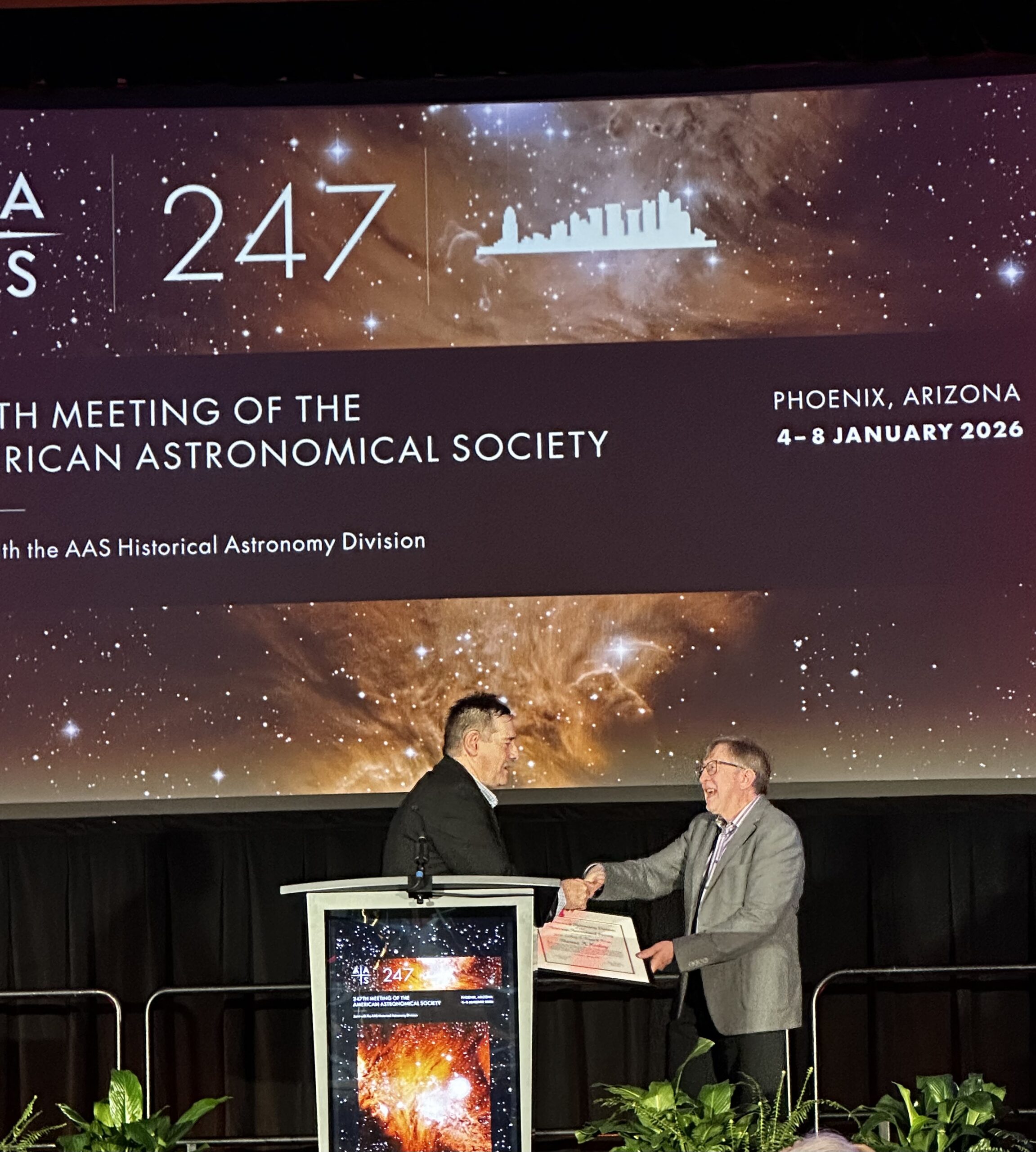
Thomas A. Hockey receives the AAS Historical Astronomy Division’s Doggett Prize at AAS 247 in Phoenix.
Today’s awards session for the Historical Astronomy Division’s Doggett Prize featured a lecture by prizewinner Thomas A. Hockey, who used his own winding career path to argue for staying open to unexpected opportunities. He described how early interests in planetary observing gradually led him toward the history of astronomy, with side projects that became central, from untangling long-standing myths about Jupiter’s Great Red Spot to preserving oral histories from figures such as Clyde Tombaugh. A recurring theme he went back to was that historical observations can meaningfully inform modern astrophysics, but only when their limitations are carefully respected. He closed by returning to eclipse-chasing and long-baseline sky watching, emphasizing how real celestial events, rather than rigid plans, ultimately shaped his career, encouraging all young astronomers to be open to opportunities that come along.
You can read Astrobites’s interview with Thomas Hockey here.
Press Conference: News from the High-Redshift Universe (Briefing video) (by Niloofar Sharei)
Today’s press conference highlighted how JWST, together with ALMA and Hubble, is sharpening our view of galaxy growth in the universe’s first billion years, while nearby low-metallicity “analogs” help us test the physics we cannot resolve at high redshift.
The ALPINE-CRISTAL-JWST Survey: A New Multi-Wavelegth Survey Reveals Early Galaxies Grow Up Fast
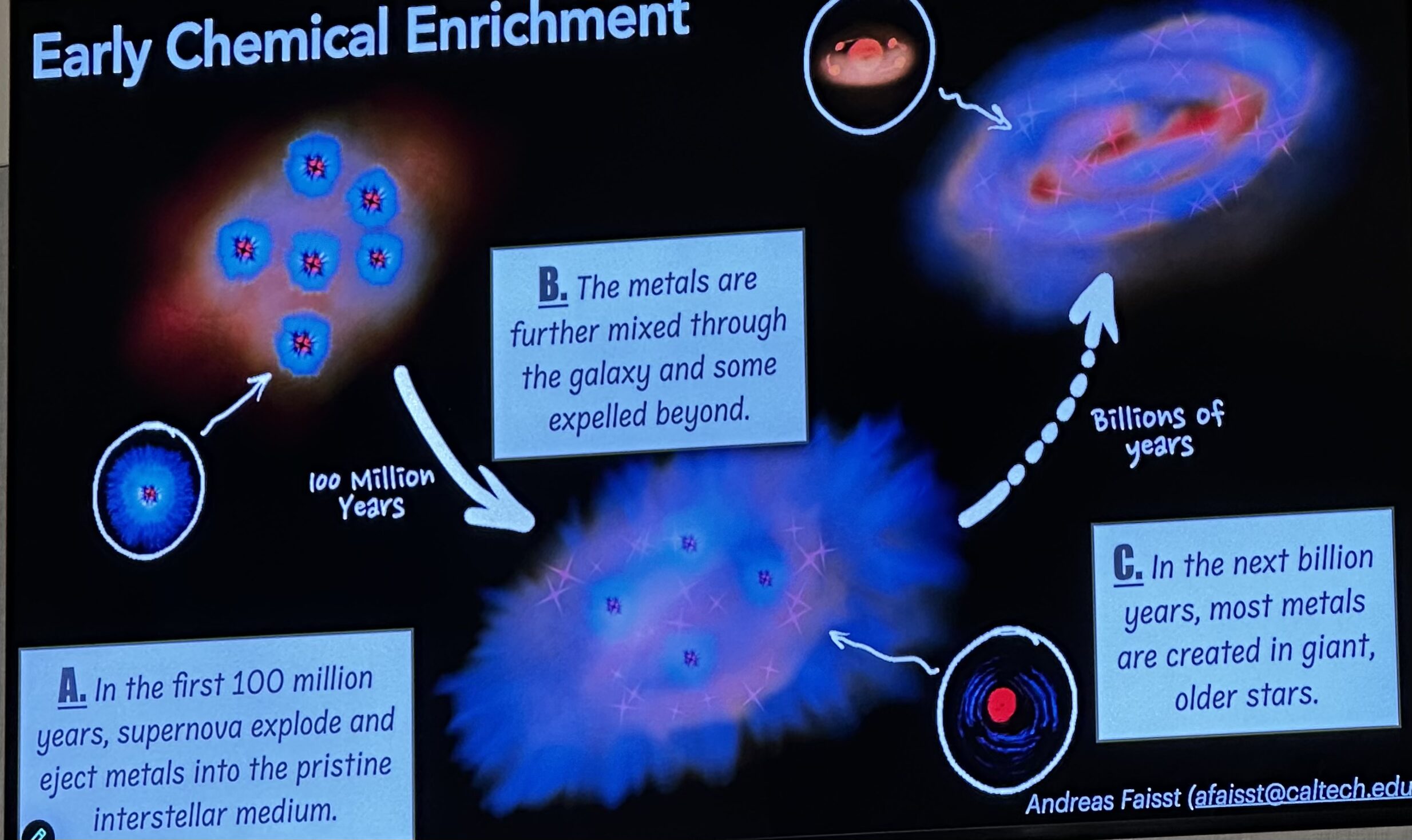
Schematic overview of early chemical enrichment in galaxies. Supernova explosions rapidly enrich the interstellar medium within the first 100 million years, metals are mixed and then driven into surrounding gas, and later generations of stars continue metal production over billions of years. Click to enlarge. [Andreas Faisst, Caltech]
A New Population of Point-Like Narrow-Line Objects Revealed by the James Webb Space Telescope
Haojing Yan and Bangzheng Sun (University of Missouri – Columbia) introduced a small but fascinating set of JWST sources that look almost like point sources in images but show narrow emission lines when you look at their spectra. Yan described them as the “platypuses of the universe.” On their own, none of their properties are especially strange, but when you put everything together, they do not fit neatly into any familiar category. Normally, unresolved sources turn out to be either stars or quasars. Yan showed that these objects are not stars based on their colors and spectra. They also do not behave like typical quasars: although they are compact, they are less luminous and lack the broad emission lines that come from fast-moving gas around a supermassive black hole.
Because of this, the team argued that these sources are not standard quasars. Two possibilities remain. They could be a previously unknown type of narrow-line active galactic nucleus, where a compact central engine dominates over an extremely faint host galaxy, or they could be very young, compact star-forming galaxies, probably younger than about 200 million years, whose early growth kept them unusually small and smooth. Either way, the speakers emphasized that this appears to be a new population, and that deeper and more detailed JWST spectroscopy will be needed to figure out what these objects really are. | University of Missouri press release; STScI press release
Supermassive Stars as the Engines Behind Little Red Dots
Devesh Nandal (Center for Astrophysics | Harvard & Smithsonian) proposed an alternative explanation for at least some little red dots: instead of being compact galaxies powered by active black holes, their light might come mainly from a single, extremely massive star growing through rapid accretion. A key motivation for this idea is what these objects don’t show: they lack detectable X-ray emission, which would normally be expected if an actively accreting black hole were present. At the same time, their very compact unresolved appearance makes them hard to explain as normal galaxies, and their spectra do not look like those of typical stellar populations either. In this picture, a supermassive star forms out of nearly pristine gas and accretes fast to push past the limits of classical stellar evolution. As long as the accretion rate stays above a critical threshold, the star remains bloated and relatively cool, giving it a red appearance even as it continues to gain mass. In theory, such a star could grow to around a million times the mass of the Sun before becoming unstable and collapsing directly into a black hole, offering a natural route to forming massive black hole seeds.
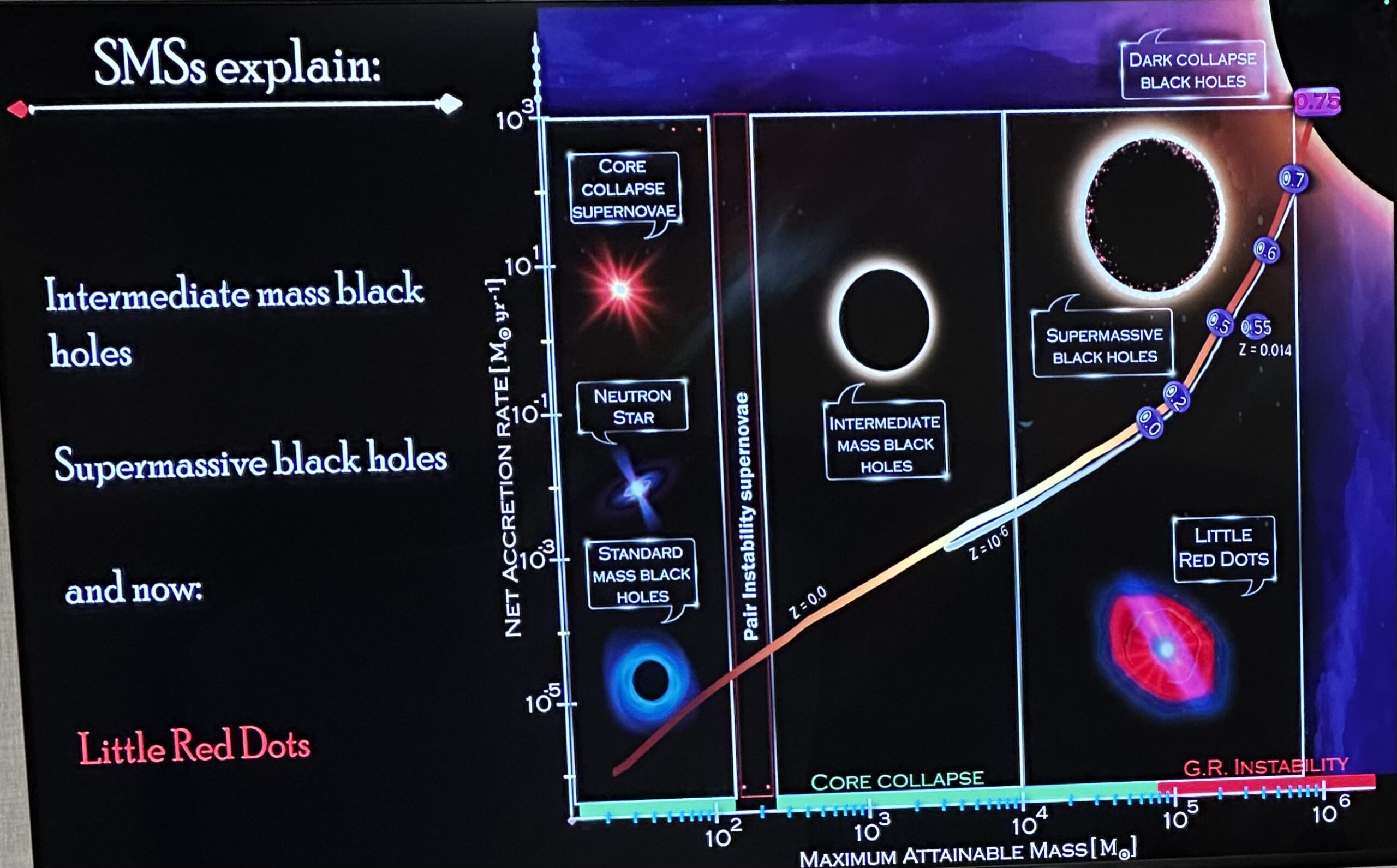
Schematic showing where JWST’s little red dots fall in a mass–accretion framework, illustrating how rapidly accreting supermassive stars could grow to extreme masses and collapse directly into massive black holes. Click to enlarge. [Devesh Nandal]
Webb Reveals Early-Universe Analog’s Unexpected Talent for Making Dust
Elizabeth Tarantino (Space Telescope Science Institute) focused on Sextans A, a nearby metal-poor dwarf galaxy used as a local analog of early galaxies, which are otherwise too distant to study in detail. Using JWST spectroscopy of a massive asymptotic giant branch star, the team found clear evidence for dust production, but not in the usual Milky Way form. The spectrum lacked the classic 10 μm silicate feature and instead pointed to iron-rich dust, showing that asymptotic giant branch stars at low metallicity can still be efficient dust producers, just with different chemistry. JWST imaging also revealed weak, clumpy polycyclic aromatic hydrocarbon emission, suggesting small dust grains survive only in protected pockets. The results show that even metal-poor galaxies can host substantial stellar and interstellar dust, reshaping how we interpret dust in the early universe. | Press release
2025 Newton Lacy Pierce Prize Plenary: What Happens to Planets After Their Stars Die?, Andrew Vanderburg (Harvard University) (by Skylar Grayson)
Andrew Vanderburg delivered a plenary centered on using white dwarfs, the leftover cores of dead stars (and a glimpse into the future of our own sun) to study exoplanets. We’re currently entering a crucial time for exoplanet astronomy, with the number of known exoplanets rapidly increasing and sophisticated techniques and instrumentation allowing us to push to more extreme and smaller systems, including those that could host life. However, there are still many open questions around habitability, what is and is not a biosignature, and our understanding of the systems life could exist in.
His talk was focused on two core questions in exoplanet research that white dwarfs can help us answer. First up: what elements are rocky exoplanets made of? This is relevant for considerations of magnetic fields and plate tectonics, the elements available for chemical processes, and (crucially) identifying geology that could produce false positives for biosignatures. Determining the composition of rocky planets with our current tools is extremely difficult, but his group has explored using the spectra of white dwarfs to uncover planetary composition. The extreme gravity of white dwarfs makes them chemically stratified, meaning the surface is almost entirely hydrogen and a little bit of helium, offering a blank slate for spectroscopic study. Planets around a white dwarf can be tidally disrupted and torn apart, and that debris can then fall onto the surface of the white dwarf, adding interesting fingerprints to the stellar remnant’s spectrum. Vanderburg’s team has been developing new methods of generating mock spectra to compare to white dwarf observations, and they are laying the groundwork for quick analysis of upcoming spectral surveys in order to efficiently hunt for chemical signatures that could be traced back to exoplanets.
The second half of Vanderburg’s talk was focused on using dead stars to understand life. When the Sun becomes a red giant, then eventually loses its outer atmosphere and becomes a white dwarf, the solar system will completely change. The inner planets will likely be swallowed up, and planets will move around in their orbits, adjusting to the changed gravity of the much smaller white dwarf remnant. But, as he explained, just because planets are orbiting a dead star doesn’t mean they themselves are dead. White dwarfs still have a habitable zone (where liquid water could exist on a planet’s surface), but it’s very, very near to the stellar remnant, in a region where any planets would have been destroyed in the death of the progenitor star.
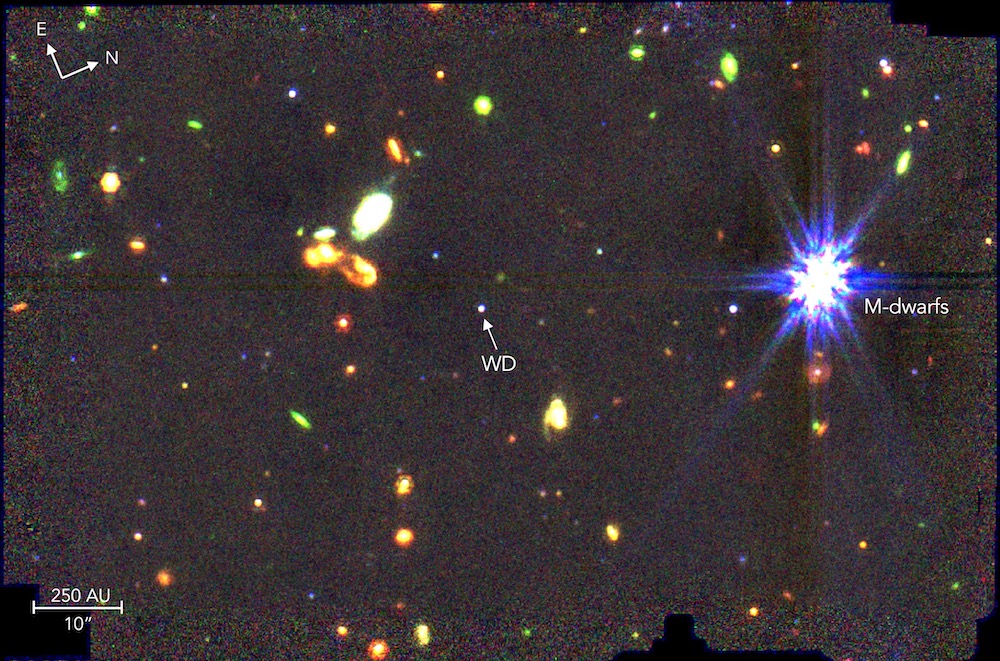
The white dwarf WD 1856+534, shown at the center of this image, hosts an exoplanet at an orbital distance of just 0.02 au. [Limbach et al. 2025]
Overall, the work presented in this plenary sets the stage for the next generation of exoplanet research. Finding planets in unique environments such as near white dwarfs, understanding the conditions under which life could be sustained, and exploring new ways to determine the composition of exoplanets will help prepare for upcoming missions like the Habitable Worlds Observatory and play a big part in the hunt for life beyond Earth.
You can also read our interview with Dr. Vanderburg here.
Press Conference: The Milky Way and Stellar Explosions (Briefing video) (by Skylar Grayson)
Resolving Iron Doublets for Galactic Center Molecular Clouds with XRISM
XRISM (the X-ray Imaging and Spectroscopy Mission) is providing higher resolution X-ray spectroscopy than anything we’ve seen before, and it’s allowing us to study components of the universe in a whole new way. Stephen DiKerby, a researcher at Michigan State University, has been using XRISM to look at molecular clouds in the center of the Milky Way. Iron in these clouds emits X-rays, and the high spectral resolution of XRISM has allowed us to study that emission in detail. One particular line, called Fe Kɑ, was revealed with XRISM to actually be a doublet, and the redshift of the iron-emitting gas could be constrained to within 10 km/s, an unparalleled precision in X-ray spectroscopy. The XRISM results have also shed some light on where the iron emission is coming from, as the lack of certain spectral features can rule out certain emission pathways. The XRISM data prefer a process called X-ray reflection, wherein material around the supermassive black hole in the center of the Milky Way produced a lot of X-ray emission that travelled to the molecular cloud over the course of 100 years, eventually exciting the gas and generating the observed Fe Kɑ. In order to produce the emission observed in the molecular cloud, the supermassive black hole would have needed to be thousands of times brighter than it is today! This work highlights how novel observations, such as high-resolution spectroscopy, can be used to constrain the underlying physics of the interstellar medium. | Press release
Continued Monitoring with Chandra of Kepler’s Supernova Remnant over 25 Years
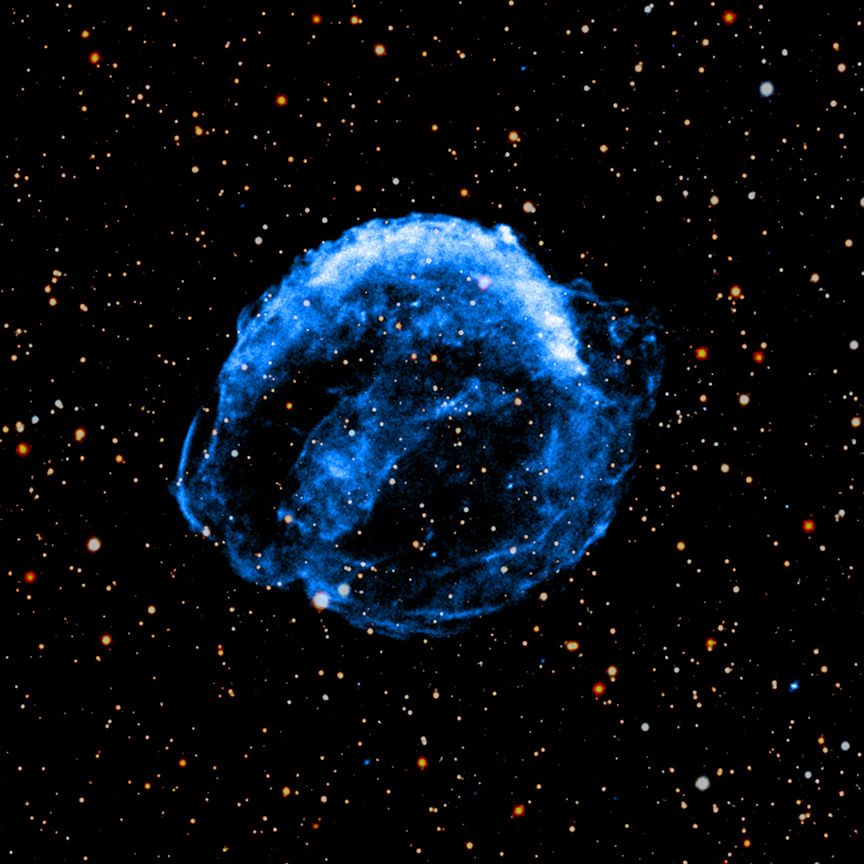
X-ray and optical image of Kepler’s supernova remnant. [X-ray: NASA/CXC/SAO; Optical: Pan-STARRS]
Where Do Stars Explode in the Interstellar Medium?
Supernovae play a major role in galaxy evolution, shaping the interstellar medium, regulating future star formation, impacting baryon cycles, and more. Understanding where supernovae happen is a key part of understanding their impacts, whether they’re embedded in dense clouds of gas and dust that they blow apart, or are located outside of dense regions and can drive winds that compress material and trigger more star formation. In order to unpack this, Sumit Sarbadhicary, a research scientist at Johns Hopkins University, has generated the first detailed census of stellar explosions in the nearby galaxy Messier 33. He looked at massive stars that are near the end of their lives (i.e., future supernovae) and compared their locations to that of atomic and molecular gas clouds as observed by the Atacama Large Millimeter/submillimeter Array and the Very Large Array. This has provided the first measurement of the correlation between massive stars and dense gas clouds. Overall, a majority of the stars won’t explode in dense gas regions, but the results did depend on the mass of the star. More massive stars were more likely to be in dense gas, which could have interesting implications for what types of stars shape cavities in the interstellar medium or trigger future star formation. Overall, these results will be important in the development of simulations moving forward, in order to ensure that we are accurately capturing the physics of stellar evolution and supernovae. | Press release
Plenary Lecture: The Creating Equity in STEAM (CrEST) Experiential Learning Programs, Raja GuhaThakurta (University of California, Santa Cruz) (by Neev Shah)
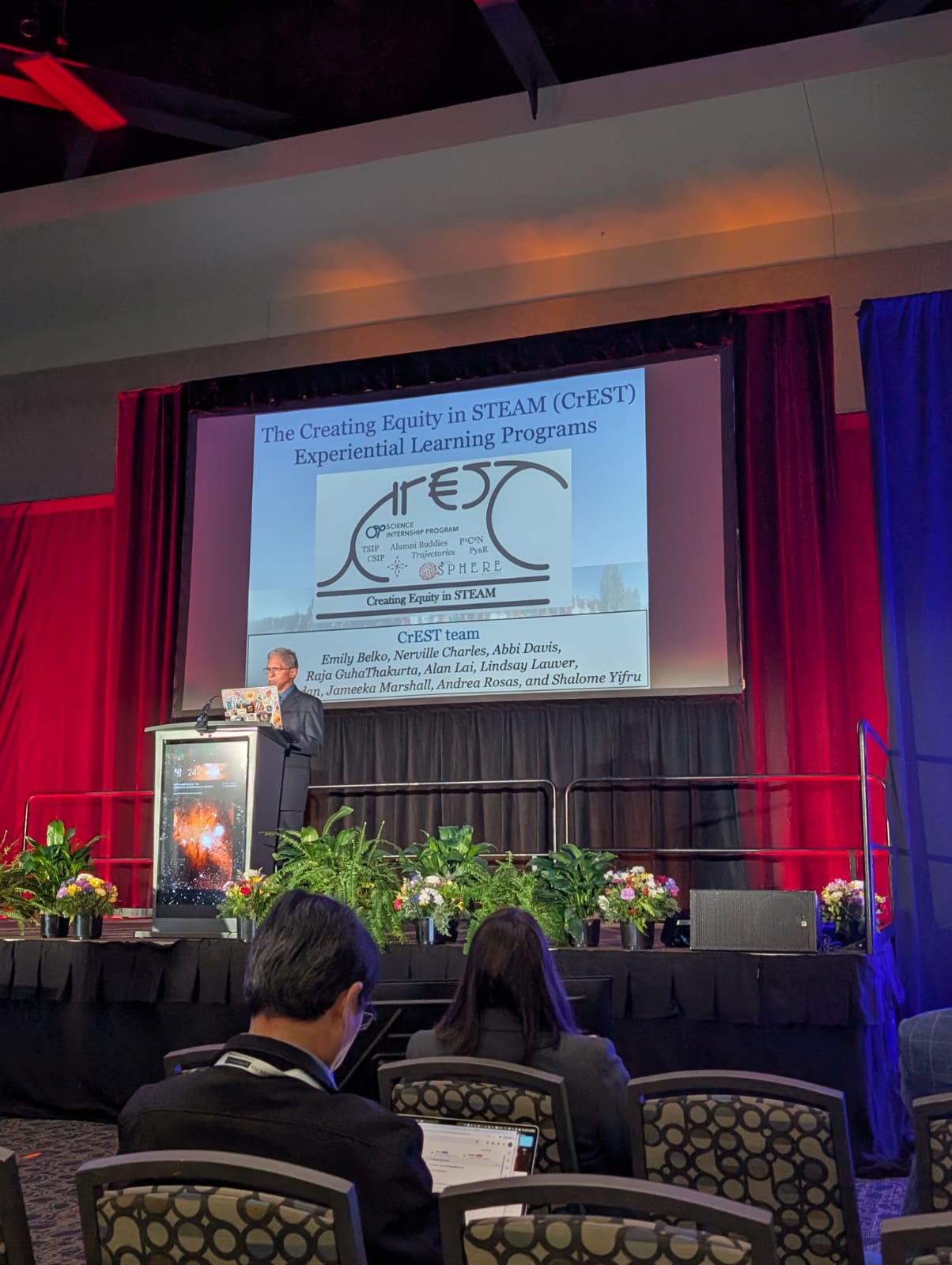
Prof. Raja GuhaThakurta delivering his 2025 AAS Education Prize Plenary Lecture at AAS 247. [Neev Shah]
Shadow the Scientists (Dipping your toes in the water): GuhaThakurta mentions that StS started in November 2020, in the middle of the pandemic when many telescopes were shut down and were being operated remotely. It started at the Keck and Lick observatories, where school students participated in remote observing sessions with the help of live translations into many languages. He also recalled a particular instance where a school consisting of Israeli and Palestinian students shadowed scientists for a project, with simultaneous live translations from English to Hebrew and Arabic. Now supported by a grant from the Heising-Simons foundation, StS has expanded to include students from Africa, Asia, Latin America, and the Middle East. He mentioned numerous examples of projects where students could shadow scientists in their work, with one of them being exploring the famous comet 3I/ATLAS. He also highlighted that StS has now expanded to several other telescopes such as Subaru, Gemini, Las Cumbres Observatory, CHARA, and CFHT, and is also in conversations with DESI at the Mayall Telescope and LIGO Hanford. To highlight the large impact of this program, he also mentioned that StS has also gone beyond astronomy to include many other projects in stem cell biology, ecology, and even volcanology
Python and Research (Learning swim strokes): GuhaThakurta next spoke about the PyaR, started in November 2018. This program, which runs every few months, develops free online tutorials for students to learn about research through coding and data analysis. He credited his former graduate students Claire Dorman, Emily Cunningham, and Amanda Quirk, who have contributed significantly to the development of these tutorials. It was initially started in an all girls high school in the Bay Area, but it has since expanded and has served a few thousand students since its beginning. He also highlighted that it has been adapted to create tutorials in computational biology, and will soon also have a new module to explore particle physics with the help of data collected at the Large Hadron Collider in CERN.
Science Internship Program (Taking a deep dive): Next, GuhaThakurta spoke about the first program that he started in 2009, SIP, which is a research internship for high school students. It is divided into a week-long online component, followed by 7 weeks in person, where they are mentored by UCSC researchers, which include graduate students, postdocs, research staff, and faculty members. Although originally started in astronomy, SIP has now expanded to all the academic divisions in UCSC. He mentions that high school students get the opportunity to be closely mentored on open-ended real research projects, which generally includes a carved-out piece of research being done by the mentors, and has a shallow learning curve through which mentors can also teach the students about the broader context of the work that they are doing. Although SIP originally started with just three students from one school, it has grown significantly and had 300 students last summer from across the world. Since 2009, SIP has also had students from 750 high schools. In fact, he highlighted that many students return to do SIP multiple times, and the program has had about 2,500 unique students. He also mentions that about a third of SIP students have had to overcome serious obstacles in their life, and the program strongly focuses on BIPOC, low-income, and first-generation students. He highlighted a study done by psychology researchers on the impact of SIP. They found a strong increase in students’ interest and confidence in STEM. He also mentioned that SIP is beneficial not just for the students, but also for the mentors as they gain leadership, project management, pedagogical experience and are also paid a stipend. Mentors are also able to advance their own research with the help of the students, and broaden the impact and awareness of their work to other communities
GuhaThakurta mentions that the CrEST programs have now reached many communities in the US, and also various countries in Africa, South America, Europe, and Asia. CrEST has an annual budget of three million dollars, with 72% of it coming from the fees paid by the students participating in the SIP program, 20% via philanthropic contributions from individuals, families and even corporate gifts. The remaining 8% comes from the StS grant funded by the Heising-Simons Foundation. He emphasizes that a third of SIP students are provided need-based scholarships as well.
GuhaThakurta recalls several other outreach initiatives that he is involved with, such as teaching courses to prison inmates at the SC county jail. He is also involved with a UC-wide program called COSMOS, which is a four-week research camp for high school students.
He emphasizes the need for more mentors and appeals to the AAS community to contact people involved with CrEST to learn more about the programs, as well as to host StS sessions. He also appeals to the audience to spread the word about CrEST programs to their network of researchers, and also to potential participants who may benefit from them. To increase impact, he also recommends others to start new programs, or even modifying the existing experiential learning programs at our own home institutions.
He ended his plenary lecture by sharing a link to a document that includes his slides and many other related resources to learn more about him as well as the programs that he spoke about.
You can also read our interview with Prof. GuhaThakurta here.
Henry Norris Russell Lecture: Finding the Most Distant Galaxies Using the James Webb Space Telescope, Marcia Rieke (University of Arizona) (by Niloofar Sharei)
This Henry Norris Russell Lecture was a mix of personal history, instrument-building, and science results. Marcia Rieke used her own career story, from early hands-on observing to leading roles on major infrared missions, to show how decades of technical progress steadily removed the practical barriers to finding the first galaxies.
She began by describing what high-redshift galaxy work looked like when she started, when infrared observations were done from the ground using single-aperture photometers. Galaxies were often not directly visible, and positions were measured by offsetting from nearby guide stars. At that time, the main motivation was cosmology rather than galaxy evolution, with the hope that distant galaxies, especially ellipticals, could act as standard candles to constrain the geometry of the universe.
She then walked us through the missions that built up the way to JWST. NICMOS marked the transition from single-pixel measurements to infrared imaging from space and revealed how powerful arrays could be. Spitzer pushed sensitivity much further, but its small mirror led to confusion-limited images. Combining Hubble and Spitzer data showed how features like the Balmer break could be identified at high redshift and revealed that extreme emission lines can strongly bias broadband colors. Another limitation was that hydrogen absorption wipes out light shortward of the Lyman break, meaning Hubble can only reach to about z ~ 10 before redshift estimates rely on a single filter.
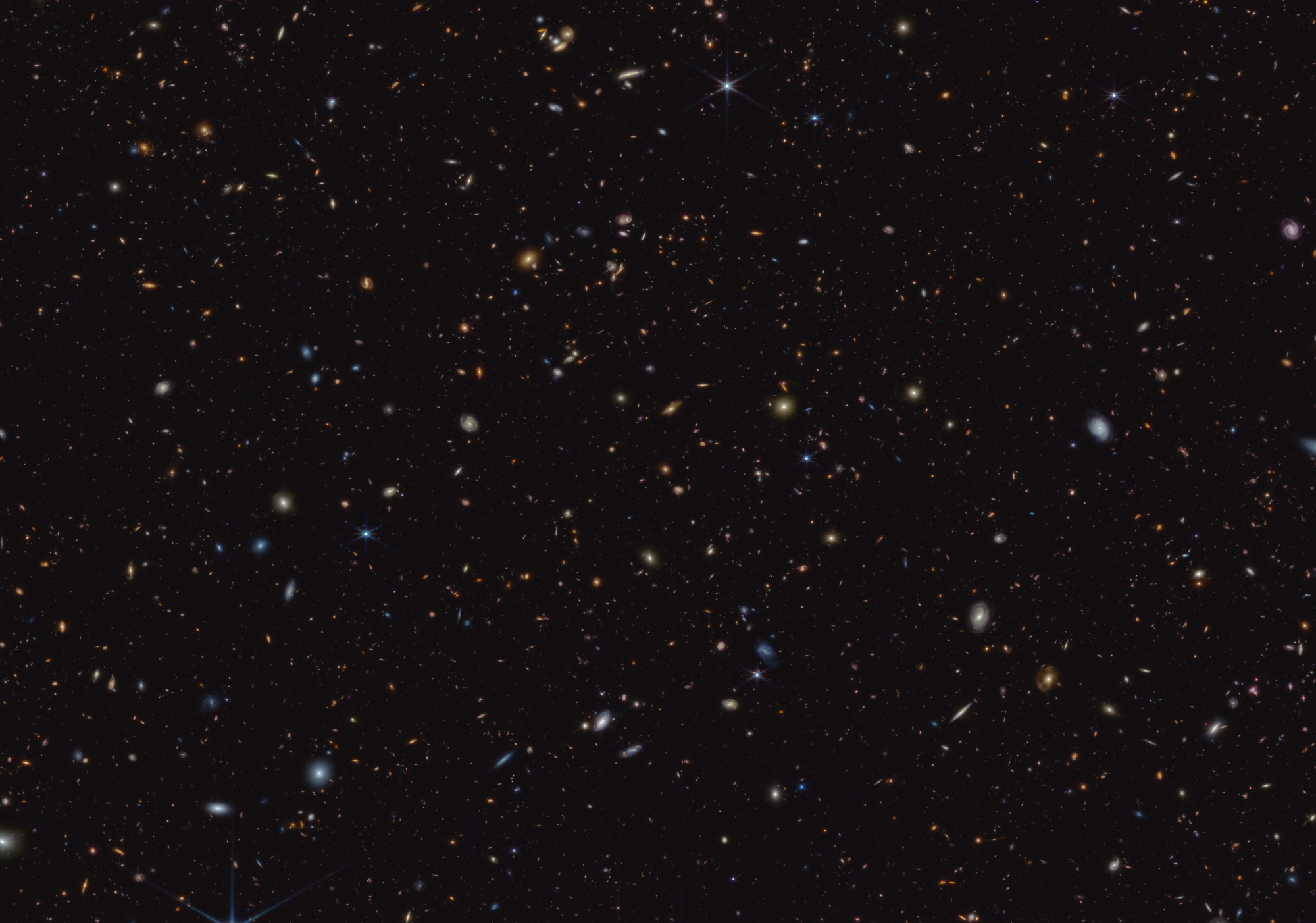
More than 45,000 galaxies appear in this image from the JWST Advanced Deep Extragalactic Survey, or JADES, program. [Image: NASA, ESA, CSA, Brant Robertson (UC Santa Cruz), Ben Johnson (CfA), Sandro Tacchella (Cambridge), Marcia Rieke (University of Arizona), Daniel Eisenstein (CfA) ; Image processing: Alyssa Pagan (STScI)]
You can read our interview with Dr. Rieke here.