
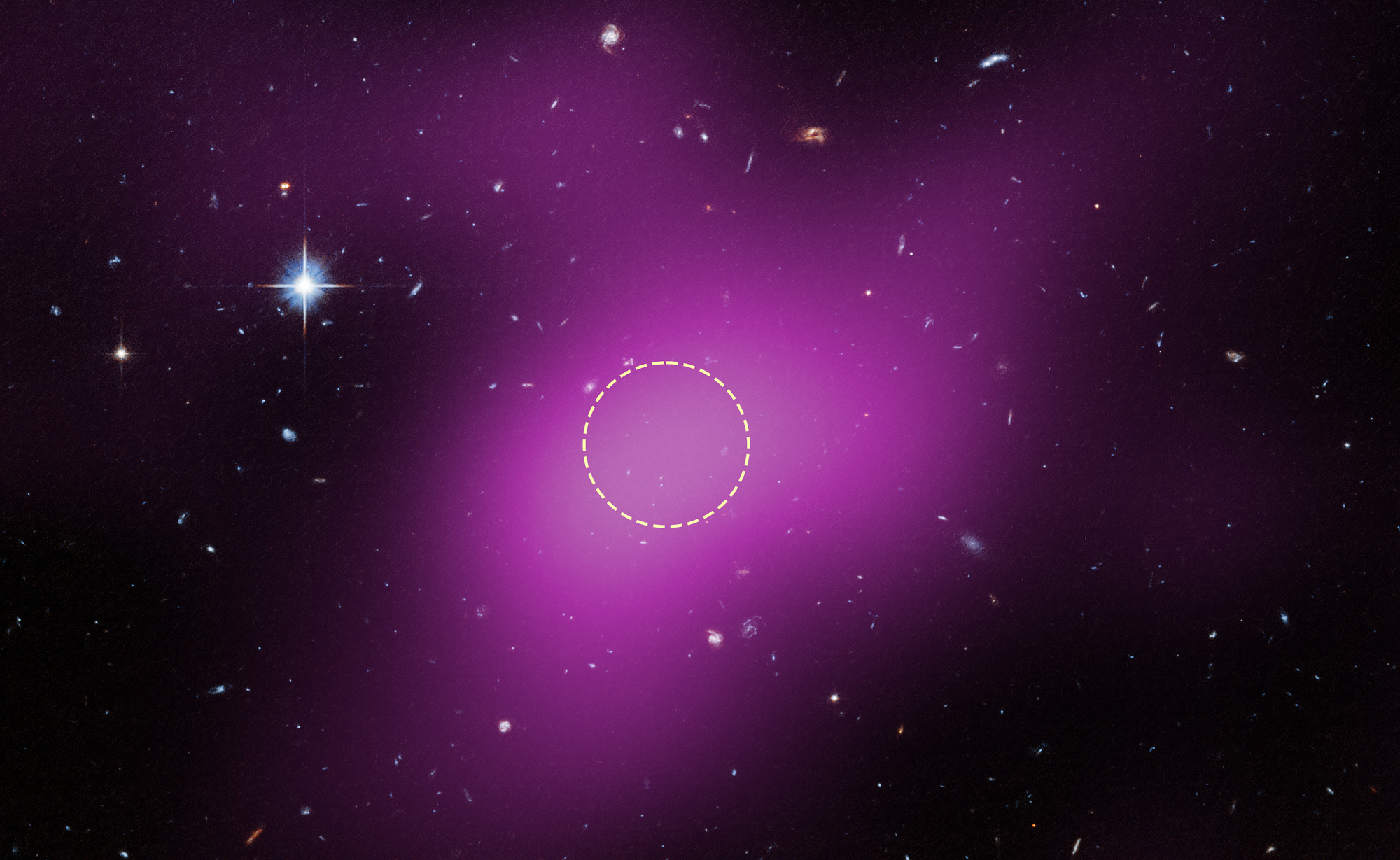
Editor’s Note: This week we’re at the 247th AAS meeting in Phoenix, AZ. Along with a team of authors from Astrobites, we will be writing updates on selected events at the meeting and posting each day. Follow along here or at astrobites.com for daily summaries, or follow @astrobites.bsky.social on Bluesky for more coverage. The usual posting schedule for AAS Nova will resume on 12 January.
Table of Contents:
- Welcome Address, Dara Norman
- Fred Kavli Plenary Lecture: From Launch to Legacy: How OSIRIS-REx Changed Our Understanding of Asteroids, Daniella DellaGiustina (University of Arizona)
- Press Conference: Galaxies Big and Small
- 2025 Royal Astronomical Society Gold Medal in Astronomy Lecture: Understanding Galaxies, James Binney
- Press Conference: Stars and Their Behavior
- Plenary Lecture: The Brown Dwarf-Milky Way Connection: How Failed Stars Play a Unique Role in Galactic Archaeology, Adam Burgasser (University of California, San Diego)
- Plenary Lecture: A New Era of Planetary Astrophysics with JWST and High-Resolution Spectrographs, Björn Benneke (University of Montreal)
Welcome Address, Dara Norman (by Lindsey Gordon)
AAS President Dara Norman opened up this year’s winter AAS meeting in Phoenix, AZ, by acknowledging what a weird year it’s been in scientific funding and politics. She thanked the community for their work with the AAS policy office in pushing for action in Congress and with their representatives to advocate for science funding. President Norman led a land acknowledgement to the Akimel O’odham and the 22 Tribal Nations in Arizona. She then ceded the stage to John Davis for a performance of two songs from local Indigenous cultures, followed by a video message from US senator and former astronaut Mark Kelly.
Fred Kavli Plenary Lecture: From Launch to Legacy: How OSIRIS-REx Changed Our Understanding of Asteroids, Daniella DellaGiustina (University of Arizona) (by Lindsey Gordon)
Dr. DellaGiustina gave the Fred Kavli Plenary Lecture for her work on groundbreaking insights into the origins of Earth and other bodies as part of the OSIRIS-REx team. OSIRIS-REx was the first US mission to collect and return a sample from an asteroid — Bennu — and has become the OSIRIS-APEX mission, traveling to the asteroid Apophis.
This sample mission was incredibly significant because of the gap in our understanding of asteroids between telescope observations, like those from the Hubble Space Telescope, and meteorites that have gone through Earth’s atmosphere. Understanding the nature of asteroids in space is essential for understanding their formation, the early solar system, and the formation of planets including Earth. The OSIRIS-REx mission went to observe Bennu, a nearby carbon-rich asteroid, taking observations of it up close and then retrieving a sample that could be returned to Earth without contamination by that pesky Earth atmosphere.
The team was in for a surprise when the mission arrived at Bennu, which did not look like what they had expected based on their existing data. They had designed the sample retrieval expecting centimeter-scale dust grains, and instead found a much larger, rugged rocky object. In 2019, Bennu also began ejecting material from its surface, a kind of active geology no one had expected or seen on such a small asteroid before. In 2020, they found a spot in this “rubble pile” of an asteroid that they could take a sample from, and in 2023 the mission returned with 121.6 grams of material, more than twice the amount the mission had defined as a successful retrieval.
After a very careful contamination control protocol to make sure the sample stayed clean, they began analysis and the results are still forthcoming today. They found indications of rock–water interactions and an origin beyond the major snow lines of the disk. The material contains lots of pre-solar dust, with a factor of six enrichment of carbon not seen in meteorites. They found that the presence of melting ice can enable abiotic organic molecule synthesis, and a bias of left-handed chirality that suggests it might be a general property of molecules and not just a unique feature of Earth. Just this year they published their findings of ribose, a molecule used in RNA, and the first-ever discovery of glucose. They know their sample control was strong, and that these molecules aren’t just contaminants from being on Earth. This suggests that complex chemistry doesn’t require full planets or massive oceans, and molecules could have started forming in the very early solar system.
Up next: Apophis, an asteroid infamous for previously having been predicted to have an Earth-impact trajectory. We know now it’s not going to hit us in the next 100 years at least, but it is going to get super close to us (10 times closer than the Moon!), and it’s not clear what that interaction will cause for the asteroid. OSIRIS-APEX will study the asteroid after its close approach and then use its thrusters to stir up the asteroid’s surface, allowing the team to study the sub-layers of the asteroid.
You can also check out our interview with Dr. DellaGiustina here.
Press Conference: Galaxies Big and Small (Briefing video) (by Niloofar Sharei)
This press conference highlighted how galaxies evolve across a large range of scales, from the resolved stellar populations of a nearby starburst, to rare galaxy morphologies mapped in huge surveys, to galaxies that shut down star formation early, and even a “failed galaxy” that never managed to form stars.
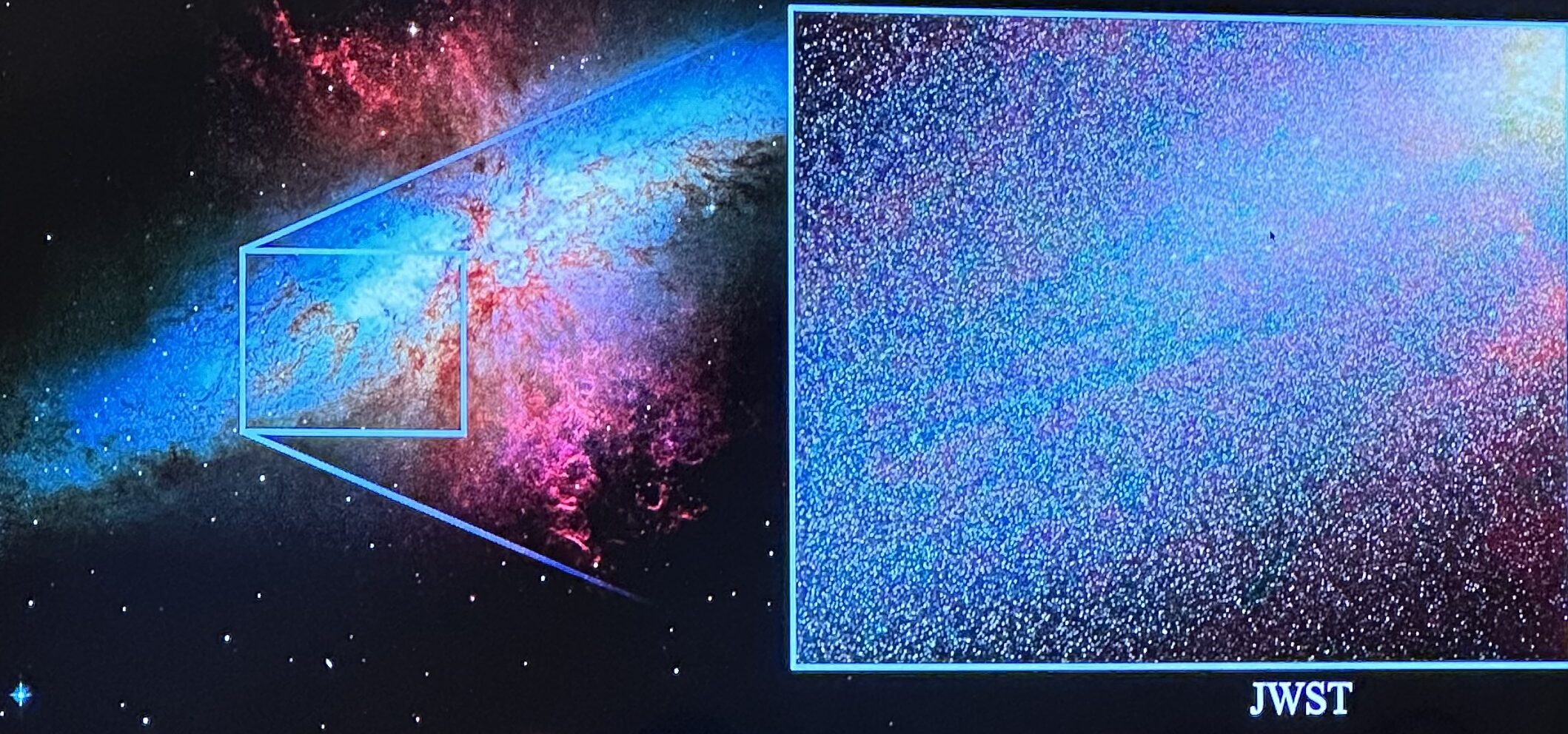
JWST image of the starburst galaxy M82 demonstrating how infrared observations pierce the dusty, crowded disk and resolve individual stars across the galaxy. [Adam Smercina / JWST]
Adam Smercina (STScI) presented a new JWST imaging survey of the nearby starburst galaxy Messier 82 (M82). M82 is forming stars at roughly 10 times the Milky Way’s total rate, but heavy dust has long made it difficult to reconstruct its detailed star formation history. With JWST’s sensitivity and resolution, the team can now resolve individual stars across the system, including about 16.5 million stars across the face of M82, enabling a much more direct, population-by-population view of when and where stars formed during the starburst.
Revealing Polar-Structure Galaxies Across Cosmic Time with DESI and Euclid
Jacob Guerrette (Brigham Young University) described “polar structure galaxies,” systems with rings, disks, or other stellar and gaseous structures oriented roughly perpendicular to the main galaxy body. Because these orthogonal structures likely arise from environmental events like mergers or accretion, building large samples is key to learning how often these interactions happen and what they do to galaxies. Earlier catalogs contained only a few hundred objects (about 150 identified in 1990, then a few hundred more in later Sloan-based work), but combining modern wide surveys produces an order-of-magnitude jump. The new DESI-based catalog and early Euclid imaging suggest that the full Euclid survey could yield thousands of strong candidates, including rarer subtypes that were previously underrepresented.
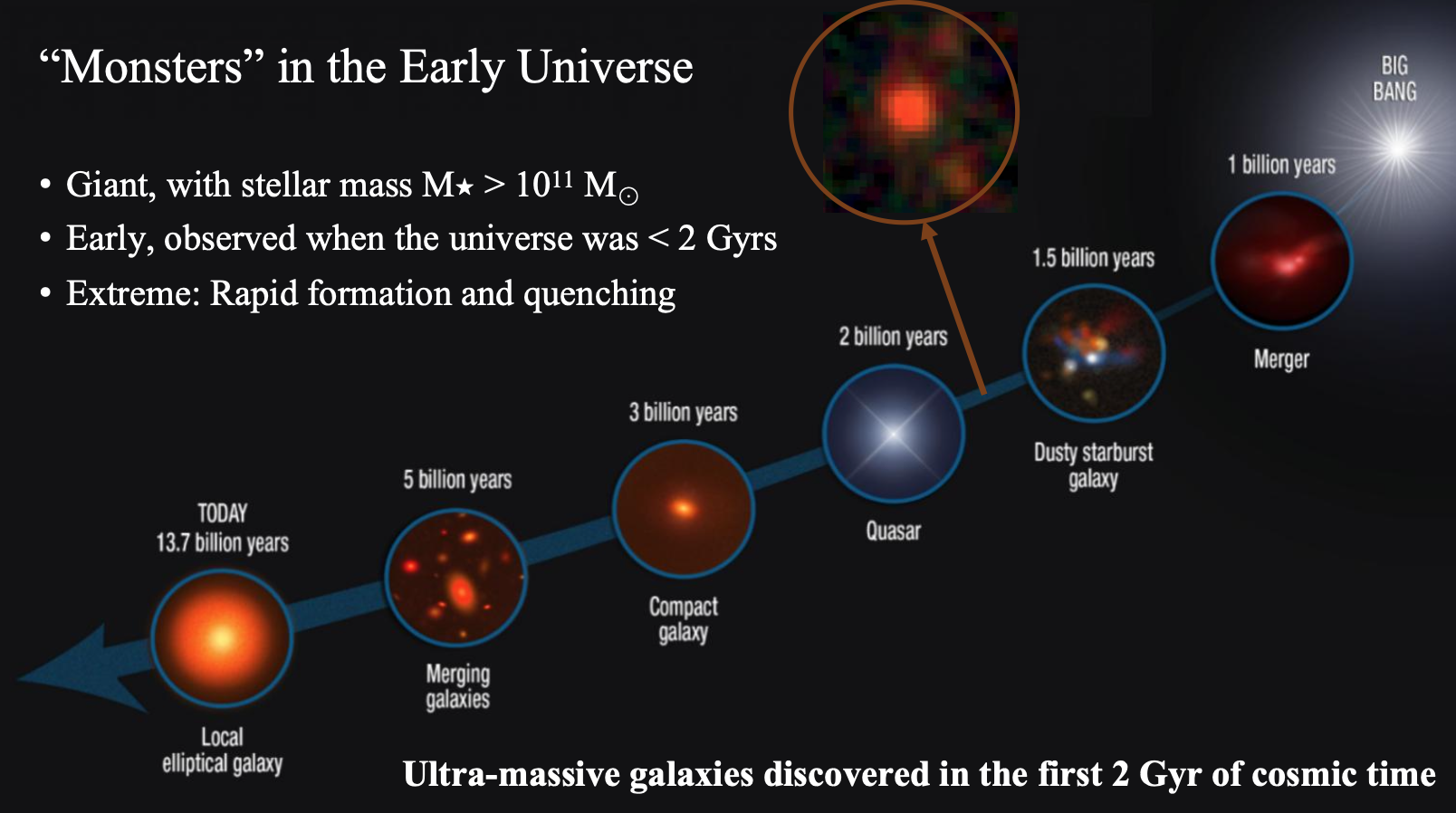
Slide illustrating ultra-massive (“monster”) galaxies in the early universe, with stellar masses exceeding 1011solar masses and rapid formation and quenching within the first 2 billion years of cosmic time. Click to enlarge. [Wenjun Chang]
Wenjun Chang (UC Riverside) presented results from the MAGAZ3NE survey, which uses more than 30 nights of Keck/MOSFIRE spectroscopy, plus far-infrared and radio data from ALMA and the Very Large Array to study the most massive galaxies at redshifts around z ≈ 3 to 4. A central goal is to clarify whether these systems are genuinely “dead” or simply dusty and star-forming. The multi-wavelength view shows a diverse set of evolutionary states at a fixed epoch: while many ultramassive galaxies are truly quiescent, others show residual dust emission or signs of obscured star formation, and some are in intermediate phases of shutting down. You can find the related press releases here and here.
The First RELHIC? Cloud-9 Is a Starless Gas Cloud
Rachael Beaton (STScI) discussed “Cloud-9,” a compact neutral hydrogen cloud that appears to be a convincing example of a galaxy that never formed a normal stellar population. Cloud-9 was first identified in a FAST radio telescope survey as a reionization-limited H I cloud, and follow-up searches in the DESI imaging survey found no associated stellar system. Subsequent observations with the Green Bank Telescope confirmed the H I detection. Radio observations reveal roughly a million solar masses of hydrogen, consistent with a dark matter halo of order 100 million solar masses, but deep follow-up with the Hubble Space Telescope (8 orbits) reveals at most a single candidate star, allowing the team to rule out any stellar population more massive than about 103.5 solar masses. Despite being near thermal equilibrium with the universe and massive enough that it should have formed stars, Cloud-9 appears to have remained starless. This makes it the most convincing observational example to date of a “failed galaxy” predicted by ΛCDM, a halo that acquired gas but never converted it into stars. You can find the press release here.
2025 Royal Astronomical Society Gold Medal in Astronomy Lecture: Understanding Galaxies, James Binney (by Bill Smith)
James Binney’s lecture focused on methods for turning the flood of stellar measurements into a physical understanding of how galaxies work. “We are drowning in amazing data,” Binney opened. With Gaia delivering astrometry for more than a billion stars (and radial velocities for a substantial fraction), complemented by MUSE integral-field spectroscopy, ground-based surveys like RAVE and APOGEE, and missions like Kepler, Binney argues the question is no longer how to get data, it’s how to synthesize that data into models that reveal how galaxies are structured and how they came to be that way. A central point of his plenary address was the relationship between galaxy structures and galactic history, about which he said that “discussion of history is pointless until structure has been established.”
One of his core methodological messages was that modern dynamical modeling must live in phase space (x, v), not just real space. While galaxies are not strictly in equilibrium, Binney emphasized that they are near equilibrium, a crucial simplification that lets us use equilibrium models as scaffolding and then study departures by perturbing them. The goal for understanding galaxies, he said, is to synthesize the data into a self-consistent “chemo-dynamical” model in which orbits (dynamics) are labeled and weighted in concert with stellar ages and abundances (chemistry), and then gently perturbed to interpret disequilibria from bars, spirals, accretion, and galactic mergers. Binney reviewed why some familiar tools struggle in the data-rich era. N-body simulations, though powerful, he argued, are specified by uncertain initial conditions, are difficult to steer toward specific observational constraints, can be expensive to run, and often hide the “why” behind emergent structure.
Binney then advocated a methodology based on actions and angles using torus machinery, in which one computes orbital actions, which can be thought of as embeddable constants of motion, and uses them to label orbits in a way that’s physically meaningful and robust to slow evolution. To do this, however, requires using the Hamilton–Jacobi equation, which is solvable only for a few potentials. Binney advocated using torus generators, fast “plug-in replacements” that return positions and velocities for a given set of inputs, and argued that they should largely replace brute-force integration. One sticking point, however, is the inverse map (finding the action given x and v). For that, practitioners still rely on the “Stackel fudge,” a fast, approximate method Binney dubbed “cheap and cheerful.”
He then turned to what the Milky Way’s actions reveal about its formation. The local stellar sample shows that essentially all stars co-rotate with the disk. Binney stressed that more than 99% of the stars we see were born in the rotating disk from gas already moving in the same direction, consistent with a formation scenario dominated by quiescent gas accretion rather than mergers. This is a cautionary note for merger-driven narratives: in the Milky Way, at least, the bulk stellar population does not look like a debris field.
Binney’s prescription for the next decade is to build chemo-dynamical models that synthesize data into a coherent distribution function for stars and dark matter, include quiescent gas accretion and mergers as perturbations rather than starting points, and use torus-based perturbation theory to interpret disequilibria. Do this, and we will not only map structure, we will have a firm foundation for credible histories of how galaxies, including our own, were made.
You can read Astrobites’s interview with James Binney here.
Press Conference: Stars and Their Behavior (Briefing video) (by Neev Shah)
Discovery of the Wake Caused by Siwarha — the Betelgeuse Companion
Betelguese, a red supergiant seen on the shoulder of the constellation Orion, is one of the brightest stars in the night sky. It also shows a variability in brightness over a timescale of about 6 years, called its long secondary period. Recently, a couple of papers proposed that the best explanation for its long secondary period is that Betelguese has a buddy, a faint companion orbiting it. Andrea Dupree (Center for Astrophysics | Harvard & Smithsonian) and collaborators presented one of the first observations that suggest that they have found evidence for a companion, Siwarha. They utilized optical and chromospheric spectra from ground based telescopes as well as the Hubble Space Telescope. They observed changes in the spectra that are characteristic of a ”wake” left by a companion within the atmosphere of Betelguese, similar to how a boat moving through water leaves a wake behind it. These observations suggest that Betelguese indeed might have a companion around it, and future observations will be crucial to confirm this discovery. Press releases: NASA; Center for Astrophysics | Harvard & Smithsonian
A Volume-Complete All-Sky Spectroscopic Census of More Than 2,100 Nearby K Dwarfs: Insights from the RKSTAR Project
K dwarfs are some of the most common stars in the Milky Way, comprising approximately 11% of all stars in the solar neighborhood. They also have long life times, which makes them an excellent tracer of abundances and star formation history in a stellar population. However, they are often neglected in exoplanet studies, and we do not know much about their intrinsic population. To mitigate this, Sebastian Carrazco-Gaxiola, a graduate student at Georgia State University, and collaborators started the RKSTAR project. They created a volume-complete sample of over 2,100 K dwarfs within 40 parsecs of the Sun. They also used several spectrographs to obtain high resolution spectra for these stars, which can be used to estimate their ages. Combining this information with Gaia astrometry, they have found that many K dwarfs are young, active and some of them are also part of young moving associations. This provides the first such complete catalog of nearby K dwarfs that will be extremely useful to study their properties and will aid in future studies exploring the habitability of exoplanets around these stars.
A Previously Unknown Binary Star System in the Eagle Nebula
Steven Cromwell and Tyler Peters, undergraduate students at San Diego State University, had just started working on a research project through the STARTastro program. Their aim was to try finding exoplanets around eclipsing binary systems. As part of this program, they were learning how to code and access public astronomical data for the first time. They started with analyzing some test data in the Eagle Nebula, home to the famous Pillars of Creation. During this, they found that one of the stars had a TESS light curve that showed periodic brightness variations, a key indicator for the system being an eclipsing binary in a ~3.5-day orbit. Interestingly, as they searched through public catalogs, they found that this star had never been categorized as a binary — they had discovered a new eclipsing binary system! Such systems are extremely useful as they provide direct measurements of the masses and radii of the stars, which can be used to calibrate stellar evolution models and to help estimate the age of the Eagle Nebula. They also highlighted that their serendipitous discovery was done using data and tools that are openly accessible to everyone, demonstrating the benefit of having such resources available to the community.
Compact Objects and the Physics of Accretion Survey (COPAS)
White dwarfs are often found to be accreting matter from companions in binary systems. The accretion processes can lead to outbursts as matter builds up in a disk around them. Such systems are called cataclysmic variables (CV) if the donor star is on the main sequence, and are called AM CVn if the donor star is also a white dwarf or a helium star. TESS, a satellite built to search for exoplanets, has a cadence of just 2 minutes, which is extremely useful in identifying systems that show outbursts. Wendy Mendoza, a graduate student at the University of Texas Rio Grande Valley, and collaborators utilized transient alerts from the Zwicky Transient Facility, Gaia, and data from thousands of TESS light curves to identify CV and AM CVn systems. They found several new systems and obtained a better characterization for the known ones. In the future, they plan to expand their analysis to the rest of the vast TESS data set and conduct follow up observations of their candidates to better characterize them. They also highlight the benefit of TESS in overcoming gaps in data, which prevents misclassification and provides a unique opportunity to study outbursts in accreting white dwarfs.
Witnessing Giant Planet Formation in the Act
Disks are a natural product of the process of star formation, and are also the sites where planets form. Such disks, when viewed edge on, provide a direct view of the radial and vertical distribution of gas and dust within it. Charles Law, a NASA Sagan Fellow at the University of Virginia used ALMA to study such an edge-on system, called Gomez’s Hamburger (GoHam), due to its hamburger-like shape. GoHam is also one of the most massive disks that we know of, and has enough material to form a multi-planetary system in the future. With the help of ALMA’s extremely high resolution, they were able to set unique constraints on the size of the dust grains, and also measure the distribution of various molecules such as CO and CS. Interestingly, they also detected emission from the molecule SO on just one side of the disk. When matter in a disk collapses, it increases in temperature and density, which can change the disk chemistry, and also increase the abundance of SO, which is exactly what they find. This hints that they have found evidence for a fragment in the disk, called GoHam b. This discovery provides the first evidence for one of the earliest stages of giant planet formation. The full press release can be found here.
Plenary Lecture: The Brown Dwarf–Milky Way Connection: How Failed Stars Play a Unique Role in Galactic Archaeology, Adam Burgasser (University of California, San Diego) (by Niloofar Sharei)
Adam Burgasser’s plenary talk focused on how brown dwarfs, objects too low in mass to sustain hydrogen fusion, can be used as powerful tracers of the Milky Way’s formation history. The big idea is that, while many classic stellar tracers tangle age and metallicity in ways that are hard to disentangle, brown dwarfs give a cleaner “evolutionary clock.”
Brown dwarfs are born hot and then cool continuously over time. Their luminosities, temperatures, and spectra change in predictable ways, so their observed properties carry direct information about age. Because they are fully convective and never undergo sustained fusion, their atmospheres retain the chemical composition of the gas from which they formed, making them valuable “chemical clocks” as well as age tracers.
Burgasser also emphasized that brown dwarfs are extremely common. Roughly one in every five objects in the Milky Way is a brown dwarf. Their wide mass range also makes them sensitive probes of dynamical processes that depend on mass, making them have a different perspective on galactic evolution than higher mass stars alone.
The main challenge, historically, has been that brown dwarfs are faint, especially for “ancient” populations far from the Galactic disk. Burgasser showed how this is now being overcome by three approaches. First, local populations can be isolated using kinematics, like proper motion cuts, with major contributions from citizen science projects such as Backyard Worlds. Second, deep surveys with JWST are pushing brown dwarf detections out to kiloparsec scales, sometimes revealing brown dwarfs misidentified at first as high-redshift galaxies. Third, globular clusters provide clean, single-age environments where the cooling of brown dwarfs can be used to constrain cluster ages and test evolutionary models.
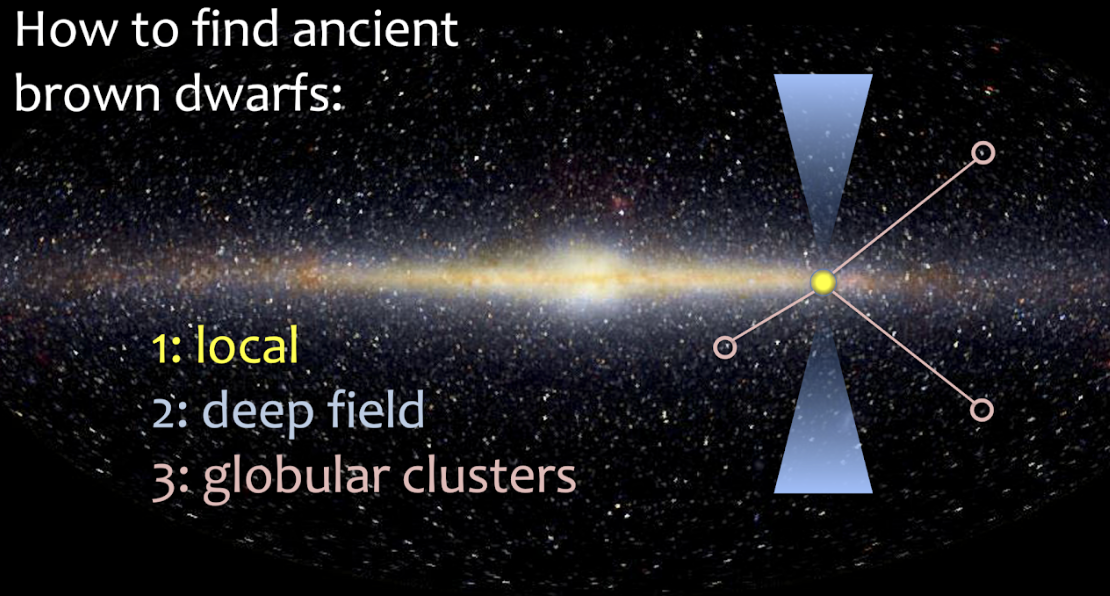
Three complementary approaches to identifying ancient brown dwarfs in the Milky Way: nearby local samples selected by kinematics, deep-field observations that probe distant populations, and brown dwarfs in old globular clusters. [Adam Burgasser, Cool Star Lab]
You can also check out our interview with Dr. Burgasser here.
Plenary Lecture: A New Era of Planetary Astrophysics with JWST and High-Resolution Spectrographs, Björn Benneke (University of Montreal) (by Lindsey Gordon)
Dr. Benneke’s plenary covered his work on big questions in the field of exoplanet physics and chemistry. He focused on three major questions in the field.
The first is the elemental abundances in giant planets and how they may differ from system to system. There are three big building blocks of element types: gases (H, He), refractories (Fe, Mg, Si, Ni), and ice forming / volatiles (C, O, N). Understanding the ratios of these different groups is essential for understanding the formation and evolution of the planet.
For giant planets in our own solar system, these measurements are quite hard to do. Jupiter only has 8–9 elements measured, and Uranus and Neptune are even worse because they’re colder. But with exoplanets, we have a much larger population to pick from and the ability to observe from a distance. It’s actually easier to study elemental composition when you can see the planet in the context of the light of its star through spectroscopy. His team works with JWST spectra of hot gas giants to estimate the chemical abundances in the planets, allowing them to begin to sequence and classify the planets by their abundances.
The second is understanding sub-Neptune worlds, and the ratio of the three building blocks of element types within them. We can measure the mass and the radius, but there’s a lot of degeneracy as to how that mass is split up. By using JWST to measure the atmospheres of these planets, you can get an estimate of the metallicity of the atmosphere. They found that the atmospheres were mixed gas envelopes, not stratified or layered models as many people predicted. A paper in 2015 (Soubiran & Militzer) actually predicted this, but the result went largely unnoticed until these measurements. The team also found that there’s not a clear temperature dependence for the presence of clouds in the atmospheres. Seemingly similar planets in terms of mass and radius, but with different temperatures, don’t have a clear scaling law as to how cloudy they are. This could be due to the different chemical compositions or their formation locations in their systems, and this result needs more follow-up observations and theoretical models.
Finally, he discussed the atmospheres of rocky planets. More specifically: whether or not they have them. You need a really big ratio of star to planet size to be able to see a very compact, CO2-based atmosphere, which means we need planets around very tiny stars. The TRAPPIST-1 system is a great example of this, and JWST has studied many of the planets in this system in detail. A study of TRAPPIST-1d — likely in the habitable zone — found no evidence for a compact CO2-based atmosphere or larger hydrogen-based atmosphere, but if there had been one they would have found it. This rules out an atmosphere similar to that of Venus, Mars, or Earth for this planet. More studies of similar targets are underway in the JWST Rocky Worlds program to get data on eclipses of favorable targets to study their atmospheres.