
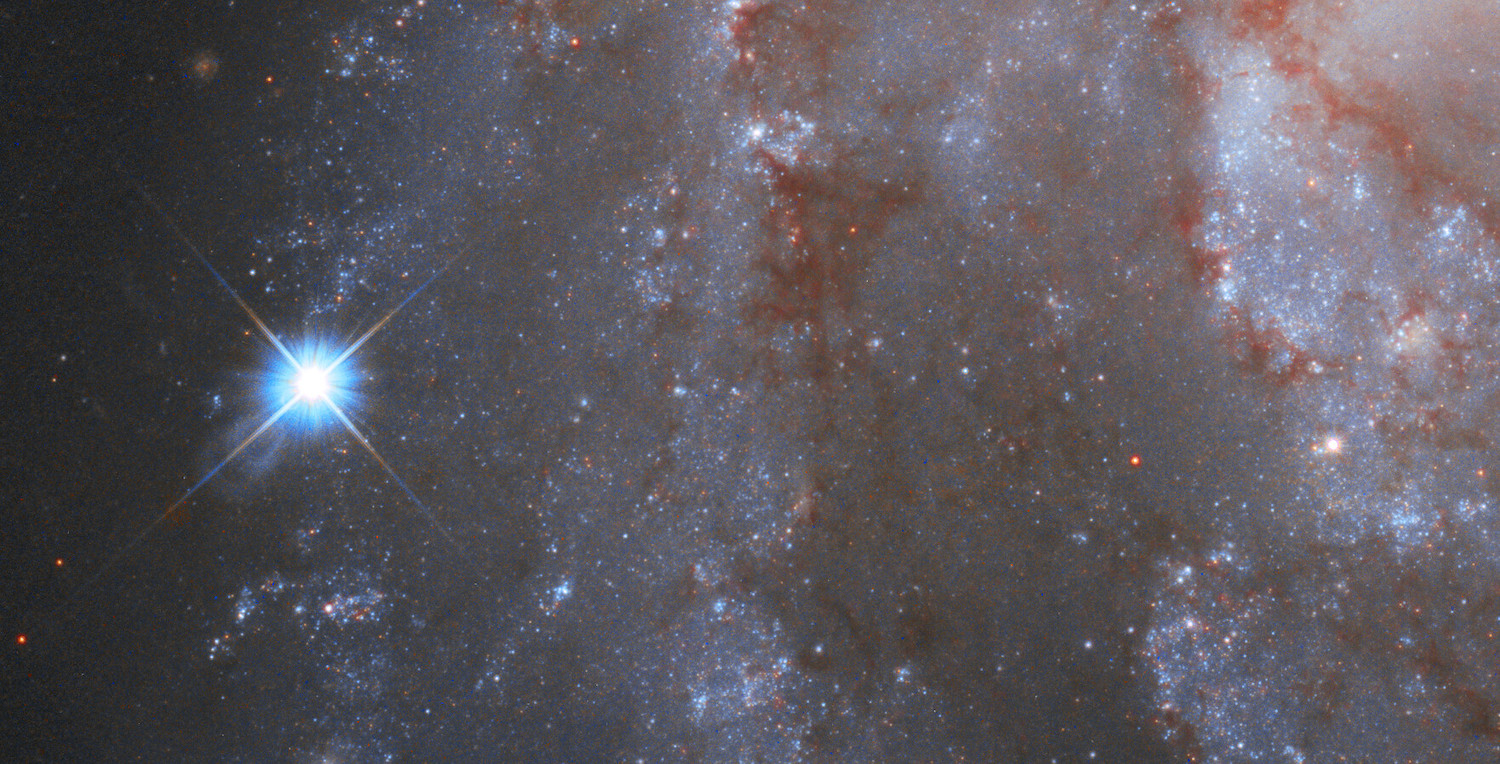
Editor’s Note: Astrobites is a graduate-student-run organization that digests astrophysical literature for undergraduate students. As part of the partnership between the AAS and astrobites, we occasionally repost astrobites content here at AAS Nova. We hope you enjoy this post from astrobites; the original can be viewed at astrobites.org.
Title: Supernova-Induced Binary-Interaction-Powered Supernovae: A Model for SN2022jli
Authors: Ryosuke Hirai (平井遼介) et al.
First Author’s Institution: RIKEN Pioneering Research Institute, Monash University, OzGrav: The ARC Centre of Excellence for Gravitational Wave Discovery
Status: Published in ApJ
There are thousands of dying stars that go bang in the night. These explosions are known as supernovae, and they are classified primarily on what spectral lines they show in the days and weeks following their initial explosion. Most broadly, they are separated into Type I (spectra that show little or no evidence of hydrogen) and Type II (spectra that show hydrogen). The physics leading to each type of supernova is different, and astronomers use all of the information at their disposal to learn about these cosmic fireworks.
One of the most useful tools for monitoring and learning about a supernovae is its light curve — the plot of the explosion’s brightness over time. This light curve usually appears as a steep incline up to a peak in brightness several days after the initial detonation, and then a shallow decline in brightness over the following weeks. There are, however, a few examples of supernovae that break this mould.
Today’s article seeks to understand the curious case of supernova SN2022jli. Unlike the typical gradual fade in brightness, the light curve of this supernova shows a periodic bump of brightness every 12.5 days (see Figure 1). The proposed mechanisms to explain this include the blown-apart supernova material interacting with concentric and regularly spaced shells of circumstellar matter, or a binary companion that interacts with the supernova remnant each orbital period. The authors of today’s article investigate the latter scenario by running 3D hydrodynamical simulations of an interacting, post-supernova binary to try to recover SN2022jli’s periodic light curve and constrain the orbital characteristics of the system.
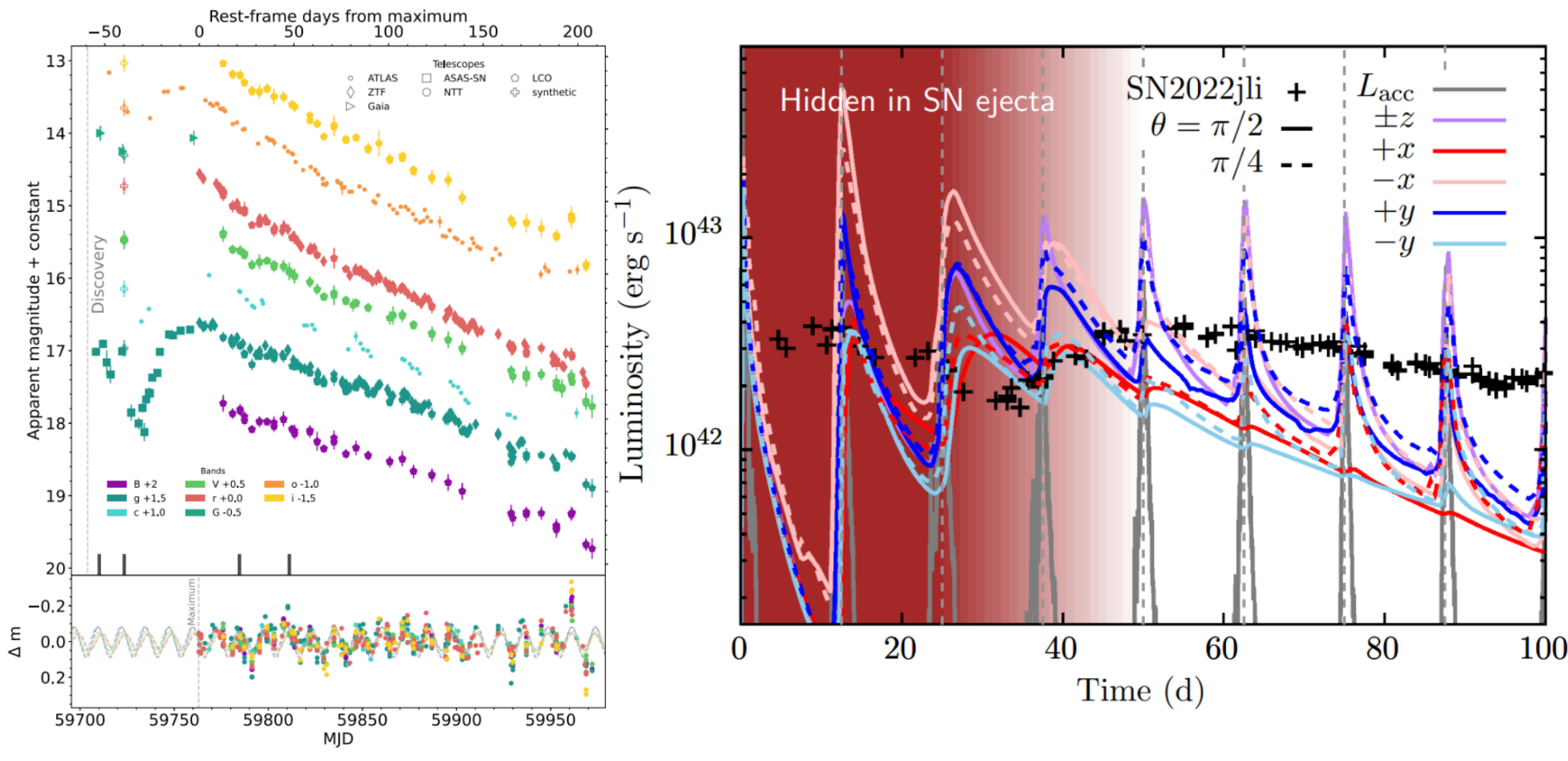
Figure 1: The light curve of SN2022jli shows periodic oscillations in the brightness, superimposed on top of the typical fading luminosity of a supernova. The left plot shows the light curve across various colours, and the associated bottom panel shows the oscillations with the typical fading supernova signal subtracted. The right plot shows the light curve of the authors’ proposed mechanism, where the different coloured lines are for different viewing angles on the system at the heart of the supernova. [Moore et al 2023 (left) and Hirai et al. 2025 (right)]
Why a neutron star? SN2022jli is a sub-class of Type I supernovae involving a “stripped” massive star which has lost its hydrogen — most likely through interactions with a close companion. These interactions typically circularise the pre-supernova orbit, and the subsequent explosion most commonly yields neutron stars. To explain the necessarily highly eccentric post-supernova orbit that may cause the periodic oscillation in SN2022jli, there was most likely a “natal kick” — a sudden and asymmetric burst during the supernova that rockets the neutron star in a random direction — which widened the orbit and de-circularised it, giving further evidence for a neutron star remnant.
Immediately following the supernova explosion, ejecta interacting with the main-sequence companion star would heat the star and cause it to swell up. This inflated companion then feeds matter to the orbiting dense neutron star, and the accretion is most intense when the stars are closest in their orbit (called the periastron). During accretion, however, mass is not perfectly absorbed onto the neutron star, and there is some feedback onto the surrounding gas due to the complex thermal and magnetic physics around the neutron star. In this study, the authors model cases where there is no feedback, feedback from thermal radiation due to accretion, or feedback from bipolar outflows via jets or disk winds. Snapshots from the simulation involving a 5-solar-mass companion on an orbit with eccentricity of 0.5 and bipolar feedback is shown in Figure 2.
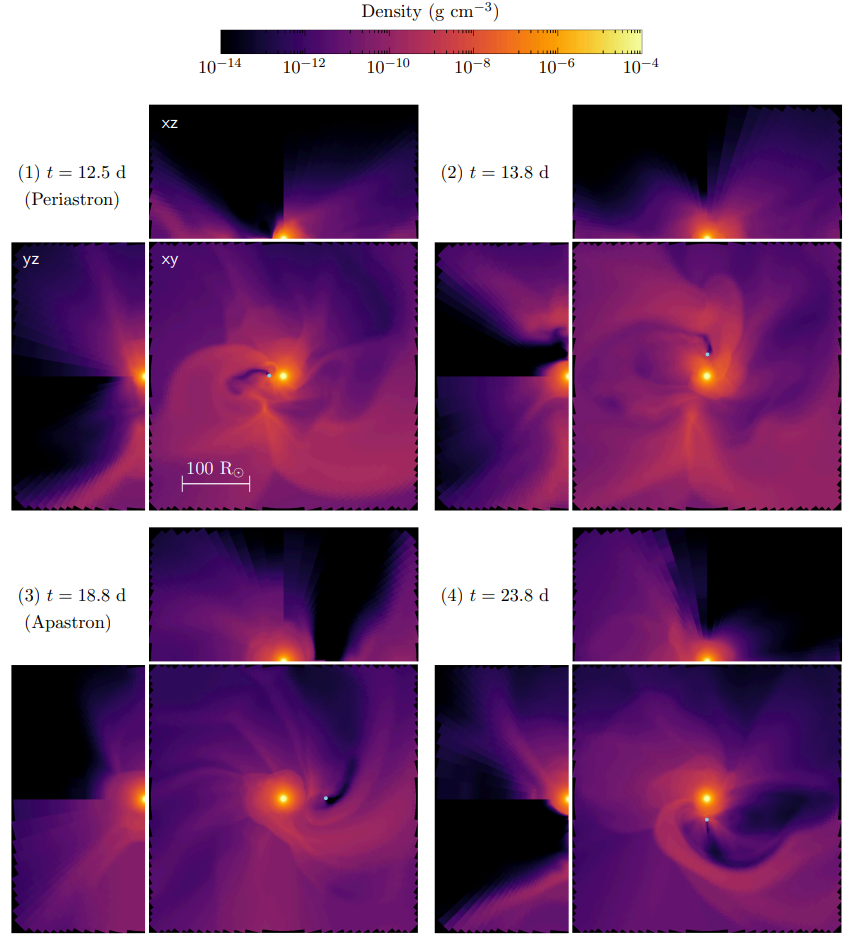
Figure 2: Several density snapshots of the 3D hydrodynamic simulations show how the neutron star (blue point) in the binary accretes and sculpts matter from the inflated main-sequence companion star (bright diffuse blob in the centre of each panel). The xy panels are a top-down look onto the orbital plane, while the xz and yz panels show a cross section through the plane. [Hirai et al. 2025]
SN2022jli is just one of an emerging class of oscillatory supernovae, with more and more being discovered with highly sensitive modern all-sky surveys. Today’s authors rigorously modelled one proposed scenario to explain this periodic oscillation in brightness and showed that it is viable. More modelling using this interacting-binary mechanism on other oscillating supernova light curves — those with longer periods and different supernova classifications — will show whether this explanation is ubiquitous, or if the population of dancing supernova light curves is due to some other process!
Original astrobite edited by Anavi Uppal.
About the author, Ryan White:
I am a masters student at Macquarie University in Australia, working mainly on binary/multiple systems with massive stars (Wolf–Rayets in particular!). Outside of study, I’m a novice film buff, baking sourdough all the time, probably drinking coffee, and trying to get more into reading and frisbee/squash. You can also find me procrastinating on Bluesky @astroryan.bsky.social.