
Editor’s Note: Astrobites is a graduate-student-run organization that digests astrophysical literature for undergraduate students. As part of the partnership between the AAS and astrobites, we occasionally repost astrobites content here at AAS Nova. We hope you enjoy this post from astrobites; the original can be viewed at astrobites.org.
Title: A Glimpse of the New Redshift Frontier Through Abell S1063
Authors: Vasily Kokorev et al.
First Author’s Institution: The University of Texas at Austin
Status: Published in ApJL
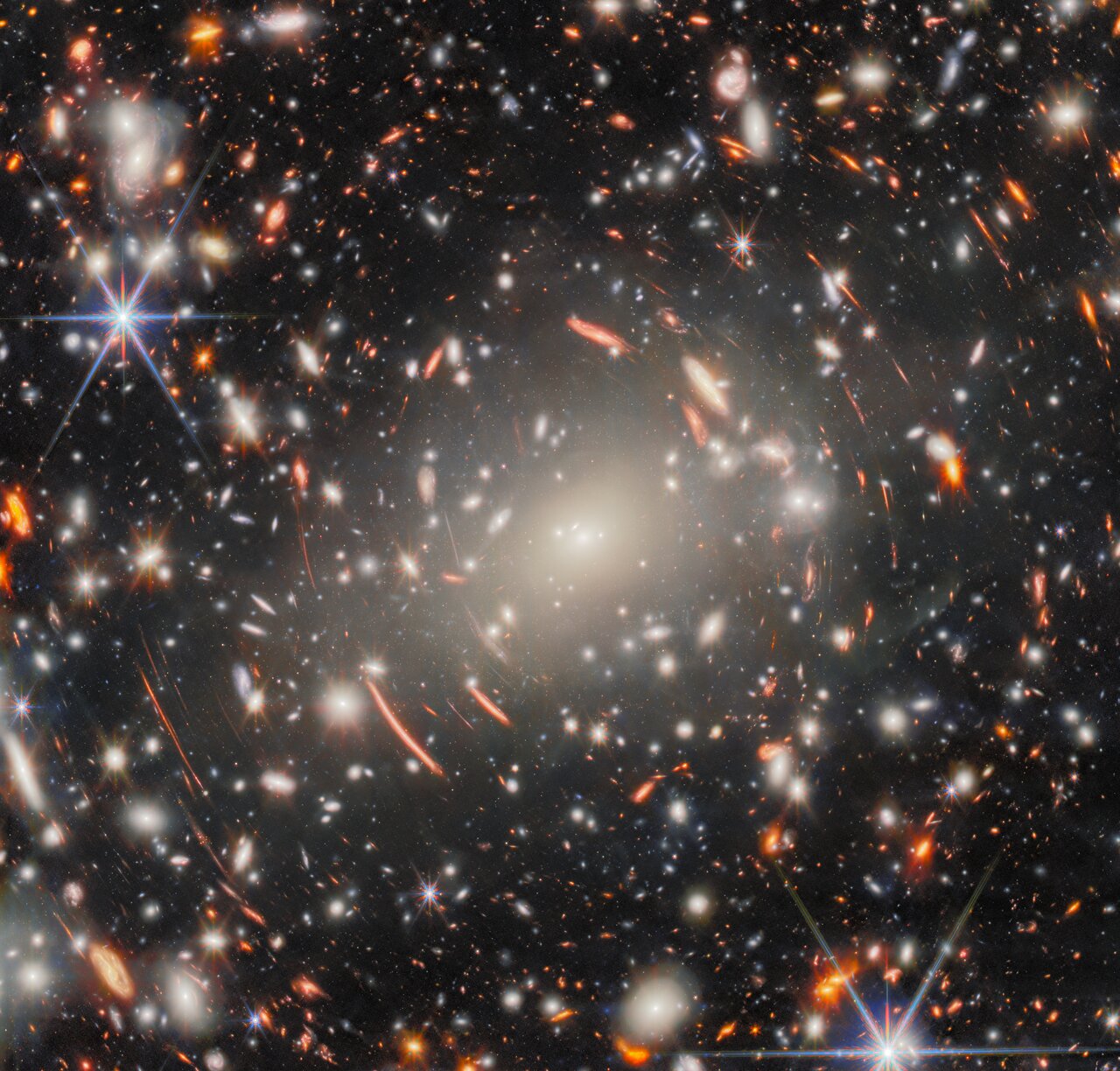
JWST has opened up a new era of early universe astronomy. Of particular interest is the hunt for the first galaxies, which are thought to have formed just a couple hundred million years after the Big Bang. But finding these early galaxies has proved to be somewhat of a challenge. While there have been many bright galaxies discovered by JWST at a redshift (z) greater than 10, no galaxies at z > 15 have been confirmed to date. Today’s article goes hunting for these very high-redshift galaxies in the GLIMPSE field, which is home to the strong lensing cluster Abell S1063, shown in Figure 1.

Figure 1: JWST image of the field used for this study. [Kokorev et al. 2025]
Step 1: Cut Galaxies by Color
Cutting galaxies by color involves finding the Lyman break. High-energy light is absorbed by neutral hydrogen in the galaxy and in the space between the galaxy and us. Thus, when you look at a galaxy’s spectral energy distribution, there is a drop-off at short wavelengths called a “break.” For distant galaxies, the location of this drop-off gets redshifted, allowing for an estimation of a galaxy’s distance. By comparing how bright sources are between two filters that are adjacent in wavelength, we can look for steep drop-offs that are caused by the Lyman break. Figure 2 shows a color–color plot (showing the difference in brightness between different filters), where the dashed line shows the region galaxies must be in to be considered Lyman-break galaxies at these high redshifts. In the whole field, the authors detect 38 objects in this region.
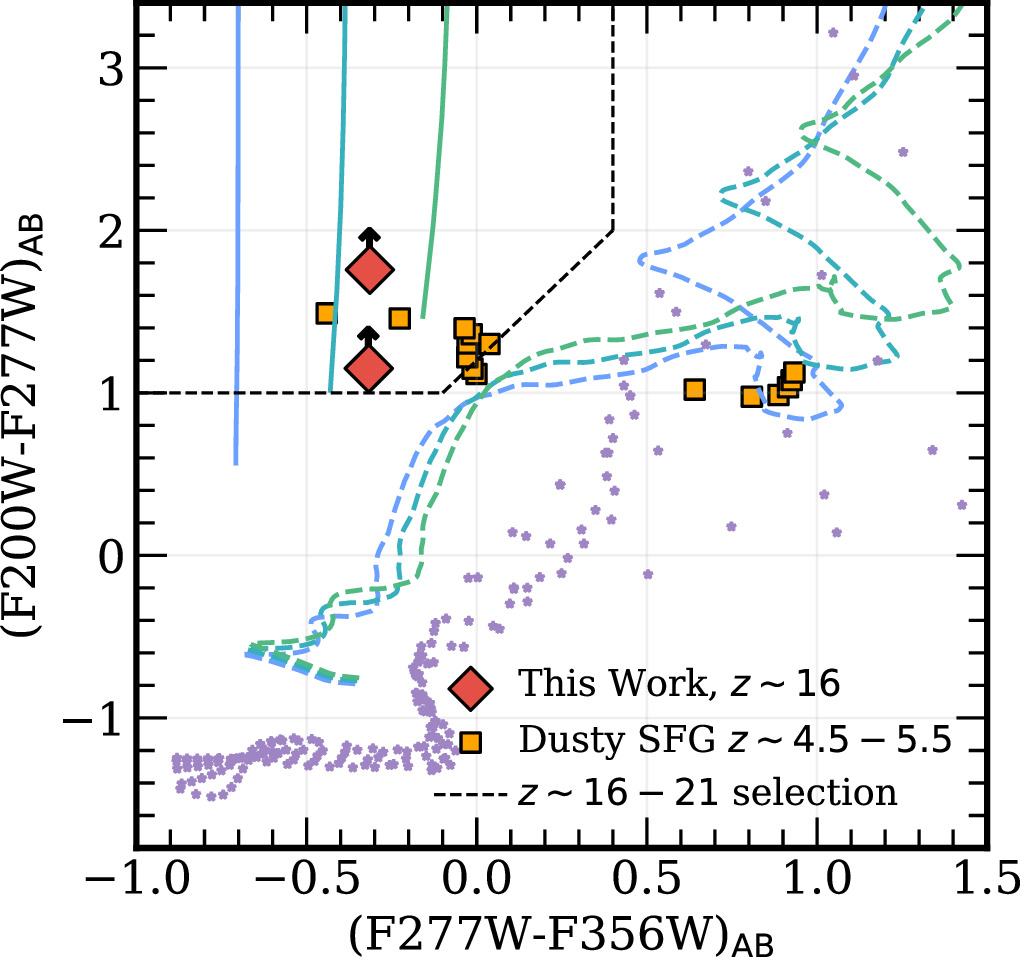
Figure 2: Color–color plot showing the selection criteria for high-redshift galaxies due to Lyman break. The upper-left region enclosed by the black dashed line represents the region that satisfies the high-redshift criteria. The various lines show properties of different populations. Solid are potential tracks for starburst galaxies at z = 16, dashed are lower-redshift quiescent galaxies, and dotted are cool stars and brown dwarfs, which can look like high-redshift galaxies in some situations. The two red diamonds show the final two high-redshift candidates in this work. [Kokorev et al. 2025]
Step 2: Calculate Redshift
However, this isn’t the end of the story. Color isn’t the only way to estimate distances to galaxies, as we can also use photometric fitting codes. These codes compare observations to templates of what we would expect galaxies to look like at different redshifts and see which templates fit best. This allows for an estimation of the redshift of each source identified in the field. All sources that the photometric fitting codes thought were at z > 16 were cross-referenced against the 38 color-identified objects, which narrowed the list to eight high-redshift candidates.
Step 3: Hunt for Imposters
But wait, there’s more! Both of these methods (looking at colors and calculating redshift photometrically) are susceptible to false positives. Lower-redshift galaxies, particularly star-forming dusty galaxies, can look just like high-redshift sources. This is apparent in Figure 2, where z ~ 4.5–5.5 dusty galaxies can also be found in the color-selected Lyman-break region. Thus, we need to explore the possibility that the sources might not be at high redshift at all. In this article, the authors do this by fitting their eight sources with a lower-redshift dusty starburst template, finding only five galaxies that match the high-redshift template better than the starburst template.
Step 4: Keep Significant Detections
The authors make one final cut to the last five sources, only keeping those that aren’t at the edges of the observation and thus have strong signals, where they can be confident we’re actually detecting something and it’s not just a hot pixel or noise. So, after all of that, they are left with only two z > 16 candidates in this field.
Figure 3 shows the images and spectral energy distributions of each of these candidates, given the wonderfully poetic names of 70467 and 72839. While there is still a lot to learn about these candidates, with the JWST data presented in this article we can uncover some things about the galaxy properties. Both sources appear to be compact, but still resolved, with effective radii of roughly 650 light-years. These observations can also tell us about the ultraviolet brightness of the two candidates, finding that they are most likely dominated by extended stellar emission, as opposed to active galactic nucleus activity. In general, these galaxy candidates are not very ultraviolet-bright, which is somewhat surprising, as JWST has found many bright galaxies at z ~ 12–14. However, it is not out of the question that galaxies at this slightly earlier epoch are just fainter than we expected, and then formed stars and increased in brightness relatively quickly.

Figure 3: Cutouts and spectral energy distributions for the two high-redshift candidates in this work. Squares show images in nine JWST filters, as well as an image of several filters combined, with a cutout width of 1.5″. Spectral energy distribution plots show different template galaxies for high-redshift (orange and red) and low-redshift dusty star-forming galaxy interlopers (blue and green). You can see how these sources are only strongly detected in a few filters, with many detections being just upper limits. [Kokorev et al. 2025]
Original astrobite edited by Bill Smith.
About the author, Skylar Grayson:
Skylar Grayson is an Astrophysics PhD Candidate and NSF Graduate Research Fellow at Arizona State University. Her primary research focuses on AGN feedback processes in cosmological simulations. She also works in astronomy education research, studying online learners in both undergraduate and free-choice environments. In her free time, Skylar keeps herself busy doing science communication on social media, playing drums and guitar, and crocheting!