

Giant Impacts Go Boom (Machine Learning Edition)
Astrobites reports on how machine learning can help researchers simulate the phase of planet formation in which planetary embryos interact, collide, and combine to form the planets we know and love.
What’s new with AT 2024wpp, GRB 250702B, and GW231123? Get updates on these three exceptional astrophysical transients in today’s Monthly Roundup.
Researchers search for a connection between short-lived black hole accretion events and neutrinos — elusive, neutral, nearly massless particles.
Astrobites reports on simulations that might help astronomers identify double-detonation supernovae early in their evolution.
How do giant low-surface-brightness galaxies form? New research investigates two galactic specimens to search for clues.
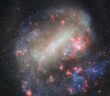
A satellite-rich dwarf galaxy poses a potential problem for current cosmological models.
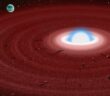
Investigating a Polluted White Dwarf
JWST spectra illuminate the composition of the debris disk around GD 362, one of the most polluted white dwarfs known.
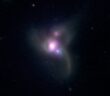
Astrobites reports on a cosmic drama in action: three active black holes, tangled jets, and fading light.
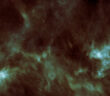
Astronomers search for a simple organic molecule in Lynds 1544, a cold, dense clump of gas that will one day become a star.