
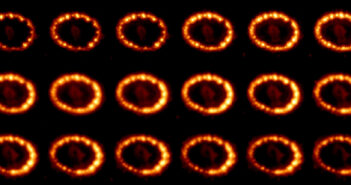
Featured Image: Evolution of a Supernova Ring
A ring of bright “hotspots” adorns the remnant of the supernova SN 1987A. Now, researchers have analyzed two decades of Hubble Space Telescope observations to track the evolution of this ring.
Did the disappearance of a star in the Andromeda Galaxy signal the creation of a black hole? New infrared and X-ray data help to discern what remained after the star disappeared.
Astrobites reports on how astronomers are using JWST to figure out if star clusters are really as old as they seem.

Researchers investigate whether the Milky Way’s smallest known satellite is a tiny dwarf galaxy or a star cluster.
What’s new with AT 2024wpp, GRB 250702B, and GW231123? Get updates on these three exceptional astrophysical transients in today’s Monthly Roundup.
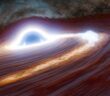
Researchers search for a connection between short-lived black hole accretion events and neutrinos — elusive, neutral, nearly massless particles.
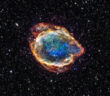
Astrobites reports on simulations that might help astronomers identify double-detonation supernovae early in their evolution.
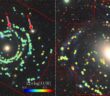
How do giant low-surface-brightness galaxies form? New research investigates two galactic specimens to search for clues.
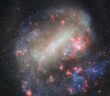
A satellite-rich dwarf galaxy poses a potential problem for current cosmological models.