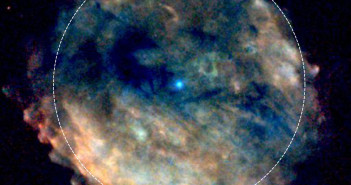
Featured Image: A Supernova Remnant in X-Rays
Chandra X-ray images of RCW 103 provide an updated picture of what’s happening in this puzzling supernova remnant.

Chandra X-ray images of RCW 103 provide an updated picture of what’s happening in this puzzling supernova remnant.
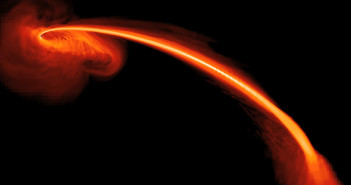
When an unfortunate star passes too close to a dormant supermassive black hole it gets torn apart by tidal forces, feeding the black hole for a short time. A recent study of the streams of stellar material in these events explains why we might be missing many of them.
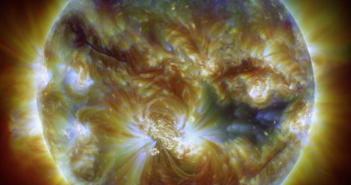
At the end of last year, the Sun’s large-scale magnetic field suddenly strengthened, reaching its highest value in over two decades. Here, researchers explain why this happened and what it predicts for the next solar cycle.
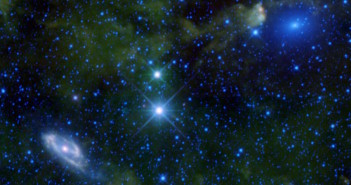
Which type of galaxy is most likely to host complex life in the universe? A team of researchers from the UK has the answer.
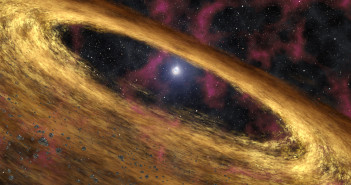
The very first exoplanets ever confirmed were found around a pulsar — but since then we’ve only found one other similar case. In this study, a team of researchers tries to figure out why.
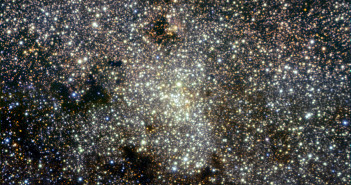
This study suggests that the stars in the central parsec of our galaxy are not a single, roughly solar-metallicity population, as previously thought.
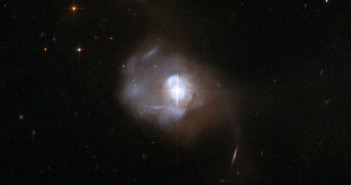
Could a pair of supermassive black holes (SMBHs) be lurking at the center of the galaxy Mrk 231?
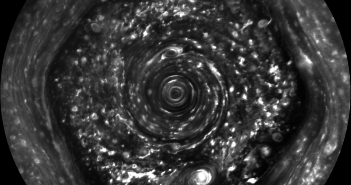
For over three decades, we’ve been gathering observations of the mysterious hexagonal cloud pattern encircling Saturn’s north pole. Now, researchers believe they have a model that can better explain its formation.
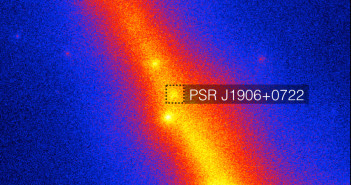
Personal-computer time volunteered through the Einstein@Home project has resulted in the discovery of a pulsar that has been hiding from observers for years.
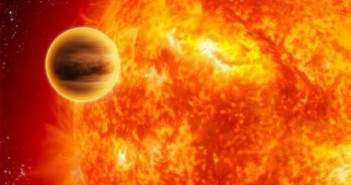
A new model proposes that early stellar ingestion of planets might be very common, and this can have significant effect on the snacking star.
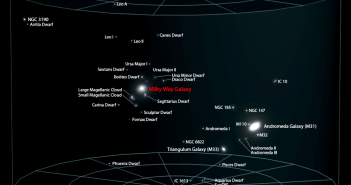
When a dwarf galaxy falls into the halo of a large galaxy like the Milky Way, how is star formation in the dwarf affected?
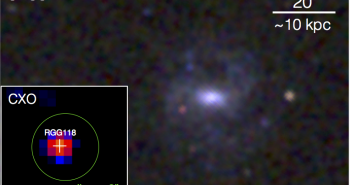
Astronomers have reported the detection of the smallest black hole ever observed in a galactic nucleus. Hosted in the center of a dwarf galaxy, it weighs in at 50,000 solar masses.