

NASA’s JWST has found a population of compact, red light sources called “little red dots” (LRDs). Numerous hypotheses have been proposed to explain these optical phenomena, and a new study further constrains their origin.
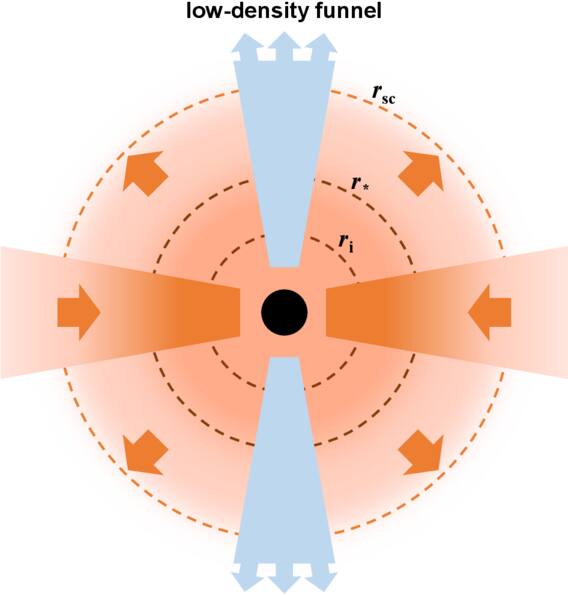
Schematic of the outflow model used by the team. Arrows denote the direction of flow. [Liu et al. 2026]
Under (Radiation) Pressure
“Little” red dots appear to be no more than a few hundred light-years across and have many hypothesized sources, from direct-collapse black holes to supermassive stars. A favored interpretation is that LRDs are gaseous envelopes housing massive black holes, but the formation mechanism of such an envelope has been unclear. A new study led by Jun-Rong Liu at the Chinese Academy of Sciences reveals that supercritical accretion of black holes may explain the origin of such envelopes.
Supercritical accretion occurs when a black hole accretes material at such an extreme rate that radiation pressure expels some of the material in an optically thick outflow. Such outflows are thought to create massive, glowing envelopes of material. The team modeled this process and compared simulated envelope properties to real observations of LRDs.
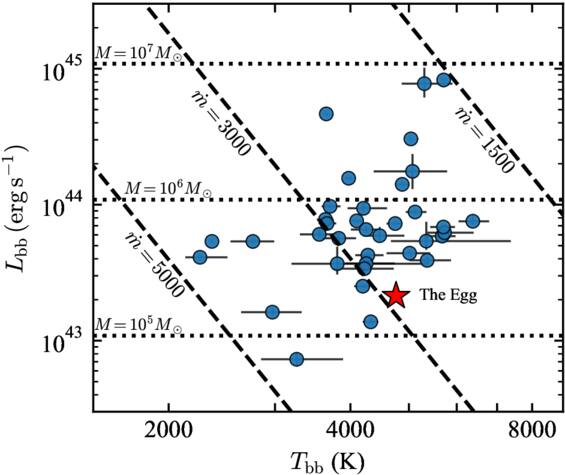
Luminosities and temperatures of real LRDs (blue circles) overlaying expected values from modeled envelopes (dotted and dashed lines). Most observations fall between 105 M⊙ < MBH < 107 M⊙ and 1,500 < ṁ < 5,000. [Liu et al. 2026]
Connecting the Dots
The team’s model of radiation-driven outflow depends on two key parameters: black hole mass (MBH) and accretion rate (ṁ). Accretion rate is a dimensionless value, and anything larger than 1 is classified as supercritical accretion. These variables dominate the physics of the model and affect the temperature, luminosity, and spectral features of the resulting envelope.
The team tested a range of black hole masses and accretion rates and compared their simulated envelope spectra against 36 real LRDs. The modeling suggested that black hole masses between 105 and 107 M⊙ and accretion rates between 1,500 and 5,000 are necessary to match the estimated temperatures and luminosities of LRDs. Supercritical, indeed!
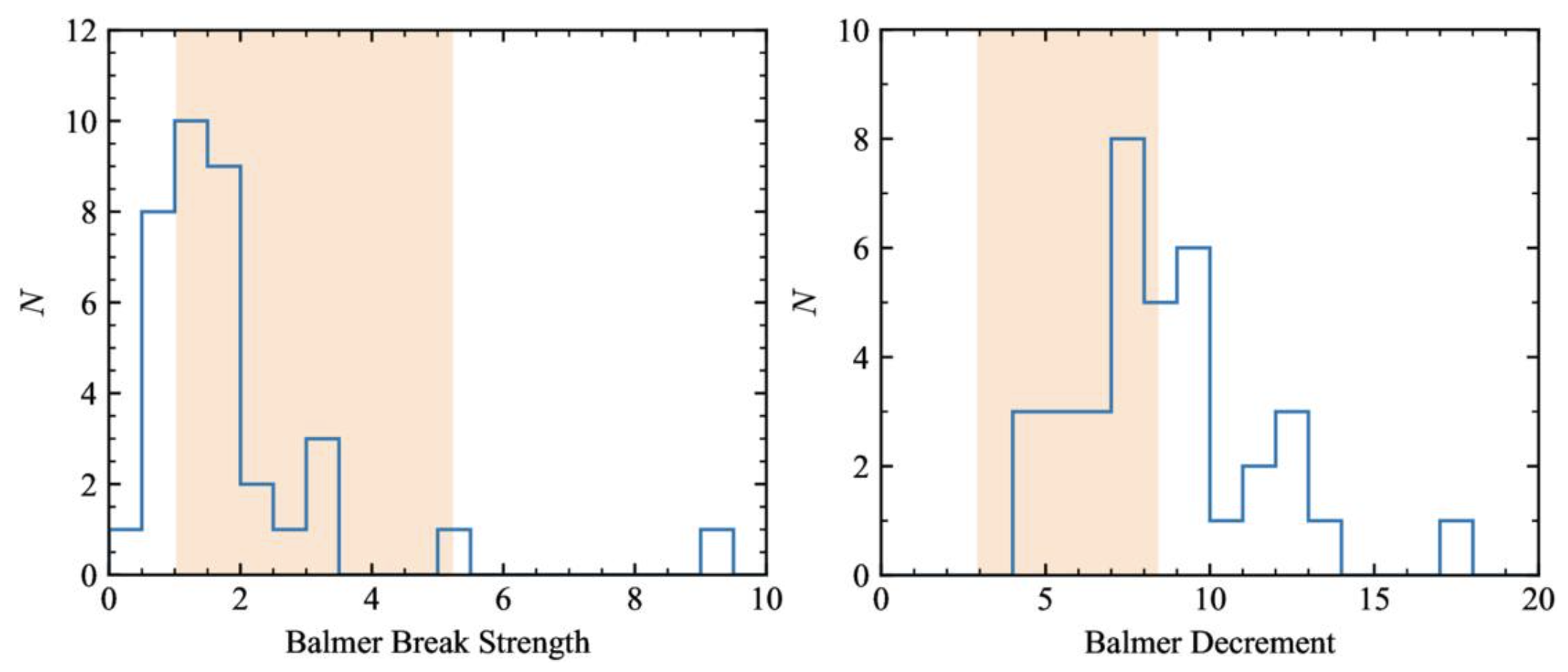
Distributions of Balmer break strength (left) and Balmer decrement (right) in LRDs (blue) and expected values from the model assuming MBH = 106 M⊙ and ṁ = 2,000 (orange). Click to enlarge. [Adapted from Liu et al. 2026]
Reading Between the (Spectral) Lines
Liu and collaborators then tested whether simulated LRDs within this range of black hole masses and accretion rates could reproduce several characteristics of real LRD spectra: the strength of the Balmer break (a sharp decrease in spectral intensity at 3645 Angstroms that acts as a proxy for the density of the envelope), the Balmer decrement (the ratio between the Hα and Hβ emission), and the width of the source’s broad emission lines (which quantifies the velocity dispersion of the gaseous envelope as it circles the black hole within).
The team’s model produced a range of Balmer break strengths consistent with real LRDs. Modeled broad emission line widths (also known as full width at half maximum) were also a good match. The one area where the model diverged from observations was the Balmer decrement. Real LRDs exhibit Hα/Hβ ratios of ∼4–17, and the team’s models were in the 3–8 range, overlapping with the lower end of the observed distribution.
Overall, the team’s model of radiation-driven outflows from supercritical accretion of black holes produced envelopes with features broadly consistent with real observations of LRDs, providing a plausible origin of these little light sources.
Citation
“Optically Thick Outflow Driven by Supercritical Accretion May Explain Little Red Dots,” Jun-Rong Liu et al 2026 ApJL 1007 L13. doi:10.3847/2041-8213/ae8dba