
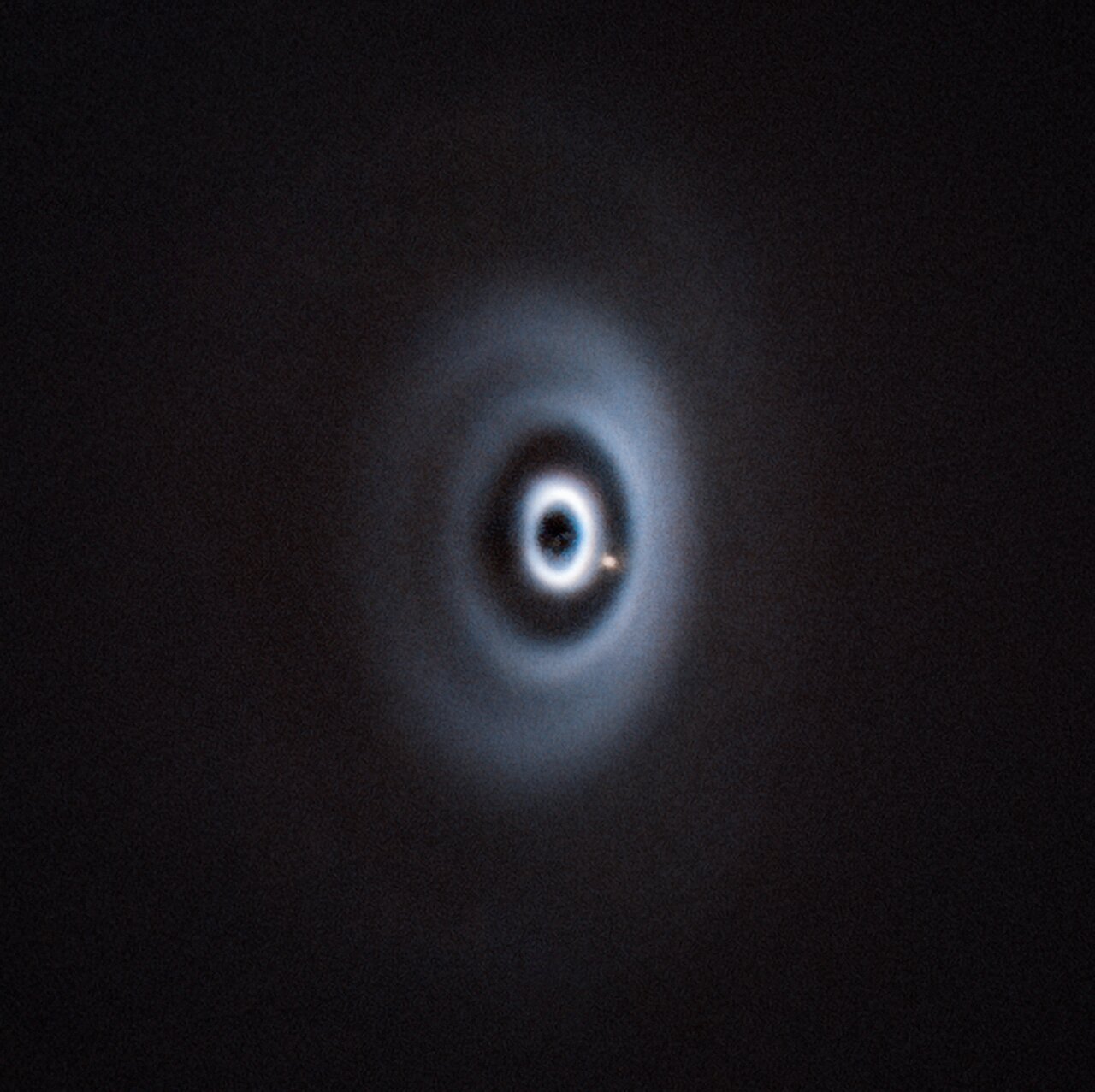
Astronomers seem to find something new every time they point a telescope at WISPIT 2, a 5-million-year-old solar-mass star located 430 light-years away. New high-resolution radio observations provide the best view yet of how the young planets of this system interact with the disk that feeds them.
Detecting Distant Planets
In 2025, astronomers carrying out the WIde Separation Planets In Time (WISPIT) survey — a targeted search for widely separated giant planets around young Sun-like stars — revealed a dusty disk surrounding the star WISPIT 2. Orbiting within this disk is a 4.9-Jupiter-mass planet, WISPIT 2b, at 57 au from the star. This makes WISPIT 2 just the second star to host a confirmed, directly imaged planet within its protoplanetary disk. Even more remarkable, WISPIT 2b was detected in Hα, showing that the planet is still growing by accreting gas from the disk.
Later observations confirmed the presence of a second planet, WISPIT 2c, which has an estimated mass of 8–12 Jupiter masses and orbits the star at 15 au. On top of these planetary discoveries, researchers have also found that WISPIT 2 is two stars rather than one!
Best View Yet of the WISPIT 2 System
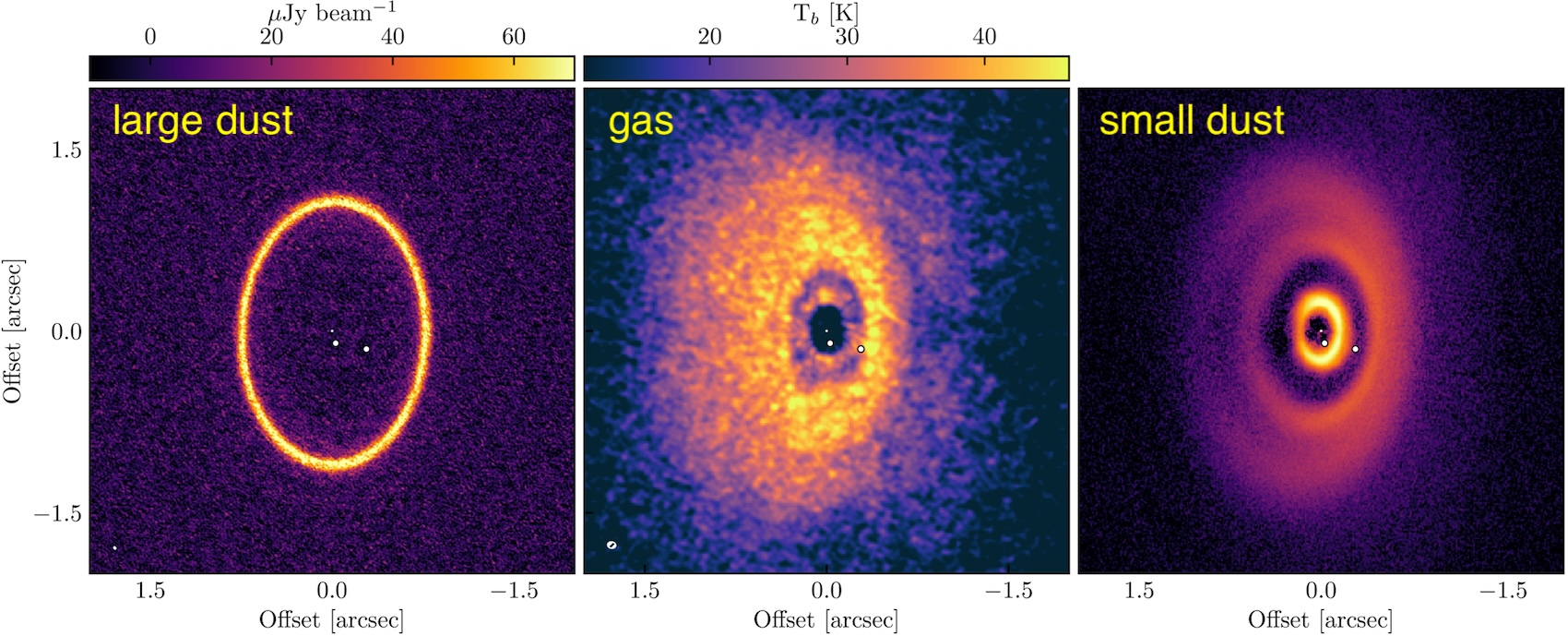
New observations of WISPIT 2 from ALMA (left and center panels) and previous observations from the Very Large Telescope (right panel). The star is shown by the small dot at the very center, and the planets are indicated by the two white circles. Click to enlarge. [Adapted from Benisty et al. 2026]
The distribution of gas within the disk, traced by emission from carbon monoxide, roughly follows the pattern seen in previous observations of small dust grains: the orbits of WISPIT 2b and 2c are depleted of gas and dust, demonstrating how the young planets have carved their own berths within the disk, creating a gap at WISPIT 2b’s orbit and a cavity around the star.
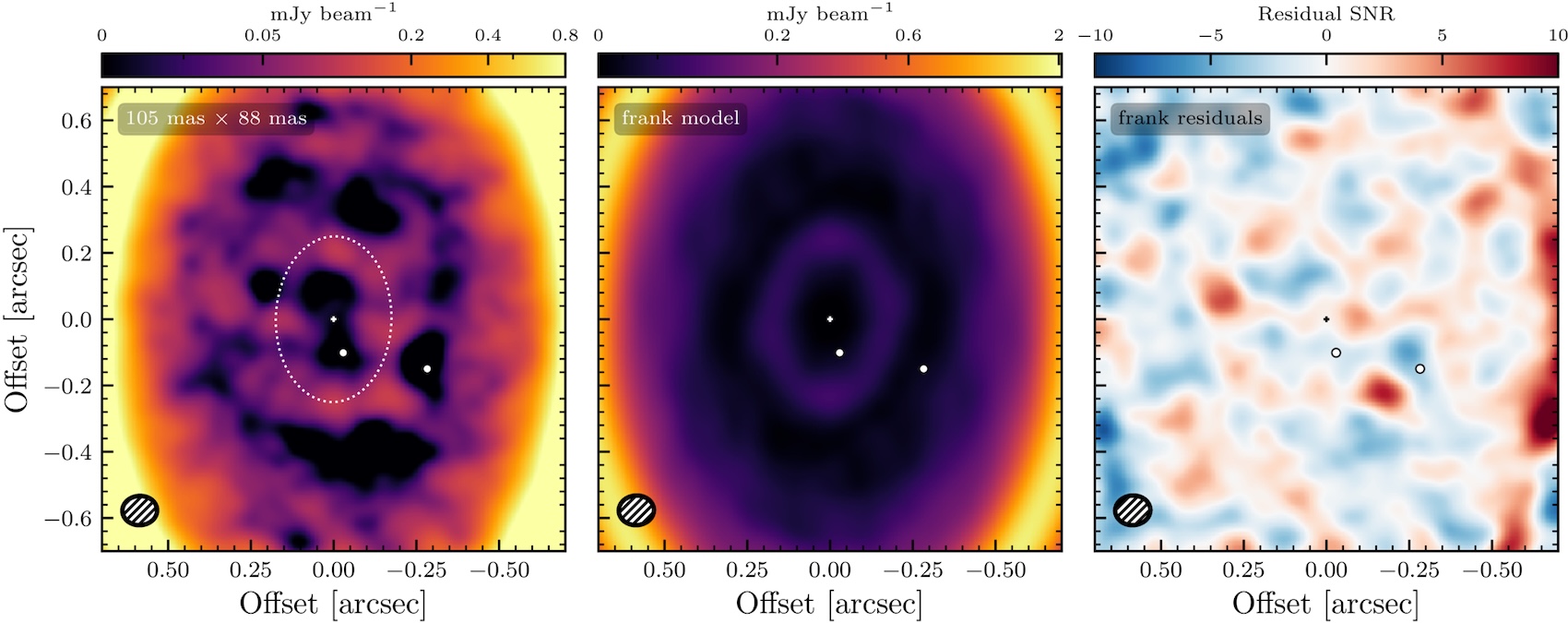
The left panel shows the dust continuum emission zoomed in on the star (plus sign) and planets (circles). The dotted line shows the location of a faint ring, which is modeled in the center panel. The right panel shows the residuals. Click to enlarge. [Benisty et al. 2026]
Spiral Wakes Making a Splash
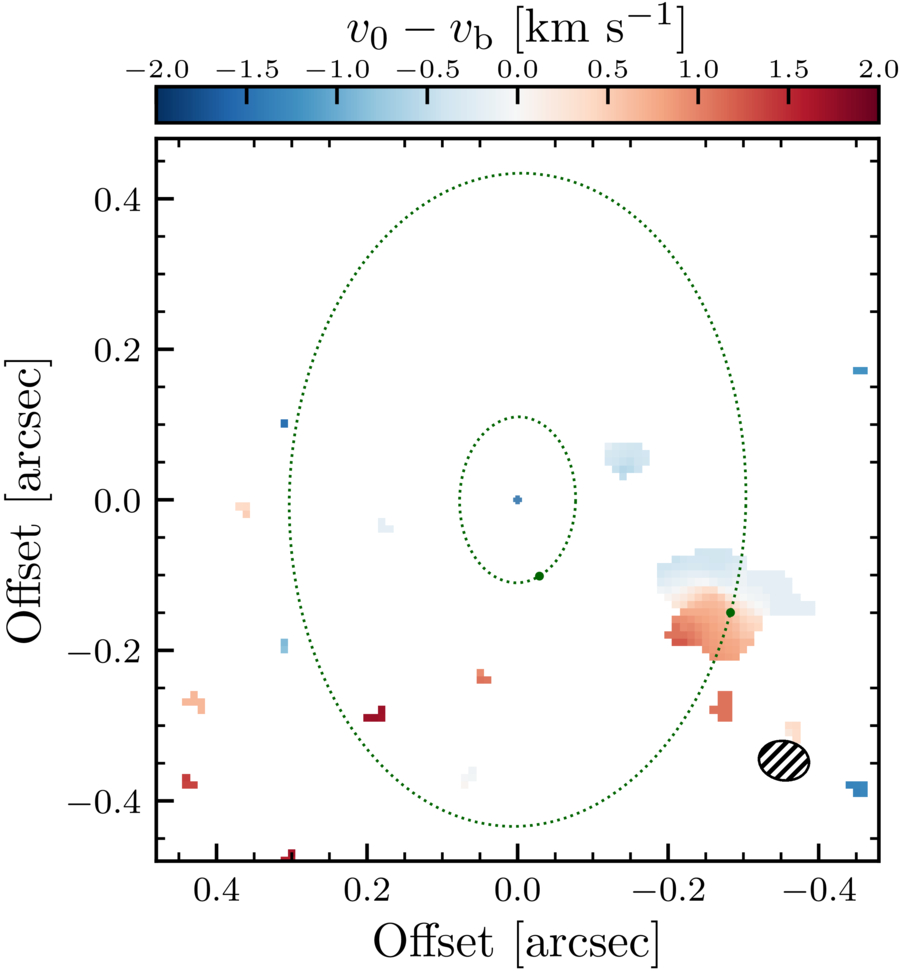
Velocity field showing the gas swirling around WISPIT 2b, which is indicated by the green circle farther from the star. [Benisty et al. 2026]
Spiral wakes have been spotted in other protoplanetary disks, but this is the first time researchers have been able to definitively associate this feature with a planet rather than other causes, such as gravitational instabilities. Looking ahead, future high-resolution spectroscopic observations of WISPIT 2b and its surroundings will offer researchers an unprecedented opportunity to compare the properties of the planet and its spiral wake against the predictions of simulations — advancing toward a powerful new way to study exoplanets embedded in protoplanetary disks.
Citation
“Mapping the WISPIT 2 Planet-Hosting Cavity at Sub-Hill-Radius Scales,” Myriam Benisty et al 2026 ApJL 1009 L32. doi:10.3847/2041-8213/aea214