
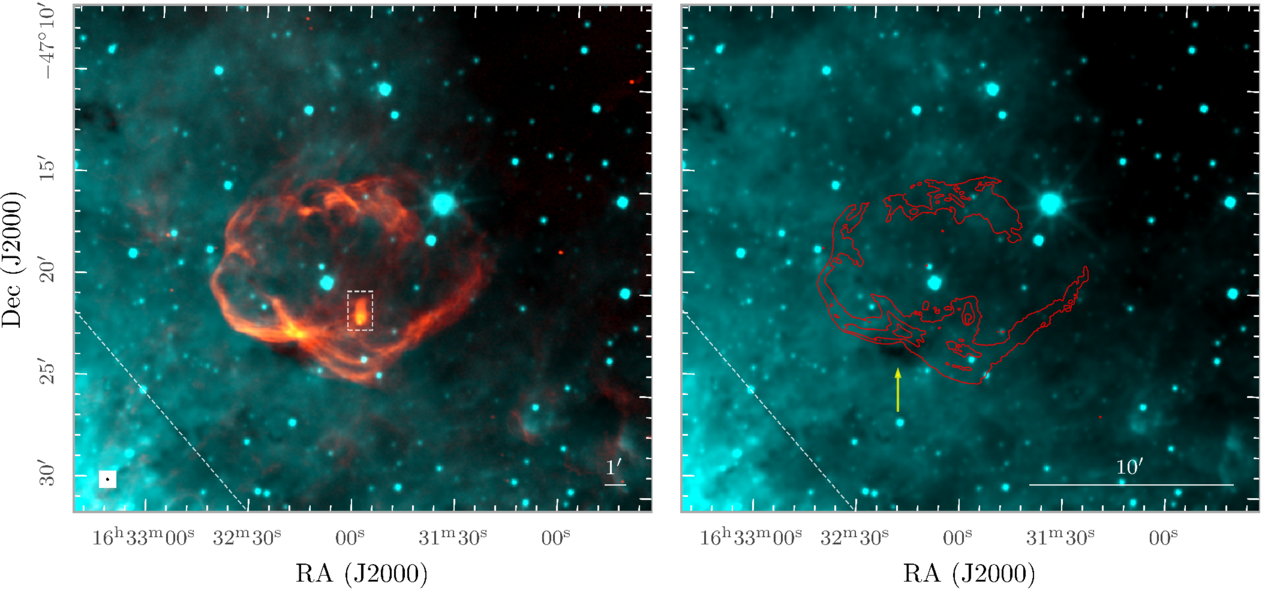
When a massive star collapses, the subsequent supernova can leave behind the star’s condensed core in the form of a neutron star. Some neutron stars are also pulsars, which rotate at incredible speeds, emit beamed radio emission, and expel winds of charged particles. A pulsar’s relativistic charged-particle winds billow around the pulsar as it travels through space — often at a few hundreds of kilometers per second or faster, having received a “kick” when its progenitor star exploded. When these winds interact with the surrounding supernova ejecta or the interstellar medium, the interaction creates a detectable pulsar wind nebula. The image above combines data from the Australian Square Kilometre Array Pathfinder (orange) and Wide-field Infrared Survey Explorer (cyan) to show a pulsar wind nebula, indicated with a white rectangle, within a larger supernova remnant. Sanja Lazarević (Western Sydney University) and collaborators discovered this pulsar wind nebula, which they’ve named “Thunder” in a nod to the supernova remnant’s moniker, “Nimbus.” The cometary shape of the pulsar wind nebula suggests that the pulsar is moving quickly, traveling outward from the center of the explosion that occurred some 30,000–45,000 years ago. To learn more about the discovery and characterization of this pulsar wind nebula, check out the article linked below.
Citation
“EMU Discovery of Thunder: A Bow-Shock PWN Powered by PSR J1631–4722 Escaping the Nimbus SNR (G336.7+0.5),” S. Lazarević et al 2026 ApJ 1007 159. doi:10.3847/1538-4357/ae7f11