
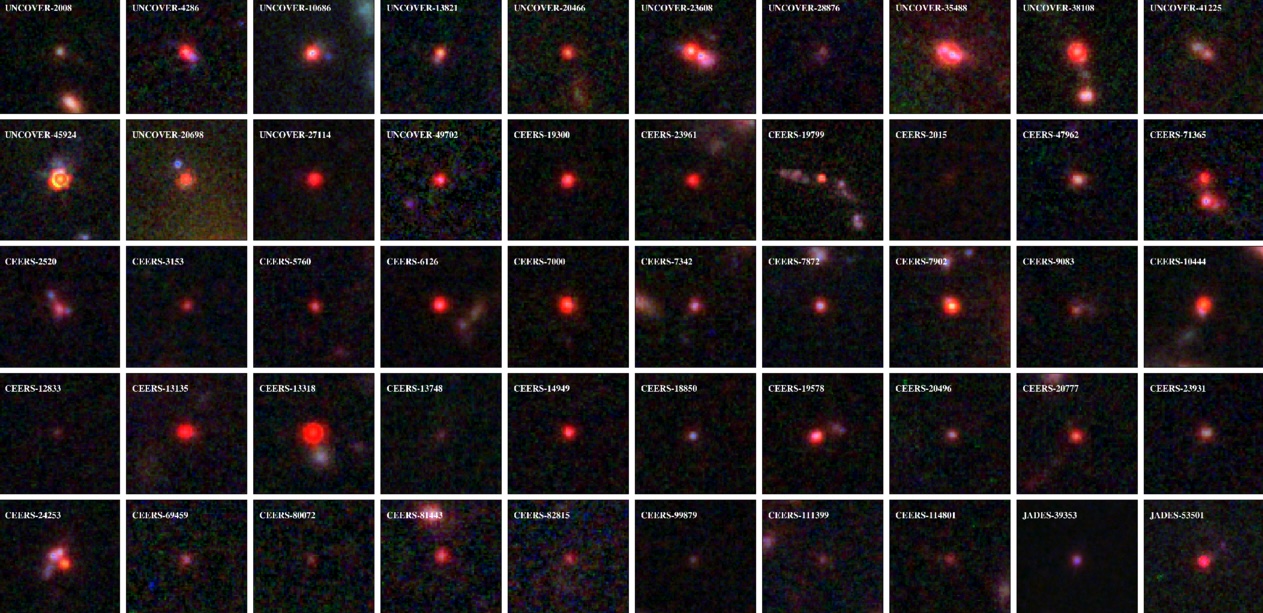
One of the biggest discoveries from JWST’s tenure is a population of compact reddish objects nicknamed “little red dots.” Numerous theories have been proposed to explain the small sizes, high luminosities, and characteristic “V”-shaped spectra of these objects, and today we’ll examine two recent research articles that have explored the identity of the universe’s most mysterious inhabitants.
Red Dot, Blue Dot
You can tell a lot about a person by looking at their friends — and the same might be true for little red dots. A team led by Josephine Baggen (Yale University) examined a sample of 83 little red dots imaged with JWST. They found that 43% of the little red dots in this sample had a little blue companion: an ultraviolet-bright object within a projected separation of 1,630–16,300 light-years. The brightest little red dots were even more likely to have a blue companion; 80% of the brightest objects in the sample were paired up.
Baggen’s team set out to test the hypothesis that these red–blue pairs are fundamentally linked rather than coincidental. Under this hypothesis, the ultraviolet-bright blue companions were assembled first. The ultraviolet radiation from these objects suppressed the cooling of molecular hydrogen in pristine gas clouds in the early universe, causing the gas to skip the usual star-forming process and instead form a massive compact object such as a black hole star, supermassive star, or quasi-star — which we see as a little red dot.
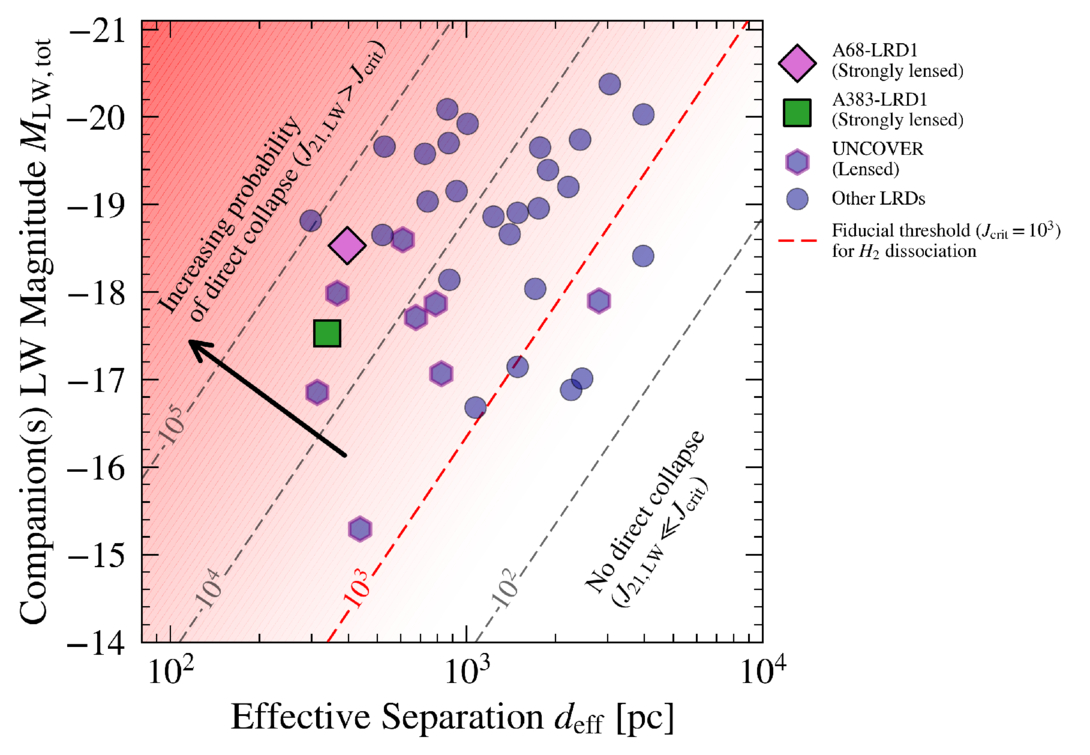
The companion’s mean flux density from 91.2 to 111 nm versus projected separation between the blue companion and the little red dot. The red dashed line shows the estimated values necessary for gas clouds to collapse. Click to enlarge. [Baggen et al. 2026]
If little red dots form thanks to their little blue companions, that would imply that every little red dot has or had such a companion. Though little blue companions weren’t so universal in the sample used in this work, the team noted that their analysis techniques, combined with observational limitations and other factors, likely yielded a smaller number of blue companions than are actually present. Further simulations exploring the collapse of pristine gas clouds into massive compact objects and high-resolution spectroscopic observations of little red dots can illuminate the potential link between these objects.
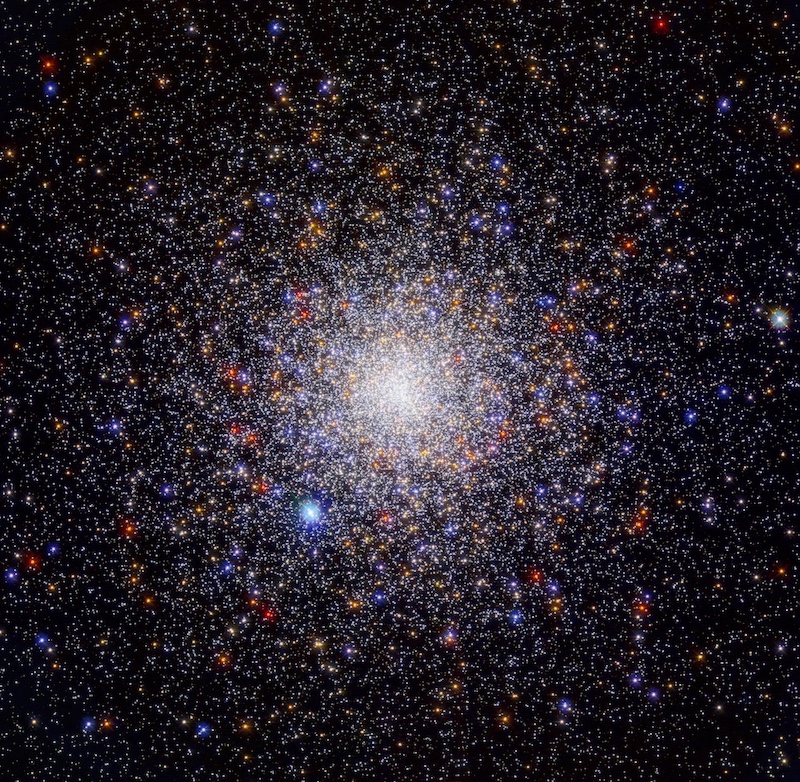
The densely packed globular cluster NGC 1851, as seen by the Hubble Space Telescope. [NASA, ESA, and G. Piotto (Università degli Studi di Padova); Processing: Gladys Kober (NASA/Catholic University of America)]
Little Red Dots as Young Globular Clusters
John Chisholm (The University of Texas at Austin) and collaborators hypothesized that little red dots represent a brief phase in the formation of globular clusters. In this hypothesis, the rest-frame ultraviolet emission of little red dots comes from the hot young stars of the newborn cluster, while the rest-frame optical emission comes from a single supermassive star at the cluster’s heart. Thus, in this framework, the little red dot phase lasts only as long as the fleeting lifespan of the supermassive star.
Chisholm’s team first showed that the spectrum of a young globular cluster with a supermassive star at its center is similar to the observed spectrum of a little red dot. But showing that the emission properties of globular clusters in formation and little red dots are similar is not enough — it’s also necessary to investigate whether the numbers and masses of these objects line up.
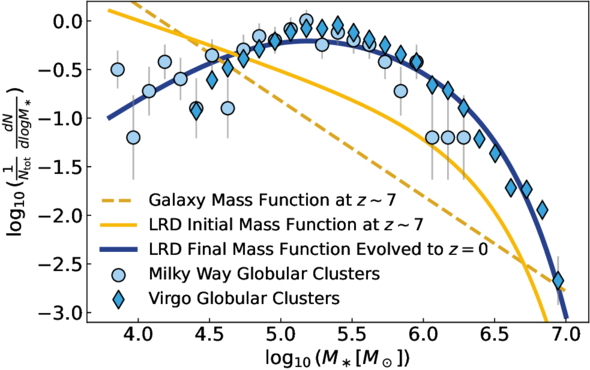
Comparison of the mass functions of little red dots evolved forward to the present day (blue line) and globular clusters in the Milky Way and Virgo (blue symbols). The results for both populations have been normalized to emphasize the shape of the distributions. Click to enlarge. [Chisholm et al. 2026]
In addition to describing how the properties of globular clusters in formation match those of little red dots, Chisholm’s team outlined some testable predictions for this scenario, including formation timescales and chemical abundance patterns. If this hypothesis withstands further scrutiny, little red dots may provide a valuable look at the early years of some of our universe’s oldest star clusters.
Citation
“Connecting the Dots: UV-Bright Companions of Little Red Dots as Lyman–Werner Sources Enabling Direct-Collapse Black Hole Formation,” Josephine F. W. Baggen et al 2026 ApJL 1002 L4. doi:10.3847/2041-8213/ae58a5
“Little Red Dots as Globular Clusters in Formation,” John Chisholm et al 2026 ApJL 1004 L4. doi:10.3847/2041-8213/ae6dae