
Editor’s Note: Astrobites is a graduate-student-run organization that digests astrophysical literature for undergraduate students. As part of the partnership between the AAS and astrobites, we occasionally repost astrobites content here at AAS Nova. We hope you enjoy this post from astrobites; the original can be viewed at astrobites.org.
Title: Near the Runaway: The Climate and Habitability of Teegarden’s Star b
Authors: Ryan Boukrouche, Rodrigo Caballero, and Neil T. Lewis
First Author’s Institution: Stockholm University
Status: Published in ApJL
To find life on other planets, we start our search for planets like Earth. (It’s the best example of a habitable planet that we know of!) Earth’s distance from the Sun allows for liquid water to exist on the surface, which is vital for life as we know it. This region, called the “habitable zone,” describes the right atmospheric conditions and proximity to its host star that a planet can have to support liquid water. Earth is also special because of its atmosphere, which contains greenhouse gases such as water vapor and carbon dioxide (CO2); these help keep the average global temperature moderate enough for life to exist.
A few factors govern the habitable zone for a given planetary system: for example, the strength of a star’s radiation, the composition of the planet’s atmosphere, and a planet’s orbital period around its star. This is because a planet’s “energy budget” is dictated by these factors. For a planet to have a “stable” climate, the energy it receives from its star must balance the energy it re-emits. For instance, in a given planetary system, the closer a planet’s orbit is to its host star, the more sunlight it receives and therefore the more energy it must radiate away. This balance is between outgoing longwave radiation, which is heat emitted by the planet, and absorbed/incoming shortwave radiation, which is the sunlight the planet receives from its host star.
Some Earth-like analog planets have piqued the interest of astronomers because observations suggest that they lie within the habitable zones of their respective stars. One system, named after its discoverer, Bonnard Teegarden, features an M-dwarf star with three orbiting Earth-mass planets. It exists about 12.5 light-years away, making it one of the closest planetary systems to us. One of the planets, Teegarden’s Star b, is believed to have very similar characteristics to Earth: a radius of 1.02 REarth and a mass of 1.16 MEarth. Because the planet orbits an M-dwarf star, which is much cooler (temperature-wise) and less massive than our Sun, the planet’s orbit is much, much smaller than Earth’s, with a semimajor axis of 0.0259 au (compared to 1 au for Earth) and an orbital period of 4.9 days (compared to 365 days for Earth).
The authors of today’s article explore how close Teegarden’s Star b is to its habitable zone based on current observations, and how future observations could lead to vastly different interpretations of its habitability.
Exoplanets are small and faint, making it difficult for current technology to study their atmospheres accurately. Modern simulations, known as general circulation models, can model how a planet’s atmosphere might behave under various assumptions. Isca, the climate and atmospheric dynamics model used in this article, has been used to model exoplanetary atmospheres in previous studies. Modeling a planet around an M-dwarf, the authors tried matching the planet’s properties as closely as possible to Earth, using a simple cloud model (which is challenging to model), moist physics (since our atmosphere contains water vapor), and a radiative transfer scheme. In their simulation, the authors also assumed that Teegarden’s Star b is tidally locked, meaning its dayside always faces its sun. For example, our Moon always shows the same side to us on Earth and is considered tidally locked.
They also assigned Teegarden’s Star b a similar atmospheric composition to Earth: 78% nitrogen (N2), 28% oxygen (O2), and a CO2 concentration of 400 parts per million by volume (ppmv). Unlike Earth, they did not include an ozone layer; however, they state that including one did not significantly change the results. Combinations of these different factors were run for 8–41 Earth years, until the Teegarden’s Star b model either reached a stable state (where the energy balance equals 0 W/m²), or it exceeded the runaway greenhouse gas threshold — the point at which the energy balance exceeds zero, and the planet’s surface temperature increases uncontrollably.
The average amount of radiation that a planet receives is called its instellation, or sometimes “insolation” when talking about our Sun. For reference, Earth has an insolation value of around 1365 W/m². Different studies of Teegarden’s Star b suggest an instellation of 1481 W/m² or 1565 W/m², so the authors multiple values in that range (see Fig. 1).
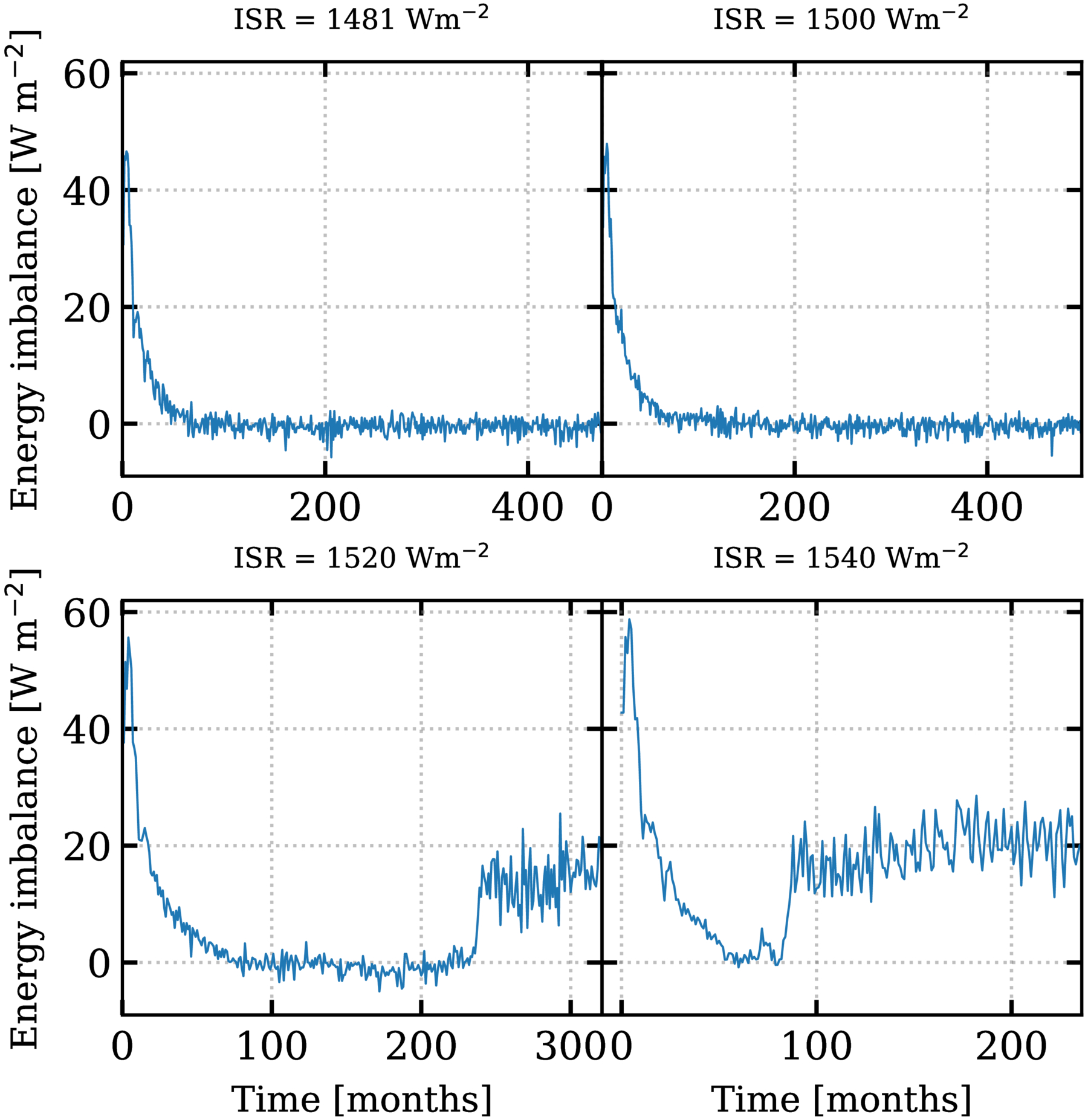
Figure 1: For a surface albedo of 0.07 (ocean-dominated), the energy balance for each tested instellation (ISR; 1481–1540 W/m²) is shown. As time increases, a stable atmosphere would consistently reach an energy imbalance value of 0 W/m². In contrast, an unstable (runaway greenhouse) atmosphere would have a value greater than 0 W/m², indicating that it is receiving more energy than emitting. [Boukrouche et al. 2025]

Figure 2: The global mean surface temperature (top) and planetary albedo (bottom) of Teegarden’s Star b are shown with various instellation values. The filled markers represent models that reached an equilibrium, or stable, state, whereas the empty markers are models that reached a runaway, uninhabitable state. The two vertical black lines represent the two main instellation estimates of 1481 and 1565 W/m². Once the models exceed the ~1520 W/m² instellation value, they start to fail and reach a runaway greenhouse effect. [Boukrouche et al. 2025]
Original astrobite edited by Joe Williams.
About the author, Mckenzie Ferrari:
I’m currently a PhD student in the geophysical sciences program at the University of Chicago. While I now study the atmosphere and oceans of Earth, most of my previous research focused on simulations of Type Ia supernovae and galaxy formation and evolution. In my free time, I foster cats for a local organization, enjoy cooking, and can often be found running along Lake Michigan.