
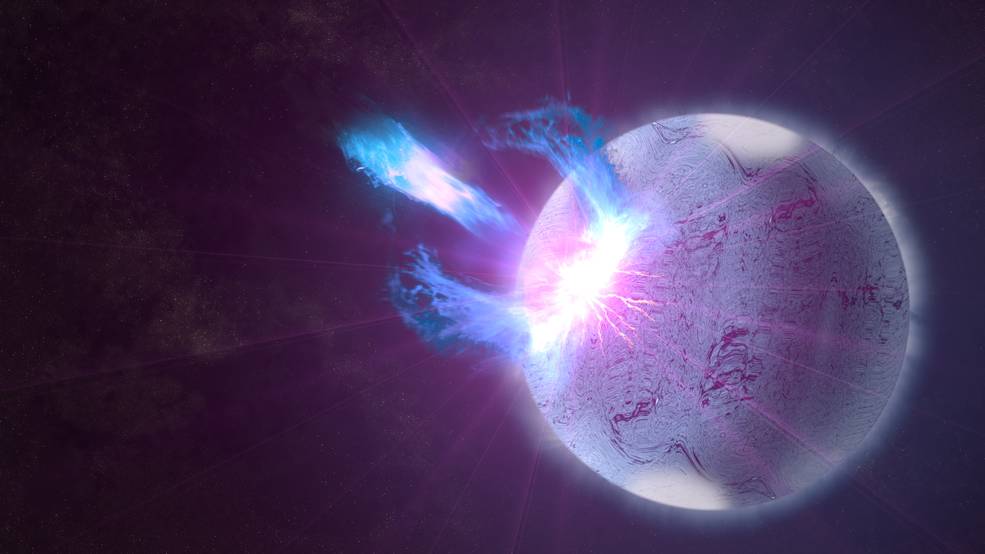
We’re used to watching magnetars throw temper tantrums which involve large outbursts of energy in the form of X-rays. One magnetar, however, recently exhibited some unusual behavior during such an outburst. What’s causing this strange demeanor?
Whoa, Magnets.
When it comes to extreme objects in the universe, it doesn’t get more extreme than a magnetar. Take a massive star’s core, crush it into the size of a small city, spin it as fast as a blender, and give it a magnetic field a trillion times Earth’s, and you have yourself a magnetar. The magnetic fields of magnetars are highly complex, and disturbances in these magnetic fields can output vast amounts of energy in the form of X-rays over the span of months or years. A team led by George Younes from the Goddard Space Flight Center / Universities Space Research Association has now monitored a particularly misbehaving magnetar: one that, during such an outburst, changed its behavior in a way that no other magnetar has before.
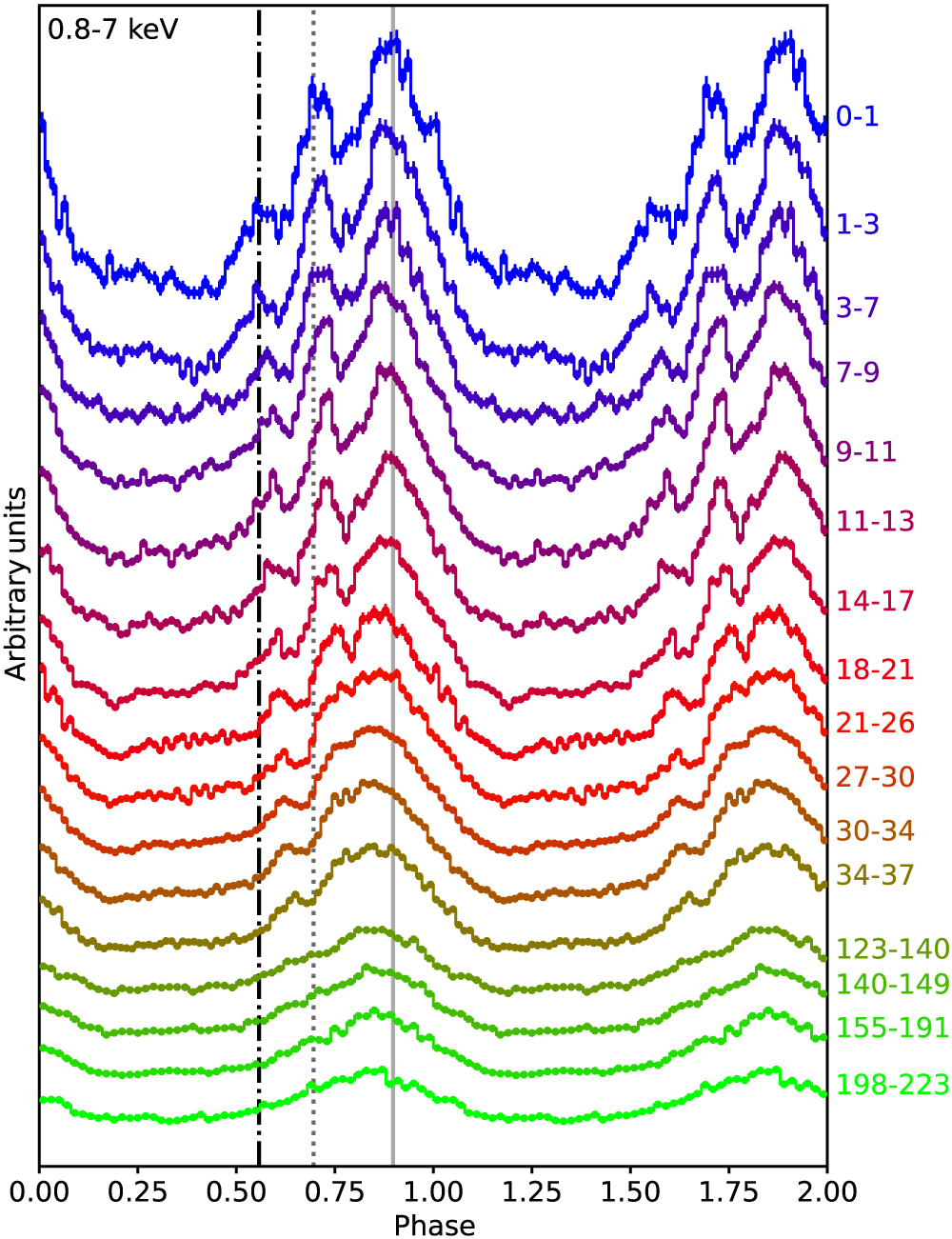
The profile evolution of the magnetar with time with the earliest profile is shown on the top. The vertical lines show the original center of each of the components. [Younes et al. 2022]
A Swift Discovery
Magnetar SGR 1830-0645 was discovered in late 2020 by the Swift/Burst Array Telescope, a highly sensitive instrument that can pinpoint a burst within seconds of its discovery, after it released a short X-ray burst. It seemed like a normal magnetar with a rotation period of ~10 seconds and a magnetic field strength of ~1014 G (for reference, the magnetic field of Earth is ~0.5 G and the magnetic field of our Sun is ~1 G). While monitoring this energetic event, astronomers noted something odd: this magnetar’s thermal pulse profile, which shows the thermal energy emitted throughout each rotation of the star, gradually changed from having three peaks to having only one. Changes in profile structure have been seen before in magnetars, but the profiles usually get more complex instead of simplifying…so what’s going on?
Crustal Cracking or Magnetospheric Meandering?
The team observed the source during the first 37 days of the outburst using the Neutron star Interior Composition Explorer (NICER) instrument. They found that the temperature of the star didn’t change, yet the hotspots on the surface (where the emission is thought to come from) get smaller during the outburst. This points to one of two things: either crustal motions or a twisting of the magnetosphere.
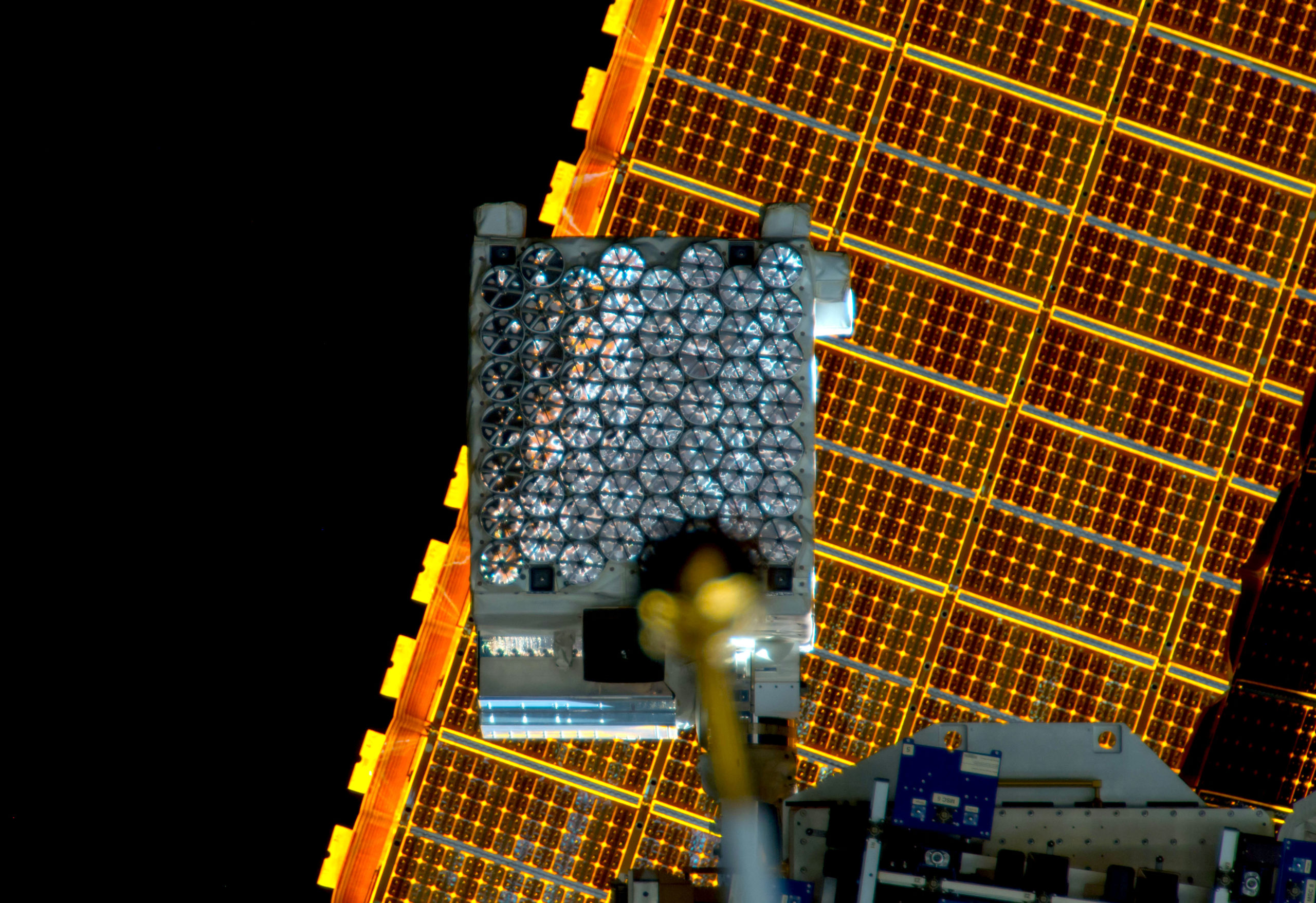
The NICER instrument aboard the International Space Station. [NASA]
Was SGR 1830-0645’s odd behavior during its outburst a one-off event where two mechanisms both happened to come together, or is this common behavior that’s only now detectable due to the NICER instrument’s high-cadence observations? More magnetar observations will tell!
Citation
“Pulse Peak Migration during the Outburst Decay of the Magnetar SGR 1830-0645: Crustal Motion and Magnetospheric Untwisting,” George Younes et al 2022 ApJL 924 L27. doi:10.3847/2041-8213/ac4700