
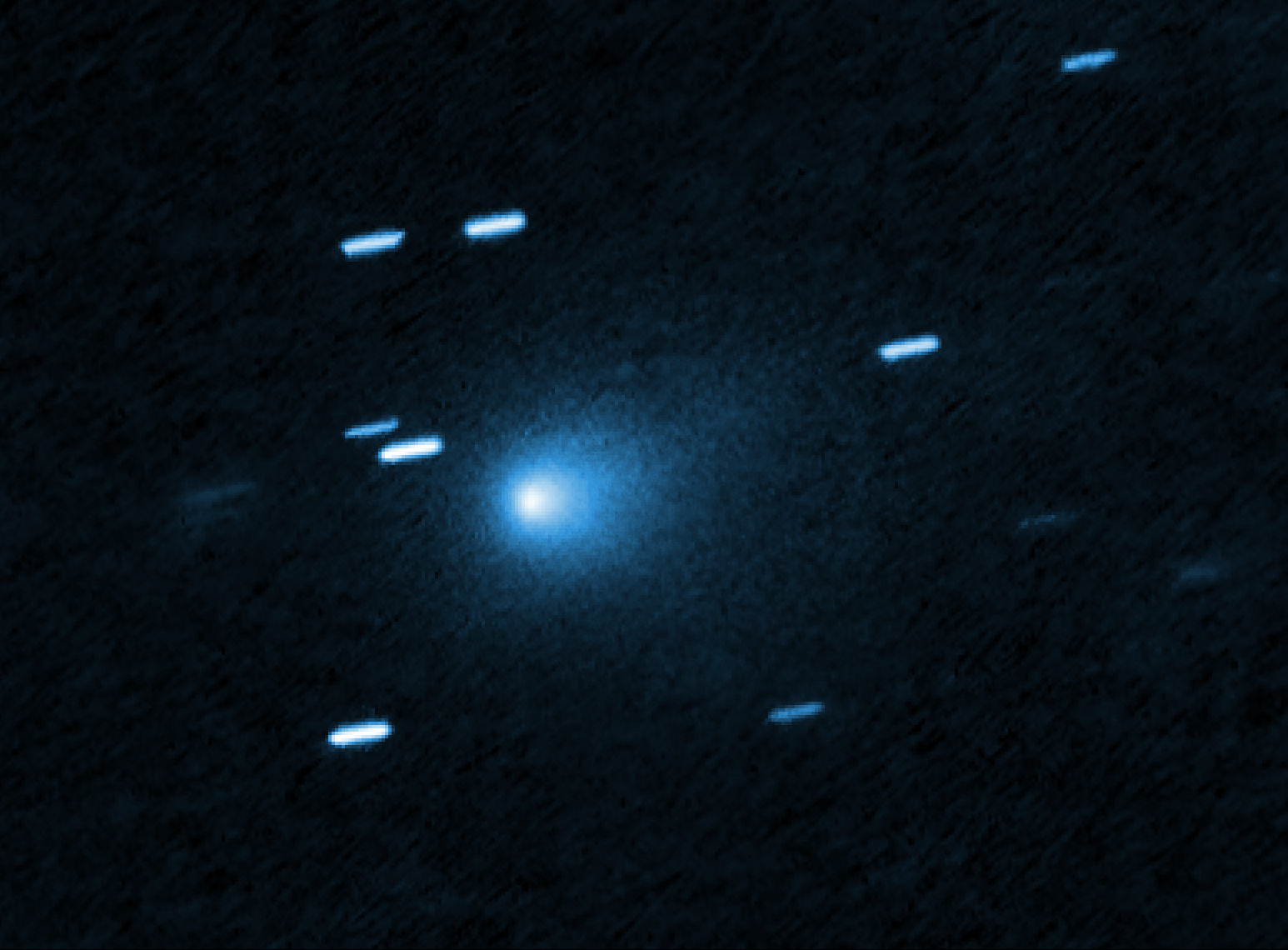
Astronomers have been measuring comets for centuries. But in December of last year, researchers collected a unique set of comet observations: they recorded some of the highest-quality data of one of the weirdest known comets while it was far from the Sun.
Simultaneous Spectra and Images
A few months after the famous interstellar comet 3I/ATLAS rounded the Sun and began its journey back into the space between the stars, a group of astronomers led by Nathan Roth (NASA Goddard Space Flight Center) aimed JWST in the direction of its retreat to watch it fade away. Using a special observing mode that leveraged the Integral Field Unit (IFU) in JWST’s Near Infrared Spectrometer, these observations didn’t result in just a single image of the comet, but a full stack of images, each corresponding to a different wavelength of light.
Using the IFU allowed the observers to combine the best of both regular imaging, which reveals spatial structure, and standard spectroscopy, which reveals wavelength dependencies. As a result, they could make spatially resolved maps of how the emission from the comet’s fuzzy atmosphere of gas and dust, or coma, changed with distance from the comet’s icy nucleus and angle to the Sun. Since different molecules radiate at different wavelengths, these maps in turn reveal the composition and geometry of 3I/ATLAS’s coma.
Mapping the Coma
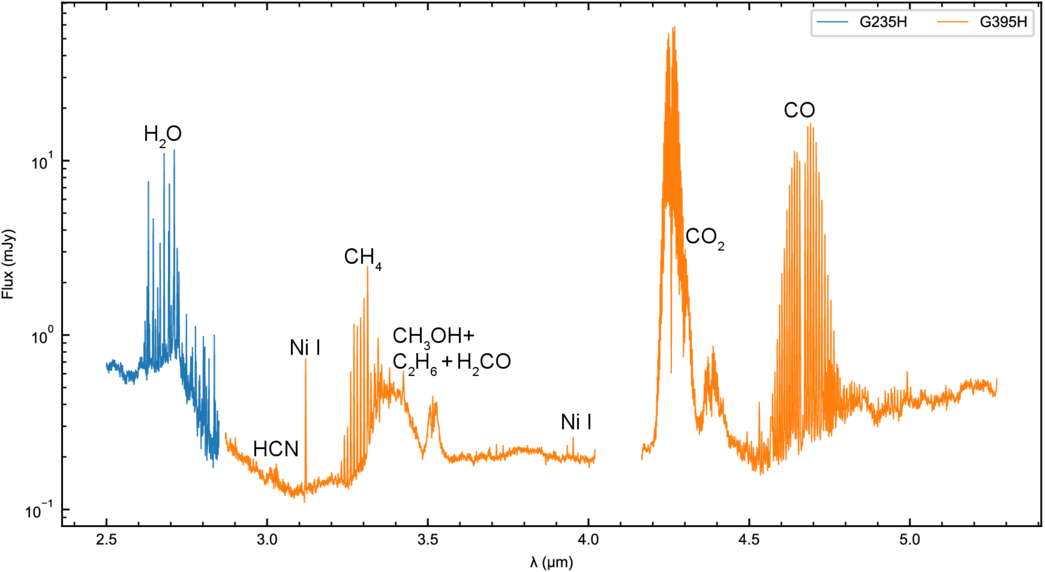
The spectrum of the coma of 3I/ATLAS. Note that this is a real spectrum, not a simulation. The contributions of various molecules are labeled alongside their most prominent emission lines. Click to enlarge. [Roth et al. 2026]
First, in contrast with normal solar system comets where water is the most abundant molecule, water was actually a secondary player here: there was significantly more carbon monoxide, or CO, than water in 3I/ATLAS’s coma. The researchers note that this might not be representative of the true distribution of the two species, but instead be the result of the timing of these observations. When observing a standard solar system comet, astronomers usually examine their targets when the object in question is within 2 au of the Sun. At these close distances, solar radiation is strong enough that water ice dominates the outgassing and activity in a coma.
However, these IFU measurements were taken when 3I/ATLAS was about 2.4 au from the Sun, or right in the transition region where water doesn’t sublimate as easily as CO or carbon dioxide (CO2). It’s likely that as the comet approaches the so-called “ice line” where water will naturally freeze out, CO will only increase its domination of the coma.

Top row: Maps of the distribution of various molecules in the coma. The white arrow shows the direction toward the Sun. Bottom row: The spatial distribution of the temperature of each species. Click to enlarge. [Roth et al. 2026]
Every Molecule for Itself
Second, each molecule seemed to be outgassing in its own unique direction from the coma. CO is leaving the nucleus in two different jets, one aimed directly back at the Sun and one perpendicular to it; CO2 and methane (CH4) are both leaking away in the anti-Sun direction; and water and methanol (CH3OH) are sublimating in nearly spherically symmetric shells. The authors speculate that these geometries may be caused by different “active sites” on the comet, and that had they observed the comet for one full rotational period, they might have seen these jets pointing in different directions.
Although 3I/ATLAS is now too far and faint for observations like these, this study reveals just how much we can learn in the brief time interstellar visitors spend in our solar system. When the fourth interstellar comet inevitably wanders through the inner solar system, astronomers will doubtless be ready to use this observing mode again.