
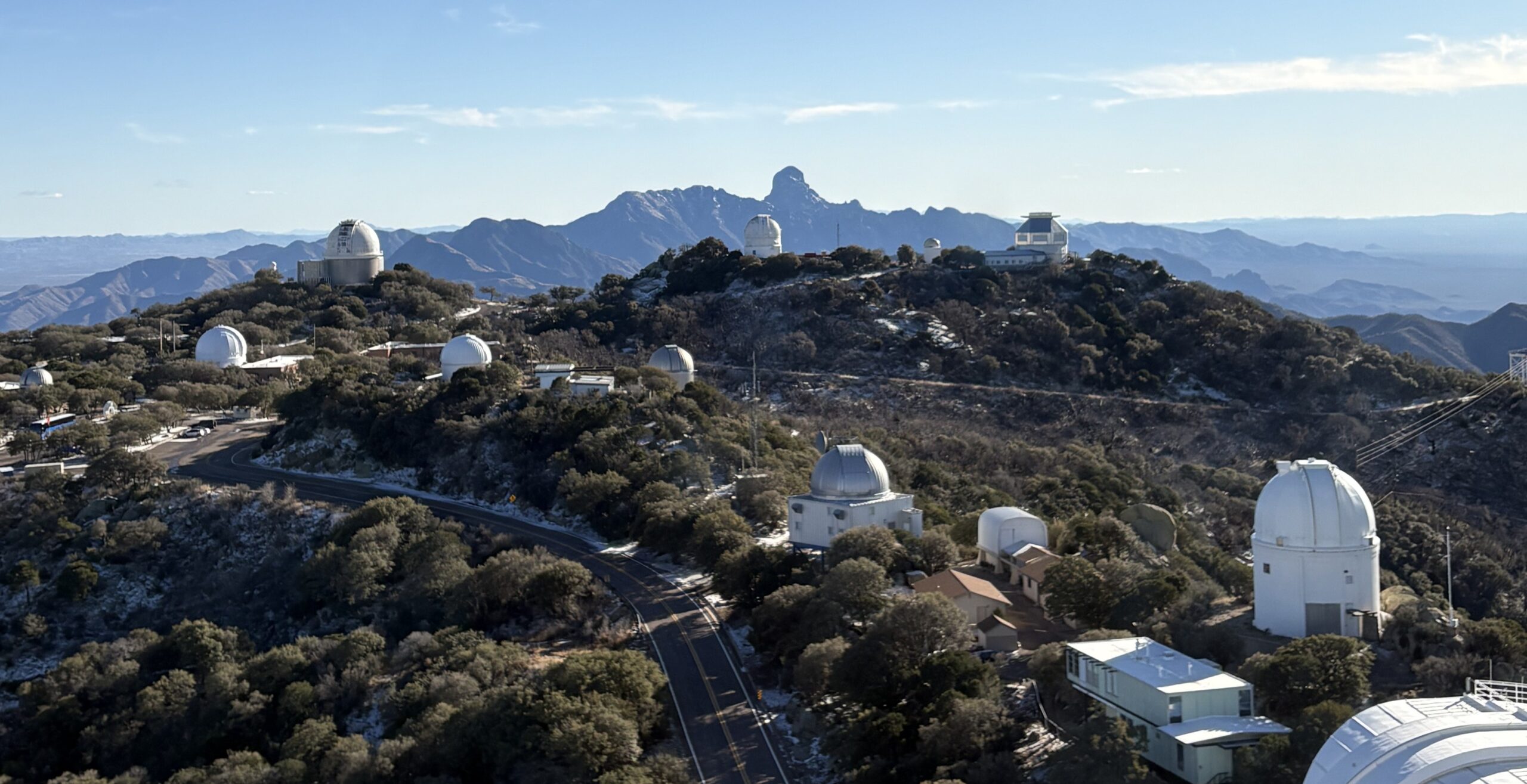
After AAS 247 in Phoenix, Arizona, AAS Nova Editor Kerry Hensley and I had the chance to travel about 150 miles south for a tour of Kitt Peak National Observatory.
A Window into Kitt Peak
Located 60 miles southwest of Tucson, Kitt Peak National Observatory (KPNO) resides on a mountain top within the Tohono O’odham Nation reservation. Founded in 1958, Kitt Peak is home to nearly two dozen active telescopes ranging in wavelength coverage and scientific objectives. Ronald Proctor, Lori Allen, and Jacelle Ramon-Sauberan, all serving in crucial roles for the observatory, led our tour around the mountain.
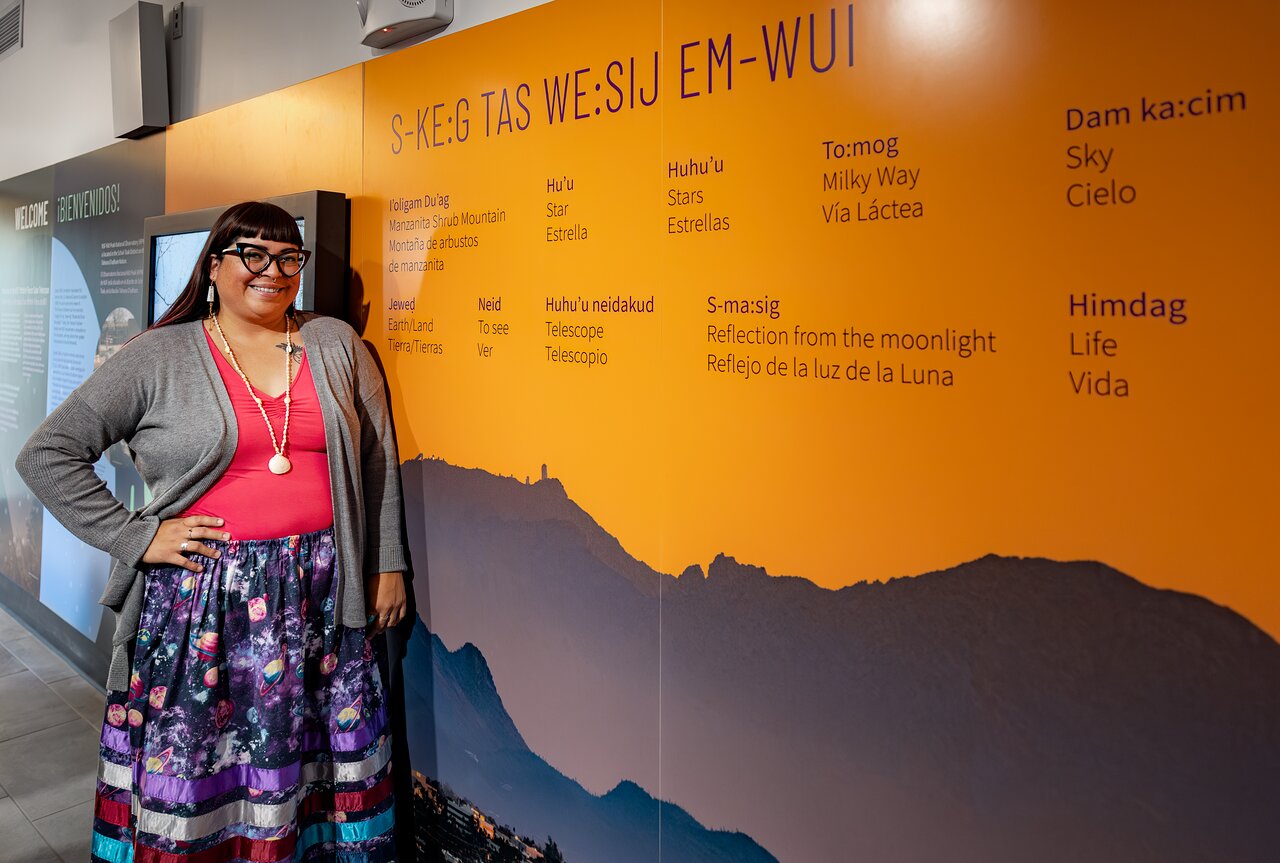
The Windows On the Universe Center’s lobby exhibit displaying the Tohono O’odham language with words describing the land and astronomy. Jacelle Ramon-Sauberan, the Tohono O’odham Nation Education Liaison, is seen to the left. [KPNO/NOIRLab/NSF/AURA/R. Proctor; CC BY 4.0]
The center’s lobby introduced visitors to the beautiful land KPNO calls home. Working with Tohono O’odham linguists, Jacelle, the observatory’s Tohono O’odham Nation Education Liaison, curated the lobby exhibit that features the native language and the Nation’s connection to astronomy and the observatory. The science center serves as an educational resource and place of cultural exchange, expanding the relationship between the observatory and the Tohono O’odham Nation.

Apollo astronauts in the control room of the McMath-Pierce Solar Telescope in 1964. [United States Geological Survey; CC BY 4.0]
At the end of the Windows Center is a Science On a Sphere Theater — a spherical display system that allows visitors to see planets, stars, moons, and even large-scale structures of the universe in 3D. Featuring multiple programs, the theater takes visitors through the universe and displays data collected right there on the mountain!
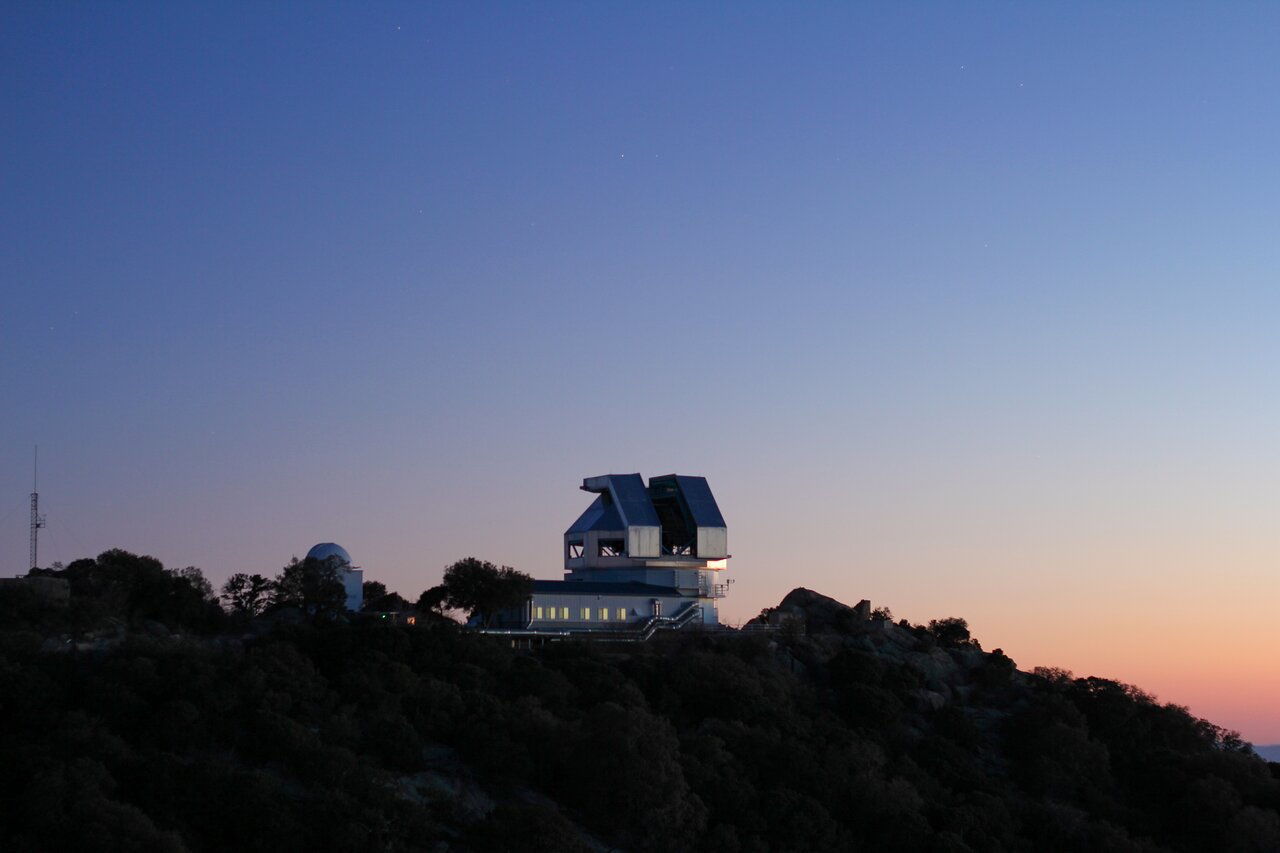
The WIYN 3.5-meter telescope at sunset. [KPNO/NOIRLab/NSF/AURA/P. Marenfeld; CC BY 4.0]
A WIYN for Exoplanetary Science
Though not typically open to the public for tours, our next stop took us to the WIYN 3.5-meter telescope. This telescope is operated and owned by the WIYN Consortium, a partnership between the University of Wisconsin, Indiana University, NSF’s NOIRLab (National Optical-Infrared Astronomy Research Laboratory; formerly NOAO), Pennsylvania State University, and Princeton University. Operating since 1994 with a strong collection of instruments, WIYN has observed galaxies near and far, stars across their lifetimes, and exoplanets tugging on their host stars.

Me, Lexi Gault (AAS Media Fellow), in front of the WIYN 3.5-meter telescope. I have used WIYN’s SparsePak spectrograph to collect data for my dissertation research! [AAS Nova/Kerry Hensley]
The partnership between public and private universities and a government institution was the first of its kind. Through this consortium, hundreds of undergraduate and graduate students have conducted research with WIYN, and the telescope’s suite of instruments have enabled early career astronomers to explore the universe both near and far.
Mysteries of Dark Energy at Mayall
We concluded our tour at the Mayall 4-meter Telescope, the tallest telescope dome on the mountain at a staggering 18 stories high. This iconic telescope saw first light in 1973, and at the time, was the second-largest (in diameter) telescope in the world. Originally built for wide-field optical and infrared studies of the universe, the Mayall has enabled decades of critical scientific research.
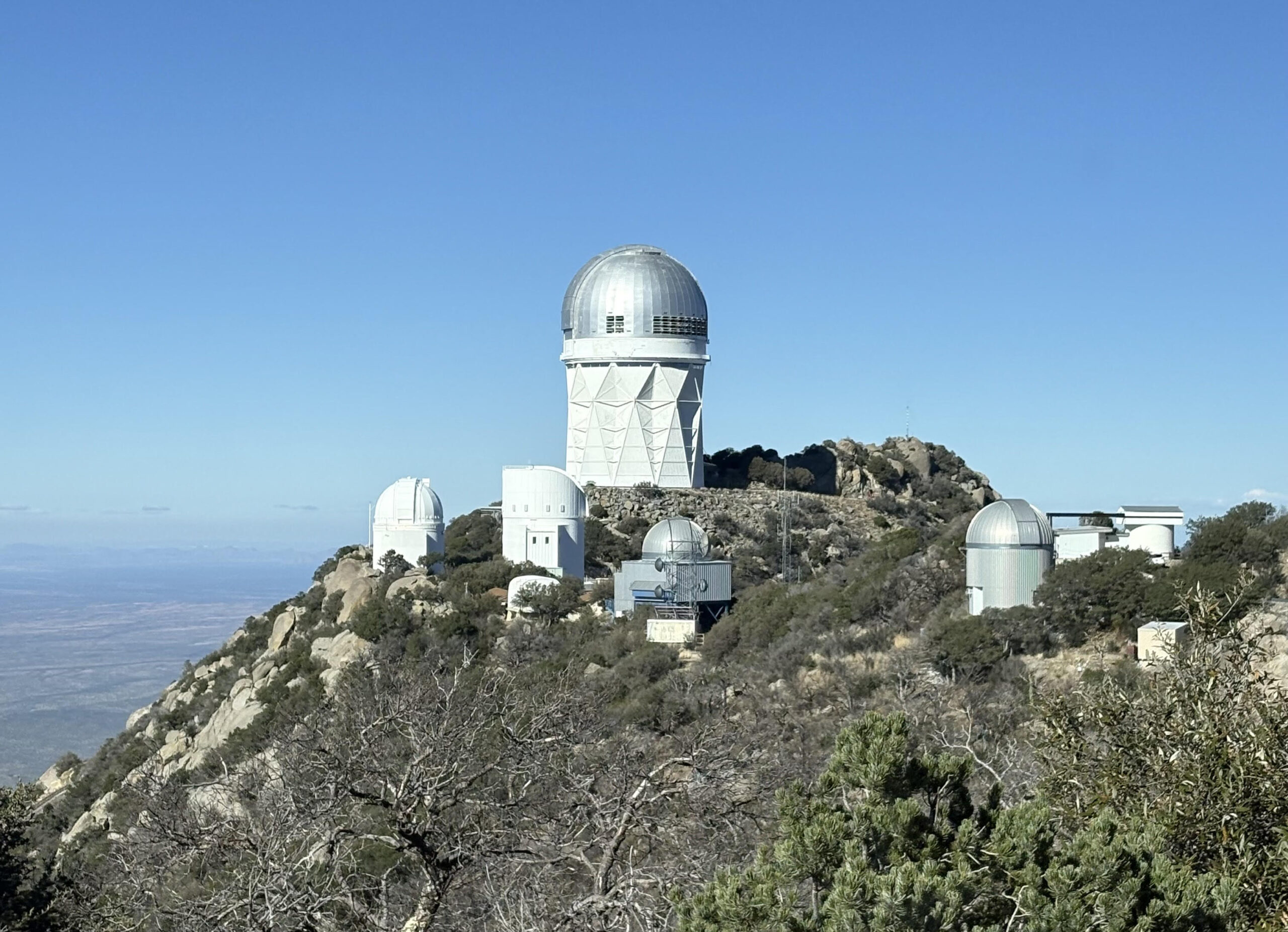
The Mayall dome across the mountain as seen from inside the WIYN dome. [AAS Nova/Lexi Gault]
From the telescope’s massive dome, to the busy DESI control room, to the gallery floor with a nearly 360 degree view of the surrounding desert, the Mayall offers visitors a unique glimpse into Kitt Peak’s history and its future. While WIYN is a hidden gem, the Mayall 4-meter Telescope is open to the public for tours daily, so you can experience the exciting era of research and discovery at KPNO.
Visit Kitt Peak
Interested in getting a peek yourself? KPNO is open to the public daily with multiple tour types to choose from, including both daytime and nighttime visits! Plan your visit to Kitt Peak here.