

Editor’s Note: Astrobites is a graduate-student-run organization that digests astrophysical literature for undergraduate students. As part of the partnership between the AAS and astrobites, we occasionally repost astrobites content here at AAS Nova. We hope you enjoy this post from astrobites; the original can be viewed at astrobites.org.
Title: Tracing the Light: Identification for the Optical Counterpart Candidates of Binary Black Holes During O3
Authors: Lei He et al.
First Author’s Institution: University of Science and Technology of China
Status: Published in ApJ
Since the first detection of gravitational waves about a decade ago, gravitational wave science has been the gift that keeps on giving (for example, check out GW231123, announced earlier this year). It is also a field where more questions with unknown answers just keep coming. A key question at the forefront of gravitational wave science is about formation channels: how does the population of black holes seen through the LIGO–Virgo–KAGRA (LVK) detectors form? The two most popular of these formation channels are the “isolated binary” channel, wherein two stars of a binary stellar system each form black holes that then merge, and the “dynamical” formation channel, wherein two stars in a dense stellar cluster (usually a nuclear star cluster) become black holes and merge just through chance and the denseness of the environment they are in.
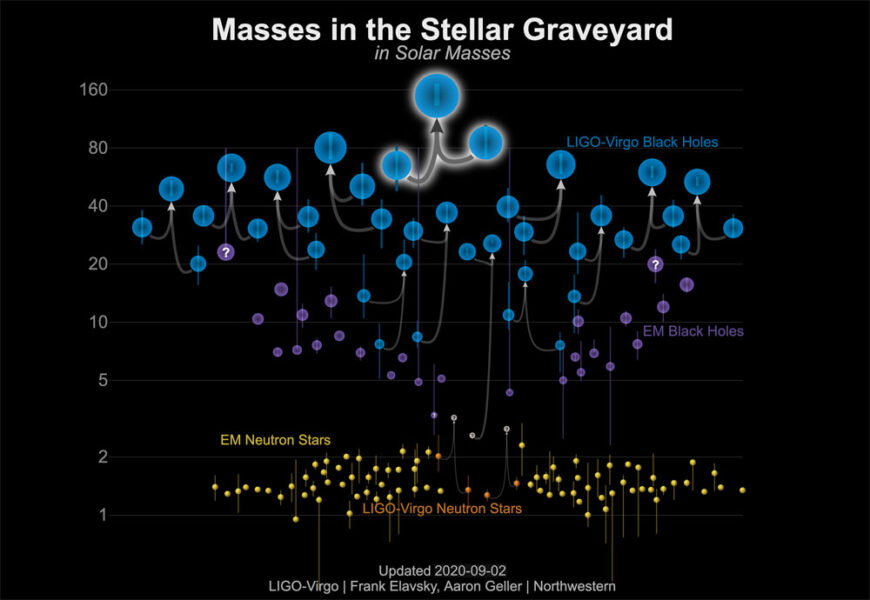
More recently, a third channel has been gaining popularity: the active galactic nucleus (AGN) disk channel. An AGN disk is a large disk of hot gas that surrounds a supermassive black hole in the center of a galaxy. The disk helps address two potential issues with stellar-mass binary black hole mergers that could pose a problem for the other two formation channels: delay time and mass. The delay time is the time between when the binary system forms and when the two black holes merge. By putting the system into the denser gaseous environment of an AGN disk, the orbits of the black holes decay faster, allowing the merger to happen on a quicker timescale. Regarding mass, the LVK detectors have detected mergers with masses above what would be expected from stellar-mass black holes alone, the so-called “lite” intermediate-mass black holes. One potential avenue through which these “lite” intermediate-mass black holes may form is in the gaseous disks of AGNs, where they can accrete material and gain mass before merging.
One potential astronomical benefit of a binary black hole merger happening inside the gaseous disk of an AGN is that the merger could disturb this disk and spark a flare of light. If we could spot such a flare and tie it to a gravitational wave event, we would then have both gravitational wave and electromagnetic observations of the same event. Prior research has suggested that some AGN flares detected by the Zwicky Transient Facility (ZTF) might be linked to binary black hole mergers observed during LIGO–Virgo’s third observing run. Today’s authors revisit this possibility by using additional years of data from ZTF combined with the public data through the third observing run.
The authors re-analyzed seven candidate flare–gravitational wave pairs originally flagged during the third observing run (see Figure 1). They examined each AGN’s long-term light curve from data from ZTF, looking for repeated flaring that might indicate a variable AGN rather than a one-time merger-driven flare. Using a Bayesian framework and an approach called Gaussian processes, they calculated the probability that each optical flare was physically connected to a specific gravitational wave event, considering both the spatial and temporal alignment of each of the two signals. Their framework allowed them to calculate a value they dub pflare, which is the probability that a given flare is indeed a genuine flare rather than a characteristic of the variability intrinsic to the AGN itself.
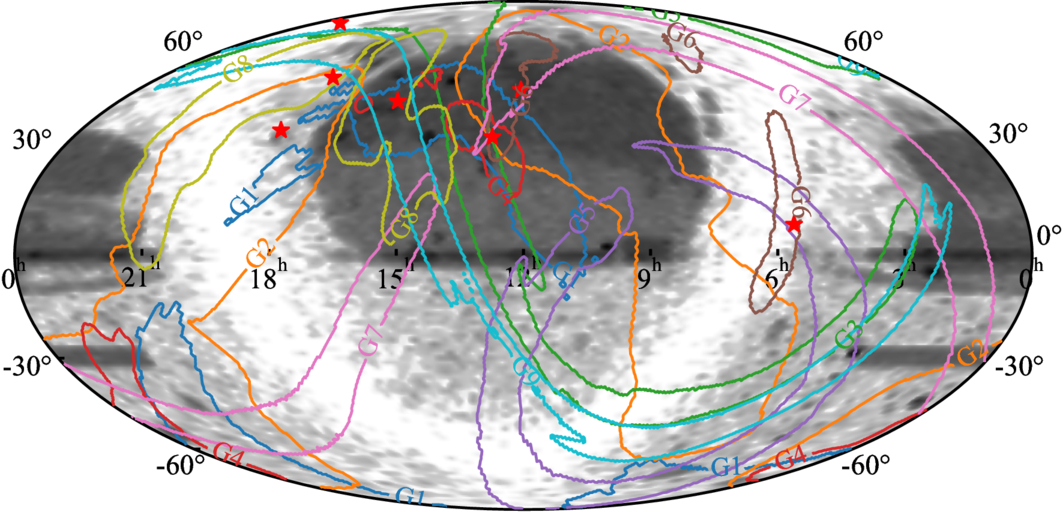
Figure 1: Sky localization of the seven AGN systems analyzed in this work. Red stars represent the locations of the AGNs with suspected flares, and colored lines represent the nine potential gravitational wave events that may be associated with each AGN flare. The white/black background represents the density of the distribution of AGNs in the Million Quasar Catalog. [He et al. 2025]
The authors take this result one step further. One primary application of combining gravitational wave and electromagnetic signals is an independent measurement of the Hubble constant. The most straightforward way to measure the Hubble constant is to measure both the recessional velocity and the distance to a single source. Multi-messenger astronomy provides a straightforward approach to this, as the redshift can be determined from electromagnetic observations and the distance from gravitational wave observations. (GW170817 is a notable example of this.)
The authors show how this could be applied to their data using flares. They use the two most promising flare–gravitational wave associations to derive a new estimate of the Hubble constant. By combining the distance inferred from the gravitational wave signal with the redshift of the AGN host galaxy, they obtained a value of the Hubble constant of about 72 kilometers per second per megaparsec (roughly the peak of the green dotted curve on the bottom of Figure 2). This result is consistent with other measurements of the Hubble constant, which are the local distance-ladder measurements from supernovae and the cosmic microwave background estimates from Planck (the two measurements that are often cited as being in tension). The uncertainty from the author’s analysis is still quite large, but it provides a proof of concept. When they included the well-known GW170817 neutron star merger, they obtained a result that is slightly more informative and slightly greater than the result from GW170817 alone.
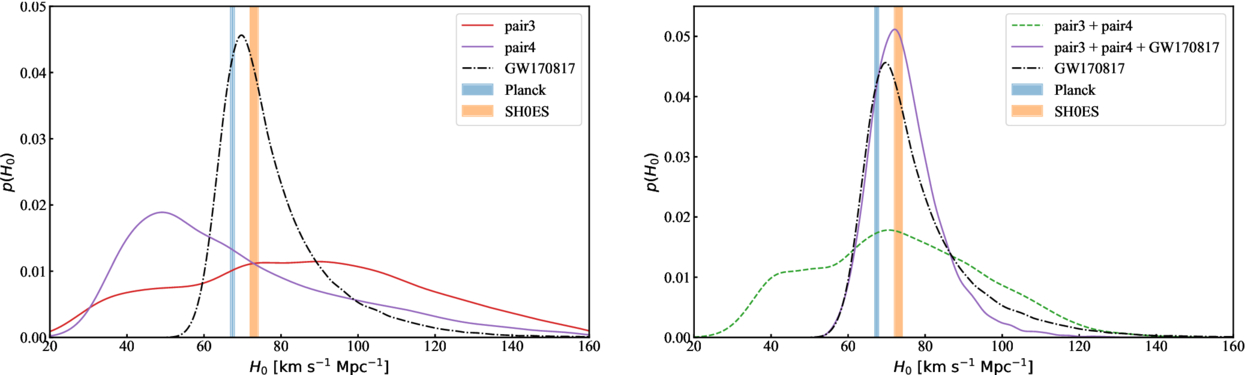
Figure 2: Constraints on the Hubble constant using multiple methods. For both figures, the x-axis represents the inferred value of the Hubble constant, and the y-axis represents the posterior probability of that value using hierarchical Bayesian analyses (for gravitational wave analyses). The vertical orange bands represent the measured value of the Hubble constant with five standard deviations of certainty using the “distance ladder” method as reported by the SH0ES collaboration. The vertical blue bands represent the measured value of the Hubble constant with five standard deviations of certainty by using measurements of the cosmic microwave background with the Planck spacecraft. The dotted black curve (both left and right) represents the posterior distribution of the Hubble constant as measured by the LVK collaboration from the first binary neutron star multi-messenger source, GW170817 (which peaks directly between the other two measurements). The purple and red curves (left) represent the posterior distributions of the two confident AGN/binary black hole pairs in this work, the green curve (right) represents the combined posterior distribution of the two confident AGN/binary black hole pairs in this work, and the solid purple curve (bottom) represents the combined posterior distribution of the two confident AGN/binary black hole pairs with GW170817. [He et al. 2025]
Original astrobite edited by Amaya Sinha.
About the author, William Smith:
Bill is a graduate student in the astrophysics program at Vanderbilt University. He studies gravitational wave populations with a focus on how these populations can help inform cosmology as part of the LIGO Scientific Collaboration. Outside of astrophysics, he also enjoys swimming semi-competitively, music and dancing, cooking, and making the academy a better place for people to live and work.