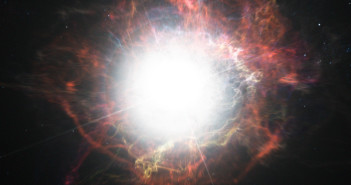
How Bright Can Supernovae Get?
Enormously bright supernovae have been observed in recent years. But is there a limit on the brightness these stellar explosions can achieve?

Enormously bright supernovae have been observed in recent years. But is there a limit on the brightness these stellar explosions can achieve?
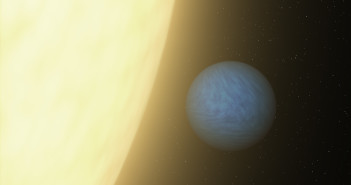
A recent study explores how two types of planets — super-Earths and super-puffs — might form.
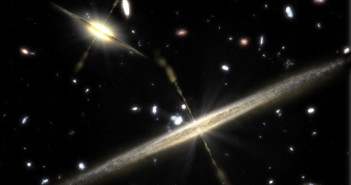
A new study seeks to explain how pure disk galaxies — galaxies without a central bulge — were able to form and survive in our universe.

Meet your new AAS Lead Editor for the High Energy Phenomena and Fundamental Physics corridor! Here’s what he thinks about his field, the upcoming HEAD meeting, and authoring scientific papers.
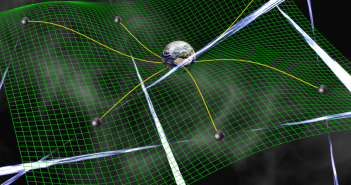
After 10 years of unsuccessful searching, how likely is it that pulsar-timing-array projects will make their own first detection of gravitational waves soon?
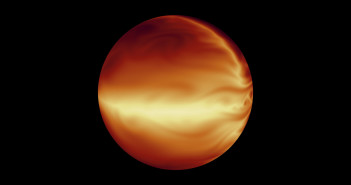
Recent observations have provided direct measurements of the extreme temperature swings in the atmosphere of the hot Jupiter HD 80606 b.
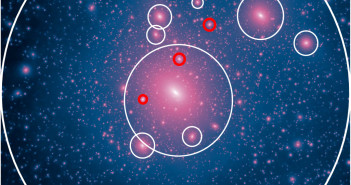
The Caterpillar Project is a series of high-resolution cosmological simulations designed to teach us about how galaxies like the Milky Way formed and evolved.
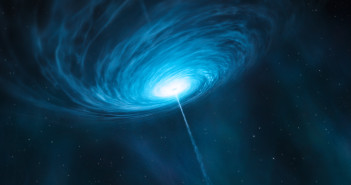
Researchers all over the world recently watched an outburst from the enormous black hole OJ 287, predicted years ago using the general theory of relativity.
Are you an astronomer considering submitting a paper to an AAS journal? Read on to find out about the exciting new things you can do with the AAS’s newest LaTeX class file.
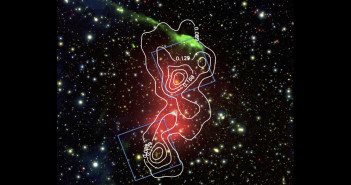
The Toothbrush Cluster’s enormous radio relic may have been caused by a past merger between clusters.
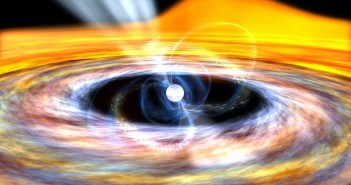
New X-ray observations reveal an accretion disk that has been pushed away from the surface of the neutron star it surrounds, possibly as a result of powerful magnetic fields.
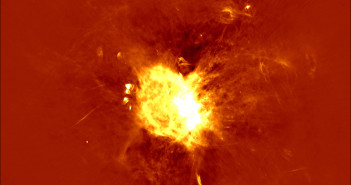
New radio images of the center of the Milky Way are providing an unprecedented view of the structure and processes occurring in the Galactic center.