
Editor’s Note: Astrobites is a graduate-student-run organization that digests astrophysical literature for undergraduate students. As part of the partnership between the AAS and astrobites, we occasionally repost astrobites content here at AAS Nova. We hope you enjoy this post from astrobites; the original can be viewed at astrobites.org.
Title: The Gap–Giant Association: Are Planets Hiding in the Gaps?
Authors: Caleb Lammers and Joshua Winn
Authors’ Institutions: Princeton University
Status: Published in ApJ
The Kepler space telescope played an almost decade-long game of hide-and-seek. After nine and a half years of operation, Kepler detected more than 2,700 planets outside of our solar system primarily by using the transit method, which is particularly efficient at detecting planets that orbit close to their host stars. Astronomers have also been detecting planets with the radial velocity technique, which is better at finding larger planets at longer orbital periods. By looking for planets with both the transit and radial velocity techniques, astronomers can look for both close-in and far-out planets to paint a more complete picture of other solar systems in our galaxy.
Using the Kepler Giant Planet Survey, the authors of today’s article found that among the 26 systems with three or more transiting planets, four were found to also have an outer giant planet. They quickly noticed that instead of an evenly spaced out inner system of planets, every single one of these four systems with the outer giant planets revealed a notable gap between two of their inner planets. They dubbed this phenomenon the “gap–giant association” — in other words, when an outer giant planet exists in a planetary system, there is evidence of a large gap between two of the inner planets, as shown in Figure 1. This pattern has been observed before, but there has been little theoretical work to explain the effects of outer giants on orbital spacings. In today’s article, the authors ask the question: are there planets inside the gap hiding from us? To address this, they conduct simulations to see if (a) these systems can host a hiding planet in their gaps without becoming dynamically unstable and (b) if such a planet can remain hidden when looked for with the transit method.
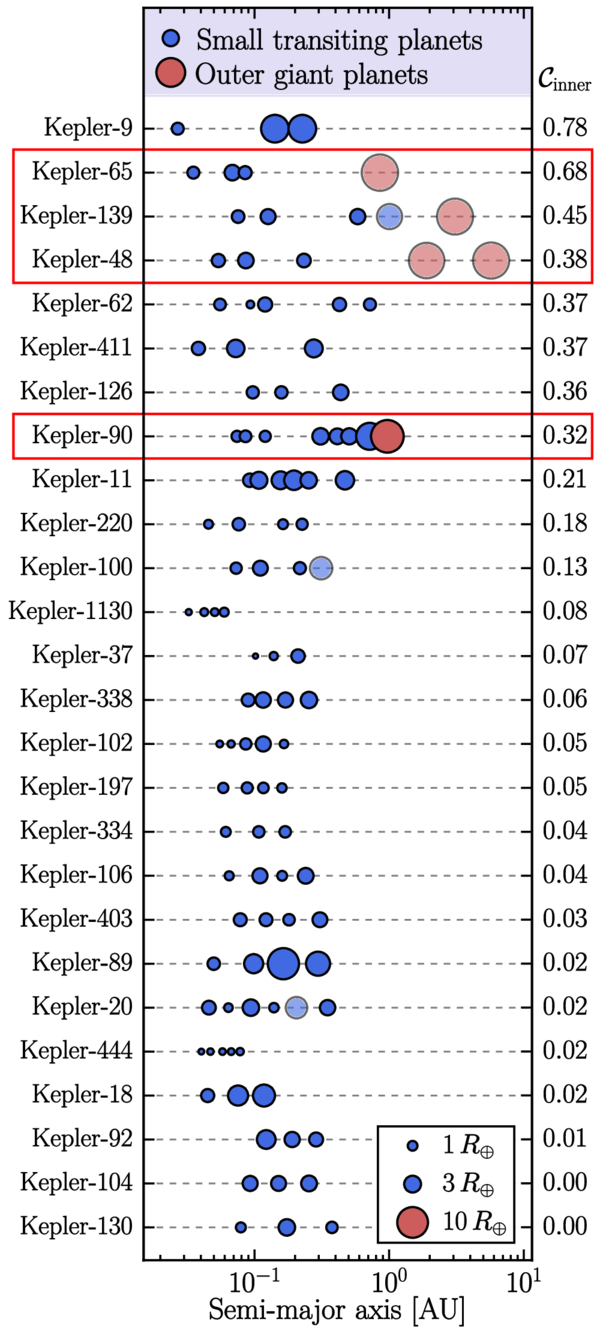
Figure 1: Orbital spacings of systems in the Kepler Giant Planet Survey with three or more transiting planets in the inner planetary system. The parameter C is a metric denoting the regularity of orbital spacings, where a smaller value would indicate a more uniform spacing. The four systems of interest all have large orbital gaps between two adjacent inner planets, and therefore high values of C. [Lammers & Winn 2025]
Close Your Eyes and Count to N
The authors of today’s article model these four systems (Kepler-48, Kepler-65, Kepler-90, and Kepler-139) with a planet added to their gaps and use an N-body simulation (i.e., fancy physics calculations that track how planets gravitationally interact) to evolve the systems over time and evaluate their long-term stability. They find that each of these injected planets has a high survival rate, which means that each of these four systems could stably host an additional ~2–20 Earth-mass planet in its gap for billions of years without falling apart. The authors then calculated whether the outer giants could “hide” these theoretical gap planets by tilting the planets’ orbits enough so that they would not be detectable with the transit method. In order to do this, the outer giant would have to exert a large enough gravitational force on the gap planet to cause it to precess at a rate independent of its neighbors, allowing its orbital inclination to grow. However, they found that the outer giant planets are either too far away or not massive enough to do the job.
Only one system, Kepler-90, has an outer giant that could potentially tilt the gap planet’s orbit enough for it to fly under the radar if the giant were also on a modestly inclined orbit. However, previous detections of Kepler-90’s outer giant suggest that its orbit is well-aligned with those of the inner system, making this hypothesis implausible. They therefore concluded that it is unlikely that planets between ~2 and 20 Earth masses are hiding within these gaps.
Seeking Out Another Option
Before completely abandoning this hypothesis, the authors propose that maybe the gaps do contain planets, but they’re just too small for Kepler to detect. They calculate the detection efficiencies as a function of planet radius and orbital period for each of the four systems and find that planets smaller than about ~0.5–1 Earth radius could have gone unnoticed (as shown in Figure 2). While this would make these systems slightly unusual (most multiplanetary systems have relatively uniform planet sizes), it’s not completely impossible. However, they don’t rule out the possibility that these gaps are truly empty, and that the presence of an outer giant could prevent planets from forming in certain regions or disrupt their orbits after formation. While it is hard to draw any firm conclusions with a sample size of four systems, this study highlights how much we still don’t understand about planetary system architecture, and therefore planetary formation and evolution.
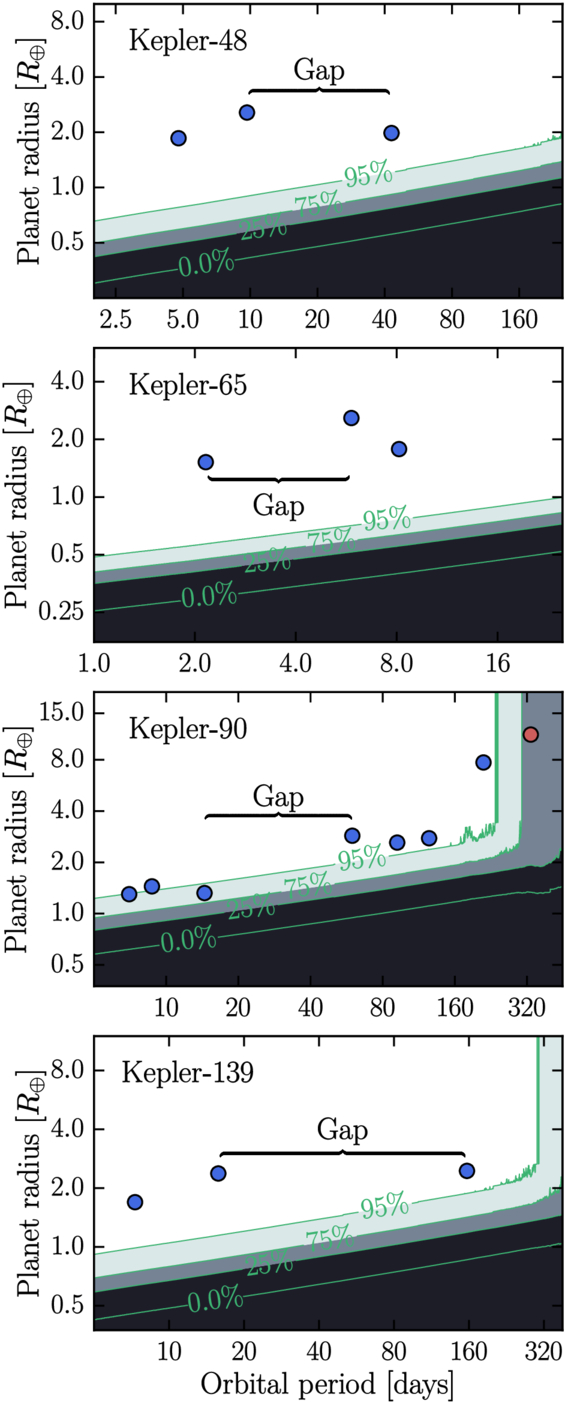
Figure 2: Transit detection efficiency as a function of planetary radius and orbital period for each planetary system. The inner planets and location of the gap are overplotted. The darker contours show regions where Kepler is not sensitive to detecting planets. In order to avoid detection, the planets in each of these systems would have to be much smaller relative to their neighbors, except for the Kepler-90 system, where a hidden planet would only have to be marginally smaller. This suggests that there could exist a demographic of exoplanets that are evading detection within these gaps. [Lammers & Winn 2025]
Original astrobite edited by Annelia Anderson.
About the author, Tori Bonidie:
I am a 5th-year PhD candidate studying exoplanet atmospheres at the University of Pittsburgh. Prior to this, I earned my BA in astrophysics at Franklin and Marshall College where I worked on pulsar detection as a member of NANOGrav. In my free time you can find me cooking, napping with my cat, or reading STEMinist romcoms!